Kharkiv Metro Projects (1962-1968)
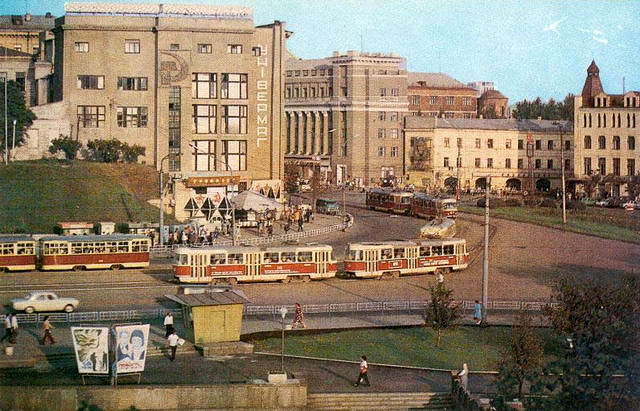
In the post-war years, Kharkiv became one of the largest industrial, scientific and cultural centres not only in Ukraine, but in the entire Soviet Union. The city gradually expanded, reaching an area of more than 30,000 hectares, stretching 35 km from west to east, while its population exceeded one million and continued to grow.
The continuous growth of Kharkiv, the emergence of new scientific and cultural institutions, and the development of industry placed urban transport in a rather difficult position. In those years, Kharkiv already had numerous bus routes and fairly well-developed tram and trolleybus networks, served by a large number of what was then advanced rolling stock. As new neighbourhoods and giant factories appeared, the transport network invariably extended to them. By the early 1960s, the transport problem had become particularly acute: many surface routes were operating at the limits of their capacity; during the morning and evening rush hours there was constant overcrowding, with passengers sometimes barely able to squeeze inside a tram or bus on their way to work. This was especially true of the central and eastern parts of the city. In this situation, it was no longer possible to improve transport conditions in the city simply by expanding the ground transport fleet.
Kharkiv in the early 1960s.

Kharkiv in the late 1960s.
The transport problem was keenly felt by very many Kharkiv residents, and it was also recognised by the city administration and the party leadership. The fateful day came on 12 December 1962, when, at a meeting of the second session of the Supreme Soviet of the USSR, the First Secretary of the Kharkiv Regional Committee of the Communist Party of Ukraine, Mykola Sobol, made a statement:
“The need has arisen to build a metro in Kharkiv. We ask you to support our request and to provide for the start of design work in 1963, and the beginning of construction of the first stage of the Kharkiv metro in 1965–1966. At the same time, we ask that during the years of preparation and construction of the metro, considerably more vehicles be allocated to Kharkiv to replenish its bus, trolleybus and tram fleets.”
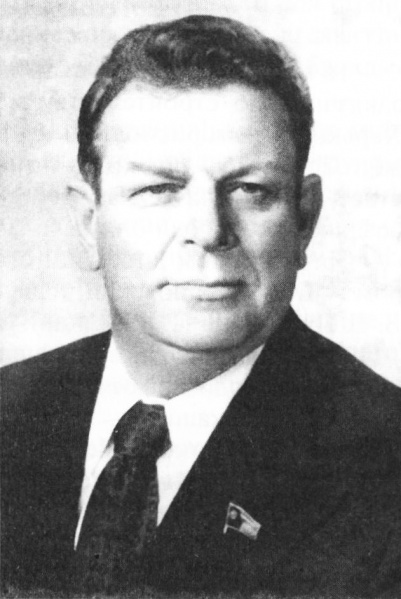
From that moment began the journey from idea to implementation of the Kharkiv metro. Not long before, the city had passed the one-million population mark, which, according to unwritten Soviet standards, gave it a chance of acquiring a metro. On the other hand, at that time only the capitals of the union republics were considered for underground systems, and, at first glance, Kharkiv could not be given high priority in that matter. Nevertheless, the townspeople quickly became enthusiastic about the idea of a metro, and the issue began to be worked on at the level of city party bodies and public organisations. The persistence of Kharkiv’s political and public figures brought the project of a new transport system in Kharkiv to the top, forcing the senior party leadership to consider it and to take the wishes of Kharkiv residents into account. Particularly zealous and persistent in this matter was Hrihorii Vashchenko, who at that time held the post of First Secretary of the Kharkiv Regional Committee of the Communist Party of Ukraine. In talks with high-ranking party officials, he used all his powers of persuasion. Overcoming all the bureaucratic obstacles required a great deal of effort and time — but it was worth it. Many agree that without Vashchenko the metro in Kharkiv might never have appeared at all.
Hrihorii Ivanovych Vashchenko
Three options for improving the transport situation in Kharkiv were considered: a monorail, a light rail (speed tram) and a metro. The monorail option was rejected almost immediately, as the varied building layouts and heights, and the narrow streets in the city centre, made this type of transport completely unsuitable.
The first results of Kharkiv residents’ efforts appeared just a few months later. Having reviewed the statements and proposals concerning the need for a metro in Kharkiv, the State Construction Committee of the USSR (Gosstroy) commissioned the preparation of “Considerations on the Necessity of Building a Metro”. This plan was submitted to the City Executive Committee for consideration, and on 20 March 1963, the Executive Committee of the Kharkiv City Council approved the materials. The approved plan, “Considerations on the Necessity of Building a Metro”, and the Executive Committee’s decision were forwarded to the Central Committee of the Communist Party of Ukraine. There, the idea was appreciated, and they, in turn, instructed the Ukrainian State Construction Committee to prepare a letter to the Central Committee of the CPSU and the Council of Ministers of the USSR, setting out all the necessary information to substantiate the project and the required calculations. However, something unexpected happened here. On the instructions of the Council of Ministers of the USSR, the State Planning Committee (Gosplan) put forward a proposal to build a light rail (speed tram) in Kharkiv.
In this situation, there was reason to lose heart and despair. At that time (as indeed always), arguing with bodies of such rank was most often futile, and sometimes even unsafe. Fortunately, those same energetic Kharkiv residents had no intention of giving up. Although with difficulty, they managed to convince the party officials in response that such an option would have no prospects at all. Citing irrefutable arguments, specialists proved that a speed tram on Kharkiv’s streets would have low effectiveness at a very high cost of implementation. In any case, one did not have to be a specialist to draw the right conclusions. Even ordinary Kharkiv residents understood that a tram could not solve the city’s transport problem because of its low speed and carrying capacity.
Sketch of a tram tunnel between Teatralnyi Descent and Bursatskyi Descent on the Saltivske Shose – Ivanivka line, with a “Tsentr” station near the present-day “Istorychnyi Muzei” (Historical Museum) metro station, drawn up in 1968. This tram tunnel is similar to the one that was planned to be built had the decision to construct a speed tram in Kharkiv been taken.

Route plan of the tram tunnel between Teatralnyi Descent and Bursatskyi Descent on the Saltivske Shose – Ivanivka line (top), and a parallel road tunnel from Melnykova Street to Bursatskyi Bridge (bottom).

To determine which type of off-street transport would best suit Kharkiv, the State Planning Committee of the Ukrainian SSR (Gosplan) commissioned “Kharkivproekt” to prepare a technical and economic report, which was submitted on time. The Institute of Integrated Transport Problems under Gosplan of the USSR and the Ministry of Railways of the USSR also worked on this report. Based on the results of this work, on 17 December 1965 the Council of Ministers of the USSR authorised the Ministry of Transport Construction to develop a design assignment in 1966 for the construction of the first stage of the Kharkiv metro. According to this assignment, the first line, 20 km long, was to run from the Southern Railway Station through the centre to the “Gorizont” microdistrict (the area of the tile factory). It was in 1965 that the decision was taken to build the second (and, in the opinion of many, the first) regional metro in the USSR.
After that, the design of the Kharkiv metro was taken under the wing of the Central Committee and the Council of Ministers of the Communist Party of Ukraine. In a resolution dated 25 January 1966, they instructed the Kharkiv Regional Party Committee and the Regional Executive Committee, jointly with the Ministry of Transport Construction, to ensure the development of a design assignment for the construction of the first stage of the metro in Kharkiv. The “Metrogiprotrans” institute was appointed as the general designer. This event charged the city with enthusiasm; the press of the time was full of excited headlines: a metro would appear in Kharkiv! Among the city’s design organisations there was no shortage of volunteers wishing to be part of these historic moments; subsequently, 30 Kharkiv organisations took a direct part in survey and design work and in drawing up the design assignment.
The next major stage began on 31 December 1965, when a joint meeting of the Bureau of the Kharkiv City Party Committee and the Executive Committee of the City Council was held, at which the “Architectural and Planning Assignment for the Future Construction of the First Stage of the Metro in Kharkiv” was discussed and, after consideration, approved. According to this assignment, the first metro line was to have 13 stations at the main passenger-generating points.
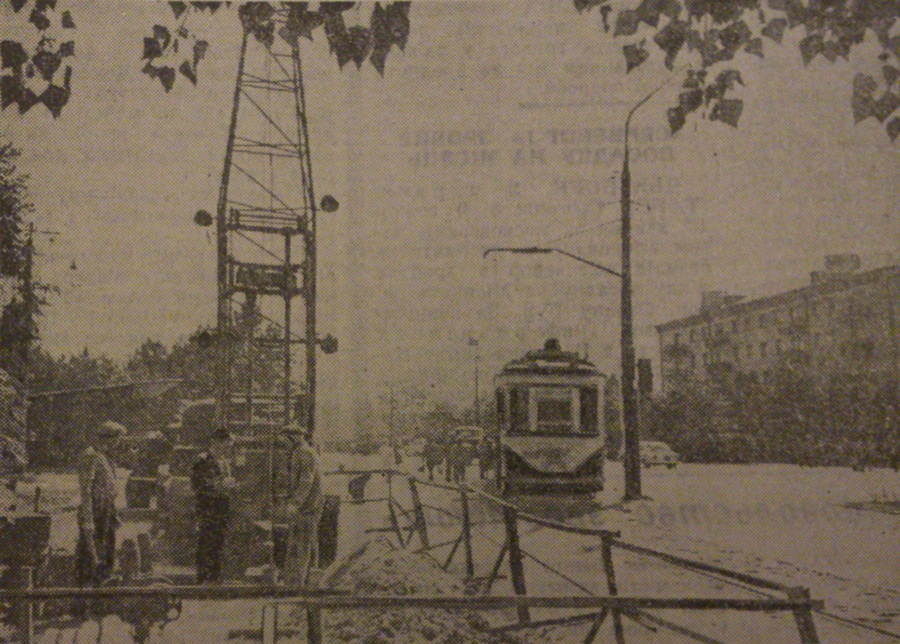
The appearance of sites for drilling boreholes and soil surveys aroused great interest among Kharkiv residents and for a long time became the main topic of discussion. The first boreholes were drilled on Kholodna Hora, in the railway station area, and on Tevelev Square (now Constitution Square). Soon, drilling crews were working along the entire proposed route of the first stage. The geological survey data were provided to the designers.
A drilling rig on Sverdlov Street (now Poltavskyi Shliakh), Kholodna Hora area.
The results of the design surveys carried out by Metrogiprotrans specialists proved less than encouraging. The conducted research revealed several serious technical difficulties along most of the planned route. The most challenging sections were the railway station area, where station structures and shallow tunnels would have to be laid in very weak and waterlogged soils with quicksand properties beneath the station building, its platforms and railway tracks, as well as the areas where tunnelling would have to take place under the Lopan and Kharkiv rivers. In addition, tunnels had to be driven under numerous buildings in the historic city centre, provision had to be made for relocating a multitude of underground utilities, and an ideal site for a depot had to be found to reduce empty mileage. It should be noted that such difficulties in no way shook the determination of Kharkiv residents to have a metro in their city.
The surveys of the soils along the future metro route forced the designers to make adjustments to the initial plan. In order to facilitate construction without violating the principle of locating stations at the main passenger-generating points, the “Tsentralnyi Rynok” station was moved from the Annunciation Cathedral to the House of Trade, and the “Tsentr” station from the “Tsentralnyi” restaurant (now Pavlovskaya Square) to the upper part of Tevelev Square (now Constitution Square). Given the exceptional difficulty of building the “Pivdennyi Vokzal” (South Railway Station, now “Vokzalna”), with a high risk of surface subsidence, it was decided to extend the line one station further west to the Kholodna Hora area, where it would be convenient to build a crossover chamber for turning trains around, while the eastern part of the line was, on the contrary, shortened by one station, leaving the tile factory area for a more distant future. These project changes were approved on 29 April 1966 by a decision of the City Soviet of Working People’s Deputies with the participation of members of the bureaus of the regional committee and city committee of the Communist Party of Ukraine.
In 1967, Metrogiprotrans developed a design assignment that examined two options for building the metro in Kharkiv. The first option envisaged combining urban and regional passenger transport, meaning metro trains arriving from the region would transition onto the underground section and then, after passing through it, re-emerge at the surface to continue to another settlement in the Kharkiv region within the boundaries of the Kharkiv railway hub. Such metro systems already existed elsewhere in the world, but in the Soviet Union few knew about them. According to the second option, the metro was to provide only intracity passenger transport, like the already existing metros in Moscow, Leningrad and Kyiv.
A map of the Kharkiv metro reflecting plans to build the system according to a “city–suburb” scheme.
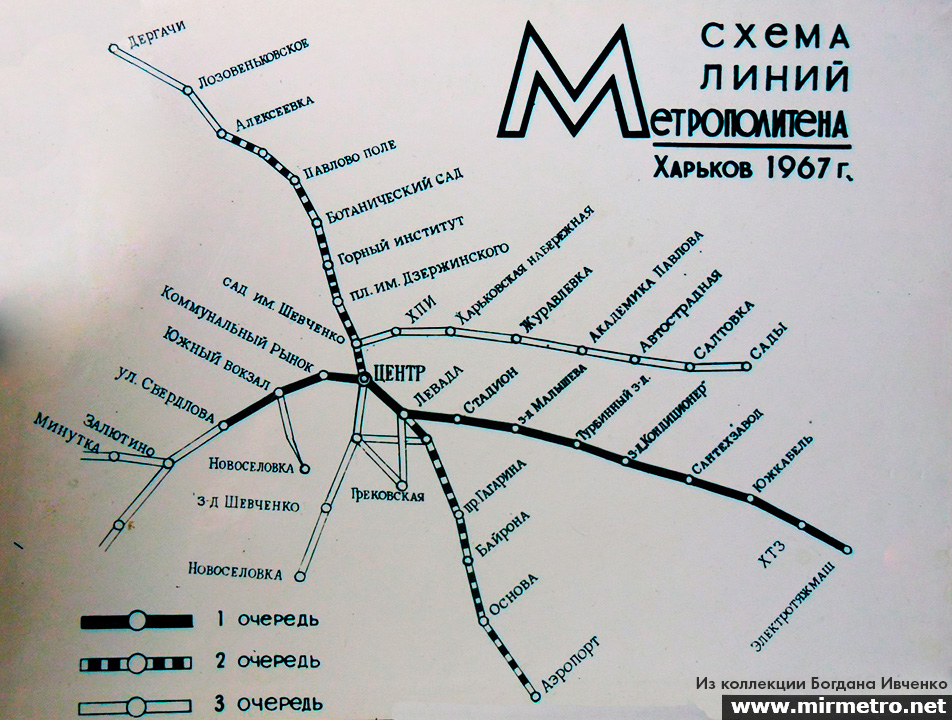
Initially, the balance of opinion leaned towards the combined transport option. The preliminary calculations for the metro feasibility study, covering a length of 45 kilometres by 1980, contained the following construction cost figures: for combined “city–suburb” transport – 149.3 million roubles; for intracity transport – 216.9 million roubles. Operating costs and the payback period for the first option also turned out to be lower than if the metro were to operate solely as intracity transport.
Proponents of this option stressed its convenience. For example, a worker employed at one of Kharkiv’s industrial giants but living in the region could board an electric train in their settlement and travel directly to work; in the same way, a market gardener could travel straight to the Central Market to sell their produce.
Nevertheless, further development of both project options, taking into account all the engineering and geological data, passenger flow studies and long-term city settlement forecasts, revealed a number of significant shortcomings in the “city–suburb” transport system. The main difficulty was that its operation would require an entirely new technological base, whereas the classic metro option could draw on the vast experience and time-tested methods proven in the construction of the already operating metros in the USSR. First and foremost, it would have required the use of new, as yet non-existent rolling stock made up of unified carriages that would serve simultaneously as both electric train carriages and metro cars (the development of such unified carriages was to be entrusted to the Riga Carriage Works), whereas the classic metro could use the then widespread E-type cars and their future modifications. The “city–suburb” system would have required extending the line by 4.9 kilometres, lengthening platforms from 100 to 170 metres to accommodate eight-car trains, increasing the diameter of running tunnels from 5.1 to 6 metres, and station tunnels from 7.8 to 8.8 metres. The introduction and fine-tuning of this entire system would have taken a great deal of time – for instance, merely setting up the production of the new carriages would have required no less than six years. The transport problem in Kharkiv could not be postponed or forced to wait that long. On the previous occasion, energetic Kharkiv residents, acting at their own risk, had managed to prevent the replacement of the metro with a speed tram; now they saw before them a similar task: to avert a colossal transport mistake. This time, however, the situation was made even more complicated by a rather unexpected circumstance. The fact was that one of the authors of the combined transport system was the wife of the Minister of Railways, and it was precisely for that reason that the USSR Ministry of Railways fiercely defended this option.
The main opponent of the “city–suburb” system was the aforementioned Hrihorii Vashchenko, who then headed the regional party committee. He openly expressed his position and declared that there was absolutely no reason for Kharkiv to serve as a testing ground for such experiments. To achieve his goal, he secured a meeting with the Chairman of the Council of Ministers of the USSR, Alexei Kosygin, and managed to convince him that Kharkiv needed precisely the classic metro – more economical, superior in terms of safety and train scheduling, and using already well-established production of structures, tunnelling and construction equipment, and rolling stock. Vashchenko understood that he was entering into a dangerous struggle with influential figures in Moscow, but the interests of the city were more important to him than his own career.
As a result, the efforts of Kharkiv’s specialists and public figures were not in vain. After reviewing the design assignment, the Politburo of the Central Committee of the Communist Party of Ukraine approved precisely the classic metro option, and subsequently the Main Directorate of Expertise of Gosstroy of the USSR confirmed that building a metro in Kharkiv was only feasible in the classic variant. In February 1967, the Council of Ministers of the Ukrainian SSR recommended this very option when submitting the design assignment to the Council of Ministers of the USSR. On 23 October 1967, the Council of Ministers of the USSR approved the submitted design assignment for the construction of the first stage of the Kharkiv metro, and on 29 April 1968 issued an order to begin construction. Thus, five years passed from the raising of the question of building a metro to its actual start.
The first thing the directorate did after the decision to begin metro construction was taken was to prepare the necessary work front for the newly established “Kharkivmetrostroy”. The range of preliminary works included resettling residents and demolishing buildings in the zone of the forthcoming metro construction – naturally, providing their owners with new housing. This was successfully carried out by the City Executive Committee, district executive committees and other city organisations. Next in line was the delivery of the equipment and materials required for construction. For this purpose, ties were rapidly established with virtually all the republics of the USSR, and production plans were drawn up for local Kharkiv factories. On 13 May 1968, the design institute “Kharkivmetroproekt” was founded as a branch of “Metrogiprotrans”. In June 1968, the first designers, engineers and builders began arriving in Kharkiv from Krasnoyarsk, Baku, Kyiv, and miners from Donbas.
A glorious day in the history of Kharkiv came on 15 July 1968. At 4 p.m., construction of the Kharkiv metro began. Thousands of Kharkiv residents gathered in Slavianskyi Lane near the Railway Station Square for a meeting dedicated to the start of work on sinking the first metro shaft. The slogan “A Warm Welcome to the Builders of the Kharkiv Metro” billowed above the rostrum. The meeting was opened by the head of the Executive Committee of the Kharkiv City Council, G. Vlasenko.
The first to take the improvised rostrum was V. Koblyakov, who began his speech with the following words:
“An unforgettable day – the 15th of July. Today we begin sinking shaft No. 1. It is known that we are sinking the shaft on the site of a prison built back in tsarist times. Complex tasks lie ahead of us, but we pledge to work so that the first train passes through as soon as possible.”
Laying of the first metro shaft.
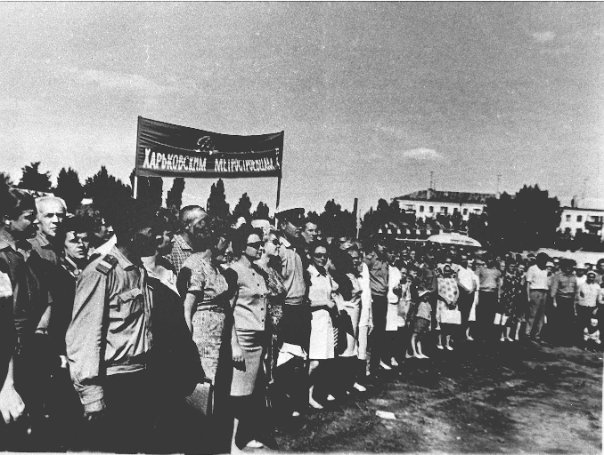
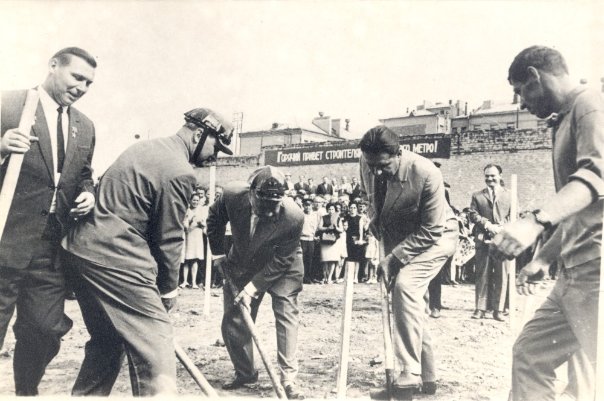

At the end of the meeting, V. Koblyakov presented the honoured guests with symbolic certificates of enrolment among the first builders, and handed out commemorative gifts – tunnelling hard hats. G. Vlasenko cut the red ribbon surrounding the spot where the sinking of shaft No. 1 would begin. To the sounds of the USSR national anthem, an excavator pulled up, scooped out the first bucket, and soon the first lorry carrying earth drove off.
People dispersed, while the excavator bit into the ground again and again. From that moment on, the working days of the Kharkiv metro builders began. And each of them wanted to believe that the sixth metro in the USSR, the second in Ukraine, would be the very best, the most convenient and the most reliable.