Metro in these days (2010-2022)
After the grand opening, the builders switched their attention to the Peremoha station, which was supposed to complete the development of the metro network in the Oleksiivsky residential area. Workers cleared the pit of the rubbish that had accumulated over the years, began earthworks, and on 31 January 2011, a solemn ceremony was held to lay the first cubic metre of concrete. The official opening of the station was scheduled for Victory Day in 2012.
Unfortunately, in keeping with an already established sad tradition, reality turned out to be much worse. The city council continued to allocate funds in small portions, but the bulk still had to be obtained from the state treasury. In the summer of 2011, the government allocated 101 million hryvnias. Alas, no one knew then that state funds for Peremoha had been received for the last time. By the end of the year, the construction readiness of the station had been brought to 45%, and then, due to a shortage of funding, the pace of work began to fall sharply. The opening date was postponed to December 2012.
A further 240 million was needed to continue the construction, and the city had nowhere to obtain it. In order not to slow down the construction, Tonelbud worked at the expense of small contributions from the city budget, as well as its own working capital and credit funds, but this money did not last long, and soon the construction site was abandoned, with only security guards and duty workers remaining on the job. The opening was postponed to May 2013, then to December 2013.
The Peremoha station under construction was to receive colourful decoration on the theme of the Second World War. This time, the structural model of a two-tier station was adopted, one that had already been used twice in Kharkiv and had proven itself well. For the first time in Kharkiv, a round-the-clock accessible underpass beneath Prospekt Peremohy was incorporated into a metro station, as well as lifts for the convenience of people with reduced mobility. A new type of rail fastening was used at Peremoha: blocks with special damping pads significantly reduce the amplitude of vibration transmitted through the rail track to the tunnel structures and surrounding buildings.
Approved concept design of the Peremoha station.

At the beginning of the new decade, Ukraine was intensively preparing for the upcoming Euro 2012 football championship. The changes did not bypass the Kharkiv Metro either. As part of the metro’s preparations for the forthcoming sporting event, in accordance with the requirements for a host city, it was necessary to completely renew the navigation, rendering it in two languages – Ukrainian and English – and also to introduce bilingual automated announcements for the duration of the championship. The voice in the English-language recording of the announcer was not very well processed and brought a smile to the faces of arriving guests. In the new navigation on the track walls, an interesting idea was implemented, adding a pictogram with an image for each station, which makes it easier for foreigners to find their way around the metro. Nevertheless, in the subjective opinion of the author of the article, the navigation turned out to be unsuccessful: firstly, its design solution is categorically incompatible with the interiors of most stations and creates obvious disharmony; secondly, it has a host of minor flaws in its execution (an abundance of empty space, large discrepancies in spacing, etc.); thirdly, the directional indicators are made in the form of a single, fundamentally unalterable panel (meaning that when stations are opened or renamed, it is impossible to hang a new element or replace it without detriment to the appearance of the navigation).
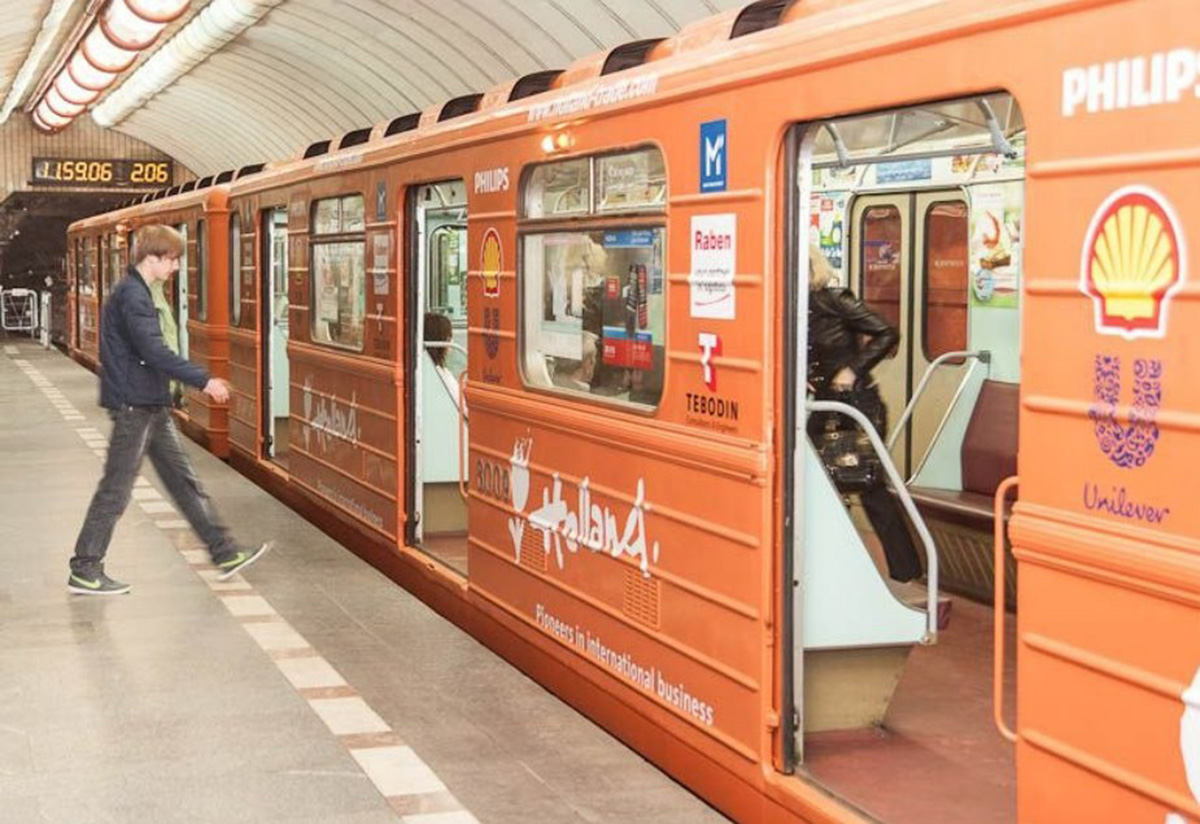
On the initiative of the Embassy of the Netherlands in Ukraine, one of the trains was repainted in the traditional colour of Holland – orange, with the addition of corresponding inscriptions on the car bodies. The train ran on the Saltivska line, since a tent camp for Dutch fans was located near the Heroiv Pratsi station. Contrary to promises to leave this train as it was, after the end of the championship it was repainted back into the classic colours.
At last, in 2013, more than real grounds appeared to believe that the 30th metro station would soon open its doors to Kharkiv residents. The city authorities concluded a deal to sell the Metalist stadium for 570 million hryvnias. At a session of the city council, deputies adopted a decision to allocate the lion’s share of these funds (400 million) specifically for metro construction. Such a sum should have sufficed not only to finish Peremoha, but also to launch a serious scope of work on the construction of the future Derzhavinska and Odeska stations. In May 2013, work on the construction site got underway in two shifts, and even before the money arrived, the construction was carried out using the company’s own funds. In September, the first 23 million of the aforementioned sum finally arrived. The opening was planned for the end of 2014.
However, something unexpected soon happened — the buyer of the Metalist stadium left Ukraine during the events of February 2014, after which his obligations to the city became impossible to fulfil. By that time, only 62 million out of the 400 million had been received into the accounts of the metro builders, and almost all of that sum had already been utilised. Soon, the construction of the Peremoha station was suspended yet again. In order not to bring the process to a complete halt, in November 2014 the city council redistributed budgetary funds, directing 40 million hryvnias that had been intended for road repairs towards metro construction. A certain additional sum was allocated at the beginning of 2015, but for a full-fledged continuation of construction, this was very little. The metro builders’ employment was unstable: today there was work, and tomorrow — go and look for earnings elsewhere.
President P. Poroshenko and Prime Minister A. Yatsenyuk, during working visits to Kharkiv, visited the construction site and stressed its high significance for the city, more than once promising to allocate money; however, these words remained merely promises — not a single coin came from the state treasury. Not counting on help from the state, the city council adopted a programme of funding the construction of the Peremoha station in small portions. In April 2015, work was resumed. Thanks to modest but stable funding, by winter the readiness of the station had been brought to 85%, and in 2016 the construction entered the home straight. Unquestionably, there was enormous merit in this on the part of the mayor and the city authorities as a whole — usually, metro construction is far too costly a project for a city to manage on its own. Credit should also be given to the selfless labour of the metro builders, who, despite all the circumstances, remained faithful to their beloved work and continued to work for the city.
On 2 August 2016, the first trial train ran along the section towards Peremoha. Twenty-five years after the start of construction, the station was ready, and the process of developing the metro network into the Oleksiivsky residential area was finally completed. Thus, the Peremoha station became one of the longest-running construction projects. In total, 605 million hryvnias were spent on the construction of the station, with 70% of this sum coming from the city budget. This figure accounts for expenses over the entire period of construction; recalculated in 2016 prices, this sum would have been much greater. Long years, arduous, painstaking — but Victory nonetheless! (The station’s name, Peremoha, means “Victory”.)
The ceremonial event and the actual opening of the station had been planned for City Day — 23 August, but the date was adjusted to fit the president’s visit to Kharkiv, and until the very last day it was not known for certain when this would happen. On 19 August 2016 at 1:00 p.m., a ceremonial meeting was held at the Peremoha station. This ceremony was marked by unprecedented security measures — there were far fewer honoured guests, it was harder for journalists to obtain accreditation, and every participant in the meeting had to pass through metal detectors. The meeting was attended by metro builders, city and state party officials, and honoured guests.

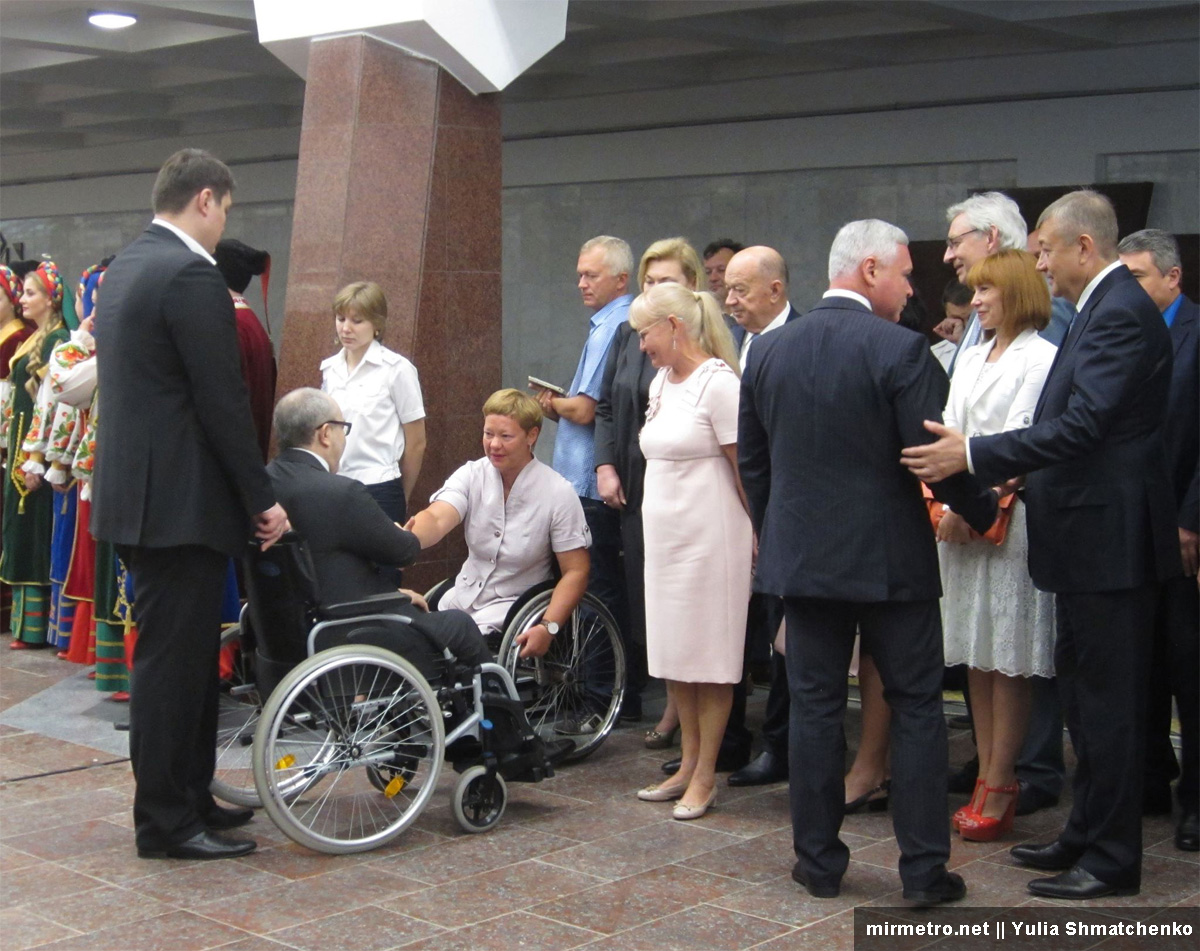
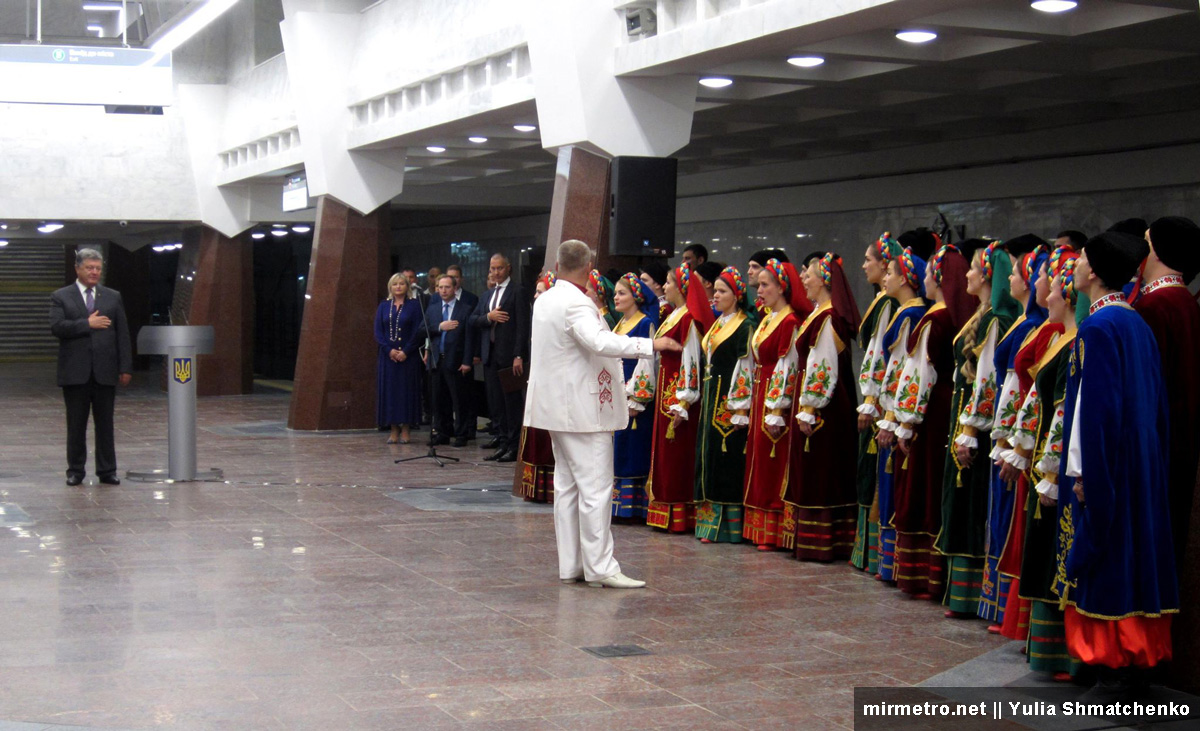
However, after the end of the meeting, passengers were not yet able to use the new station. For this, a decision was required from the executive committee of the city council on the transfer of Peremoha from the balance sheet of the metro construction to the balance sheet of the Kharkiv Metro, and a subsequent publication in the government newspaper. The station opened on 25 August 2016 at 3:00 p.m.
In the following few years, a certain lull settled in the history of the metro. The greater part of news reports spoke of the buyout of housing subject to demolition for the construction of the future Derzhavinska and Odeska stations, the preparation of construction sites, and, in fact, promises to begin construction. Starting with loud proclamations about the start of work immediately after the previous opening, promises to begin construction “this year already” were heard in various formulations for another whole five years. On 19 December 2017, the final package of documents was signed on the provision of a loan of 320 million euros from the European Bank for Reconstruction and Development and the European Economic Bank. These funds were intended to go towards the construction of new stations, an electric depot, as well as the acquisition of rolling stock. According to the plans of that time, these funds were supposed to be utilised by 2021. Nevertheless, they were in no hurry to begin the work. The construction of tunnels to the new Oleksiivske depot also did not last very long and was suspended after some time. The situation is quite depressing, for even in the difficult 1990s it never happened that nothing at all was done over the course of a year.
A new chapter in the history of the metro opened in March 2020. The rapid spread of the pandemic caused by the COVID-19 virus, and the restrictions associated with it, came as a surprise to many Kharkiv residents, as, indeed, to hundreds of millions of people around the world. Since the metro quite obviously belongs to places of mass gatherings, intensive disinfection was carried out at stations and in passageways from the beginning of March. Cleaning began to be performed three times a day, whereas previously it had been done once a day. A specially trained person continuously monitored the condition of the cleaners so that, if symptoms of illness were detected, the necessary measures could be taken. The city authorities did not plan to close the metro even after it was directly provided for by an order of President V. Zelensky. Mayor Gennady Kernes made a statement about the inadmissibility of closing the metro, but under the pressure of threats of liability for failure to implement measures to combat the pandemic, he nevertheless changed his decision, and on 17 March 2020 at 8:00 p.m., the Kharkiv Metro was closed for passenger transport for the first time in its history. The reopening dates for the metro were repeatedly postponed, until finally, on 25 May, its doors opened again. At that time, the passenger flow was roughly half of what had been observed before the start of the pandemic.
As in many cases, when the true importance of something is realised only after its loss, the closure of the metro demonstrated its significance for Kharkiv. The very next day, a real transport collapse set in in the city: overcrowded trams, trolleybuses and shuttle taxis, into which it was not always possible to squeeze even after several attempts; hastily altered routes; passengers unable to alight at their required stop; numerous conflicts between passengers and drivers over the refusal to take additional passengers on board. The order limiting the maximum occupancy of surface transport to 10–20 people sounded like an inappropriate joke, as it was impossible to comply with it for obvious reasons. To ensure such occupancy, even with reduced passenger flow, it would have been necessary to increase the number of tram and trolleybus cars many times over. To enforce the indicated measures, police raids were organised with the issuing of fines, which did not help at all. Still, they only exacerbated the general tension, to the point where many drivers refused to go out on their routes under such conditions. Against the background of loud phrases about fighting the pandemic, the situation looked absurd, especially given that not everyone bothered to observe the mask regime.
The closure of the metro, back in that period of time, provoked a wave of indignation and dissatisfaction among many Kharkiv residents. The main argument of the critics was that the idle metro and the deserted streets became a city attribute at a time when not a single case had been officially registered in Kharkiv region, whereas later no such initiatives were heard. Throughout 2021, when the number of cases was in the tens of thousands, the city lived a full life with the usual range of cultural events, and no one even thought of restricting the operation of transport. Such a long period of running idle, of course, led to very large losses for the metro.