Development prospects

The future development of the Kharkiv Metro remains uncertain. Funding for regional metro construction in Ukraine has never been sufficient, and new lines and stations have traditionally been built at a very slow pace. Every stage of expansion has required considerable effort and financial resources. Nevertheless, many Kharkiv residents remain optimistic, and announcements about the construction and opening of new stations continue to appear with remarkable regularity.
The outbreak of the full-scale war inevitably pushed metro expansion into the background. At a time when countless residential buildings, schools, hospitals, and other infrastructure have been destroyed or severely damaged, the city’s highest priority is understandably the restoration of essential facilities and the provision of housing for people who have lost their homes. Even so, the city has not officially abandoned its plans to expand the metro network.
Near-term perspective
The next planned extension is the 3.56-kilometre section from Metrobudivnykiv to Odeska, including two new stations: Derzhavinska and Odeska. This extension is intended to connect the southern part of Kharkiv with the existing metro network. The station designs underwent several revisions over the years. In 2015, it was decided to swap the architectural designs of the two stations. Specialists at Kharkivmetroproekt are ready to develop new projects whenever their work is paid.
According to the original plans, an intermediate station called Kashtanova had to be built between Derzhavinska and Odeska. Its future remains uncertain, although it is now considered unlikely to be constructed because the surrounding area is sparsely populated and consists mainly of low-rise housing. Instead, builders are expected to leave a straight section of track with sufficient space between the tunnels to allow the station to be built in the future if necessary.
For more than four years, negotiations were held with the European Bank for Reconstruction and Development (EBRD) and the European Investment Bank (EIB), and finally, on December 11, 2017, an agreement was signed on the granting of a loan of 320 million euros. These funds will be used for the construction of stations and depots, and for the purchase of 85 new rolling stock cars. Since April 2018, negotiations have been underway with residents of houses to be demolished, for the purchase of housing and to provide a new one in return. Work on the construction of two new stations was promised to begin at the end of 2017, then in 2018. With sufficient funding and provision of materials, the stations are realistic to build and put into operation in two to three years. However, now not everyone believes in such statements; many agree that Kharkiv residents will not see the new stations for a very long time. Unfortunately, the current state of the Ukrainian economy and the experience of building over the years of independence make the second scenario more likely. For a long time, 2022 was called in terms – this is what we were promised by numerous banners at stations and in cars. From year to year, from the city authorities, there were promises to start construction “this year already”, but in fact, since the autumn of 2016, the construction of stations has not been underway, and work on the construction of “Derzhavinska” and “Odeska” stations has not yet begun. Contrary to the tragic circumstances of the present day, according to the city authorities, the money allocated for construction is still in the accounts and waits for its hour. Nevertheless, hardly anyone can now say when in a severely destroyed city it would be able to return to such a project as the construction of the subway, because the war, unfortunately, has not yet ended…
Since November 2017, construction has been underway on a connecting tunnel leading from Peremoha station to the future electric depot. The depot is of great importance, as the Oleksiivska Line currently has no depot of its own. At present, all trains serving the line are stored and maintained at the Nemyshlianske depot, resulting in additional operational costs. Once the line is extended and the fleet is expanded, this problem will become even more significant. The construction contract was awarded to Kyivmetrobud, as the tender required the contractor to finance the initial stages of construction without advance payments. Kharkiv-based Pivdenspetsbud was unable to meet this requirement due to insufficient financial resources. Originally, the depot was expected to be completed in 2020. However, by that time, even the connecting tunnel from Peremoha station had not been finished, while construction of the depot buildings and supporting infrastructure had not yet begun. By 2022, the project had reached an unusual impasse. Not only had construction failed to start, but much of the land originally reserved for the depot had already been occupied by newly built houses and cottages. This raised serious concerns, as compliance with the required minimum distance between a depot and residential buildings would leave only a small fraction of the necessary site available. The outbreak of the full-scale war further complicated the situation. After both existing depots suffered damage during Russian attacks, the possibility of constructing the new depot underground began to be discussed. However, underground depots are extremely rare in metro systems around the world. Such a project would require entirely new engineering solutions and substantially greater financial investment, making its implementation highly uncertain.
The geological conditions in this area are also far from ideal. The ground consists mainly of water-saturated sandy soils with unstable properties. Although the stations themselves are planned to be built using the cut-and-cover method, updated geological surveys indicate that the tunnels will have to be constructed several metres deeper than originally planned. As a result, much of the tunnelling will have to be carried out using underground excavation rather than open construction. To minimise disruption to traffic on Aerokosmichnyi Avenue, the tunnel alignment has been shifted slightly away from the avenue itself. Construction is expected to employ a modern tunnel boring machine capable of advancing approximately 20–30 metres per day.
At the same time, opening the stations one at a time — as was done with the previous two extensions — would make little sense. Derzhavinska station alone would provide only limited benefits, as it is located very close to the existing interchange hub. For this reason, construction is planned to begin with Odeska station, where the site reserved for the station since the 1990s will first be excavated.
Derzhavinska station will be located on Aerokosmichnyi Avenue at its intersection with Kotsyubaylo Street. The station’s project name will almost certainly be changed, as Derzhavinska Street was renamed in 2023 in honour of Hero of Ukraine Dmytro Kotsiubailo. The station is designed as a shallow column station.
Сoncept design of Derzhavinska station
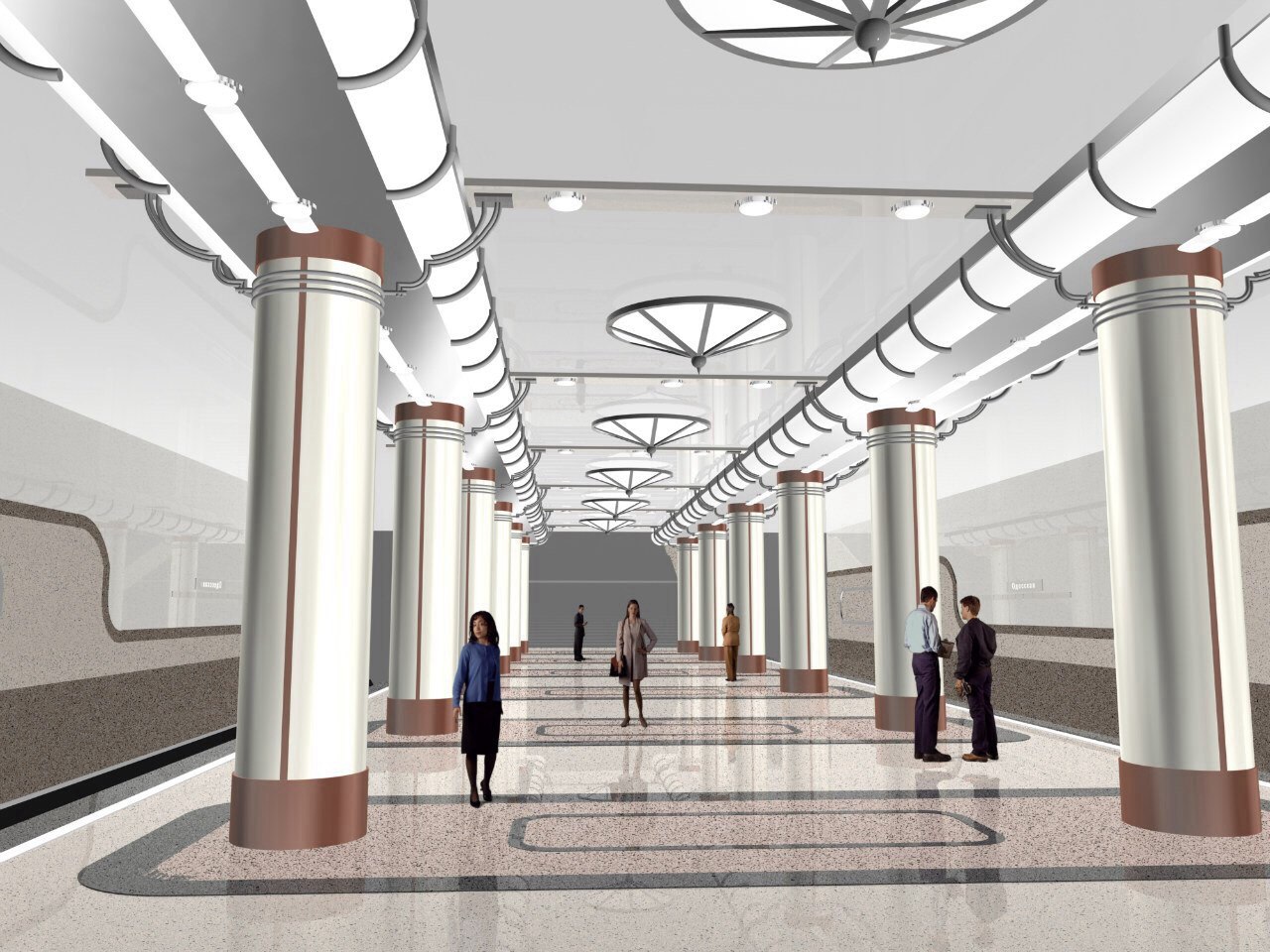
Odeska station will be located on Aerokosmichnyi Avenue near the intersection with Odeska Street and Byron Street. The opening of this station is particularly important, as it will provide metro service to the large Odeska residential district and improve transport connections with the southern part of the city as a whole.
Сoncept design of Odeska station

Medium-term perspective
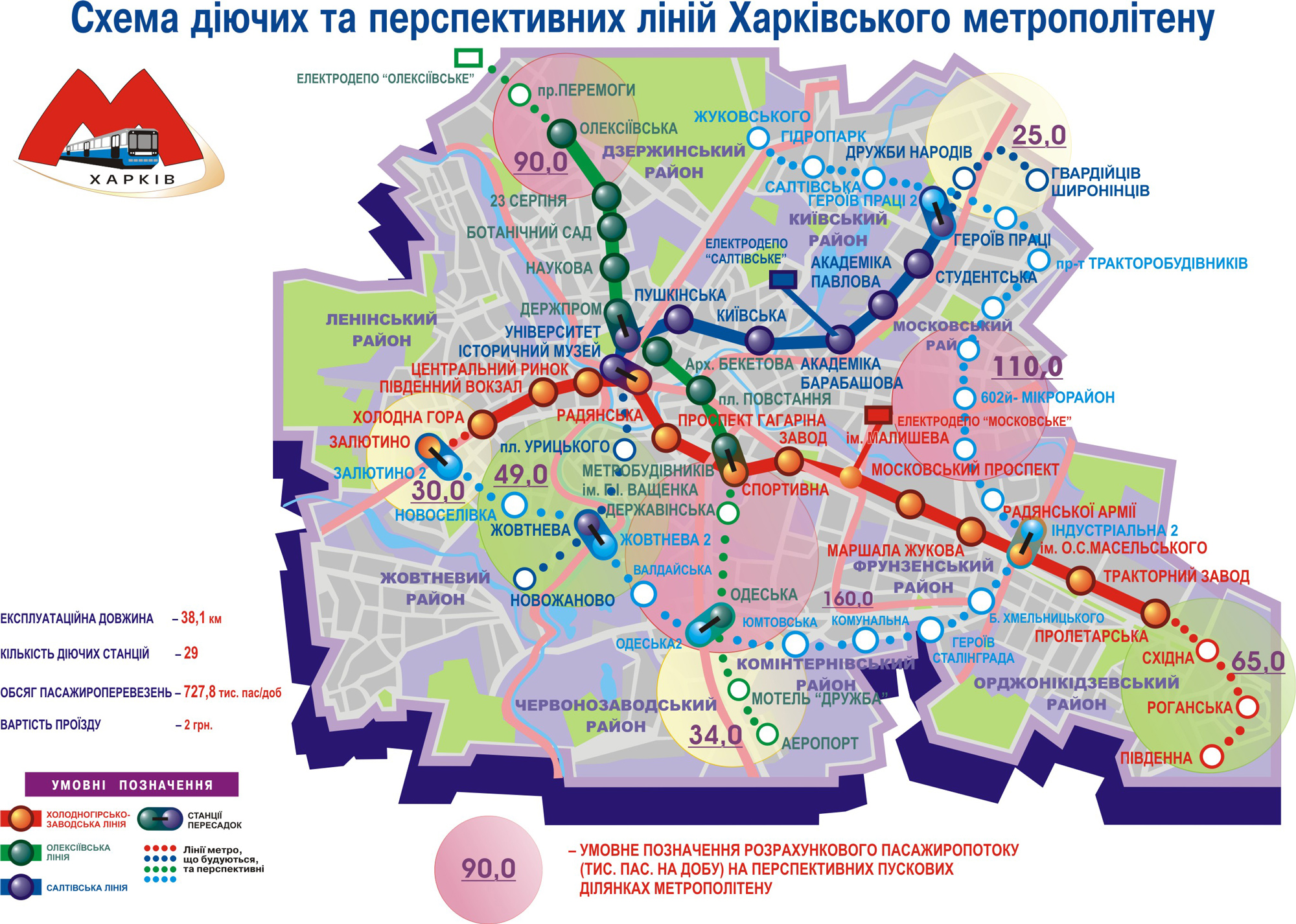
In the medium term, the Saltivska Line is expected to be extended by one station at each end.
Extension Istorychnyi Muzei – Ploshcha Uritskoho (1.8 km). The planned Ploshcha Uritskoho station will be located near the Kharkiv Circus. Its project name has so far remained unchanged, even though Uritskoho Square was renamed Iryna Buhrymova Square in 2004. The station is not expected to generate particularly high passenger traffic and would normally be considered a relatively low priority. However, there are several important operational reasons for extending the line. At present, only a single turnback track is available beyond Istorychnyi Muzei station, limiting the line’s capacity and making it difficult to reduce train headways when necessary. In addition, the nearest ventilation shaft is located at a considerable distance. For these reasons, extending the Saltivska Line to the south is considered essential.
Extension Saltivska – Druzhby Narodiv (2.4 km). The planned Druzhby Narodiv station will be located in the North Saltivka district, at the intersection of Les Serdiuk Street and Sobornosti Ukrainy Street. The station is expected to play an important role in providing metro service to North Saltivka, one of the city’s largest residential areas. High passenger demand is anticipated, and the need for this extension is considered almost as great as that for Odeska station. The station’s project name will also almost certainly be changed. In 2024, Druzhby Narodiv Street was renamed Sobornosti Ukrainy Street.
Although both stations are included in Kharkiv’s general development plan up to 2031, the prolonged war, the current economic situation, and the lack of adequate funding will prevent them from opening on schedule. Moreover, no detailed designs for these stations currently exist. The situation is further complicated by challenging geological conditions along both extension routes. The Druzhby Narodiv station is set to be built on highly waterlogged soils with quicksand properties, while the construction of the Ploshcha Uritskoho station will require tunneling under the Kharkiv River – a particularly difficult and time-consuming endeavor. According to calculations carried out in the 1980s, building the extension from Istorychnyi Muzei to Ploshcha Uritskoho will cost roughly twice the usual amount, and the Ploshcha Uritskoho station itself will require a deep foundation. All of the above circumstances make the prospect of extending the Saltivska line even more remote.
The Kholodnogirsko-Zavodska will also be extended in both directions:
Extension Kholodna Hora – Zaliutine with a length of 2.4 km. Zaliutine station will be located in the eponymous district, on the western outskirts of the city. In this place, there is no dense development, and now the need for the construction of this station is doubtful, but in the future, this site may be important. In addition, a new transport hub is planned to be built near the Zaliutine station. Due to the long length of the transmission on this site, an additional substation will likely be built.
The Industrialna–Roganska extension stretches 3.9 km and includes two stations: Skhidna and Roganska. Its feasibility study was approved in 1994 on the initiative of local industrial enterprises, and the stations were originally scheduled to open in 2005 – a target that proved unrealistic from the outset.
Skhidna station is planned for the area near the tile factory, while Roganska station will be situated in the Horizon microdistrict, right in the heart of the Rohansky residential area. Although this part of the city already experiences significant traffic congestion, the metro construction would be fully justified only if these districts see further residential and commercial development.
Today, the prospects for building these stations remain highly uncertain. Most likely, over the next 15 years, even if the extension of the Kholodnogirsko–Zavodska line is brought up for discussion, it will not advance beyond preliminary talks.
Distant perspective
In the long term, the construction of a branch line from Akademika Barabashova station remains a possibility. The station was originally designed with provisions for such an extension, and this proposed branch has appeared on official metro maps displayed in train carriages for many years. The new branch would provide metro service to the Eastern Saltivka residential districts, one of the most densely populated parts of the city, where rapid transit would play an important role. The proposal includes three new stations: Hvardiitsiv Shyronyntsiv, Traktorobudivnykiv, and Skhidna Saltivka.
The most ambitious proposal for the future development of the Kharkiv Metro is the construction of a fourth (purple) line, with 11 stations. The line would run entirely through the eastern part of the city, linking the northern and eastern districts of Saltivka with the Tractor Plant district while providing interchange stations with the existing Kholodnohirsko-Zavodska and Saltivska lines. In fact, this line would form part of the large metro ring that was planned during the Soviet era. Its construction is expected to become increasingly important as the city grows and the existing three metro lines approach their capacity limits. Although the fourth line is officially regarded as the next major expansion project after the completion of the Odeska extension, current circumstances make it impossible to predict when construction will begin, let alone when its first section might open. Such a project is likely to become feasible only if Ukraine’s economic situation improves significantly. It is also possible that the country’s post-war reconstruction could create favourable conditions for the implementation of projects on this scale.
Also, in the long term, with the development of the city in the future, the following stations may be built:
— Extension of the Kholodnogirsko-Zavodska line to the west. Initially, it was planned to extend the line to the Nova Bavaria district with the construction of a station of the same name, but in recent years, this was rejected in favor of Pesochyn village.
— Extension of the Oleksiivska line to the south with the construction of two stations, Motel Druzhba and Aeroport. This section was planned from the very beginning of the design of the Kharkiv metro, but in recent years it was excluded and does not appear in the official plans.
— Extension of the Oleksiivska line to the north in Dergachy village.
— Extension of the Saltivska line to the south through the Moskalivka district to the Novozhanove district with the construction of two stations: Zhovtneva and Novozhanove.
An ambitious vision for the future development of the Kharkiv Metro, prepared by the Kharkivmetroproekt Institute in 2011. Whether these plans will ever be fully realised remains uncertain. Even so, Kharkiv residents and metro enthusiasts continue to look to the future with optimism. Only time will tell.