Third Line (1984-1995)
The intensive development and expansion of the Saltivsky residential area gave rise to a serious transport problem – buses ran overcrowded, and at peak times it was difficult to squeeze into some of them. Therefore, the residents of Northern Saltivka eagerly awaited the opening of the new section. Initially, its opening was planned for 1987, but the builders aimed to complete the work in time for City Day in 1986.
The construction of the three new stations was carried out by the open-cut method; however, this time a considerable part of the tunnels was also built from the surface. This became possible because this section runs almost entirely along Akademika Pavlova Street and has a perfectly straight trajectory in many stretches. Those sections of the tunnels that were built by the open-cut method were constructed from new monolithic-section reinforced concrete blocks, two metres in length, which were assembled from the surface using a crane. The use of such blocks yielded a gain in construction speed; moreover, the outer surface of the tunnel walls did not need to be plastered before applying the waterproofing layer.
The construction conditions for the stations and tunnels in Saltivka proved to be very difficult. The soils in this area are predominantly weak sands and clays with quicksand properties. In addition, streams flow intensively from natural underground springs located under the hills of the Saltivsky residential area, forming a powerful underground lake. To combat the groundwater, a number of already proven technical solutions were employed: the laying of several layers of waterproofing material, pumping out water with pumps from boreholes, and the installation of wellpoint filters and catchments.
The single-vault station Akademika Pavlova was built using a fundamentally new technology. Whereas previous single-vault stations had been constructed from cast-in-situ reinforced concrete with the aid of travelling formwork, this time all the structures were made of precast reinforced concrete elements. The upper vault was made of three elements with longitudinal hollow channels – these are used for the passage of lighting and other wiring. The elements were joined by loop reinforcement projections and by monolithic casting with concrete. The use of a precast vault structure instead of a monolithic one gave a huge gain in both the speed and cost of construction. For the first time in the construction of the Kharkiv Metro, a combined lining for the running tunnels was employed: the lower part of the tunnel rings was laid from cast-iron tubbings, and the upper part from reinforced concrete ones.
The column stations Studentska and Heroiv Pratsi were again built from precast reinforced concrete elements; however, because of their architectural features, their construction required the creation of new, much more complex moulds. Usually, when constructing a column station, the frame of the room is first assembled from reinforced concrete structures, then covered with a roof, and then work begins on the platform. At Heroiv Pratsi station, the platform was built first in the excavation, so that the walls and roof could then be erected simultaneously, yielding a gain in time.
Concept design of Studentska station

Concept design of Heroiv Pratsi station

When the accident at the Chornobyl Nuclear Power Plant occurred, 32 people from among the Kharkiv metro builders set off to save the motherland. Each of these heroes was a volunteer; in some brigades they even drew lots among those wishing to go and fight the invisible enemy. Of course, at that time no one yet realised the full extent of the danger they would have to face. From May to October 1986, the workers of Kharkivmetrobud took part in driving a tunnel leading from the third reactor to the fourth for the injection of liquid nitrogen into the reactor, built decontamination points, and assembled and erected filter structures within the 18-kilometre zone of the station. Subsequently, many of those engaged in these works died or contracted serious illnesses, for large doses of radiation cannot pass through the body without leaving a trace. For many years, information about the heroic feat of the metro builders was not disclosed, and only 25 years later were those of them who lived to see that day awarded the “Chernobyl Honour” badge of distinction.
Construction proceeded at a fairly rapid pace – for instance, the Heroiv Pratsi station was built from scratch in just three years. Owing to some delays in the supply of materials and other reasons, it was not possible to complete all the work by August 1986, but it was nevertheless finished earlier than the following year. In total, the construction of the second launch section of the Saltivska line cost 34.5 million Soviet roubles. On 11 October 1986, the first trial train carrying honoured guests ran along the new section, and on 23 October the state commission signed the acceptance certificate for the operation of the second section of the second line of the Kharkiv Metro, grading it “excellent”. Three stations were put into operation: Akademika Pavlova, Studentska, and Heroiv Pratsi (now Saltivska). The Kharkiv Metro grew to 21 stations and became 3.6 km longer.
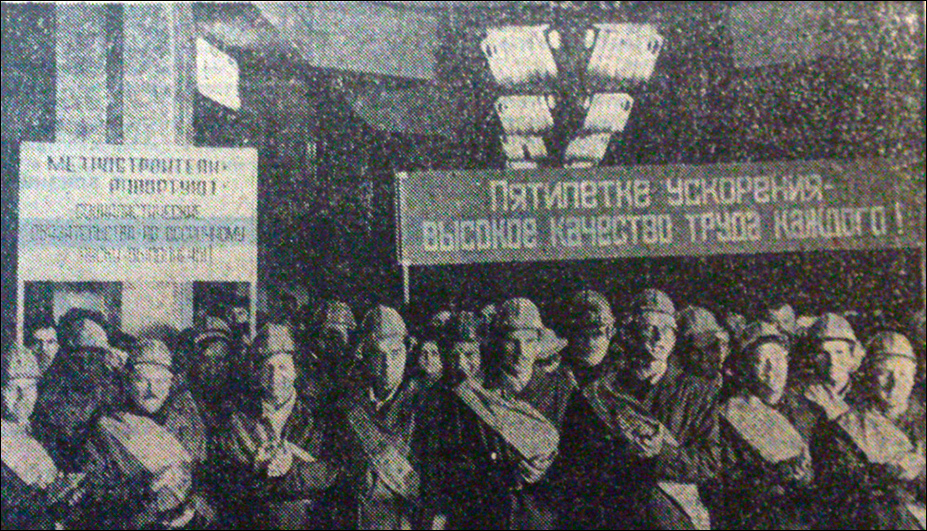
On 24 October 1986 at 3:00 p.m., a ceremonial meeting dedicated to the commissioning of the second launch section of the Saltivska line was held at the Heroiv Pratsi station. It was attended by metro builders, city and union-level party officials, and honoured guests.
Metro builders at the ceremonial meeting.
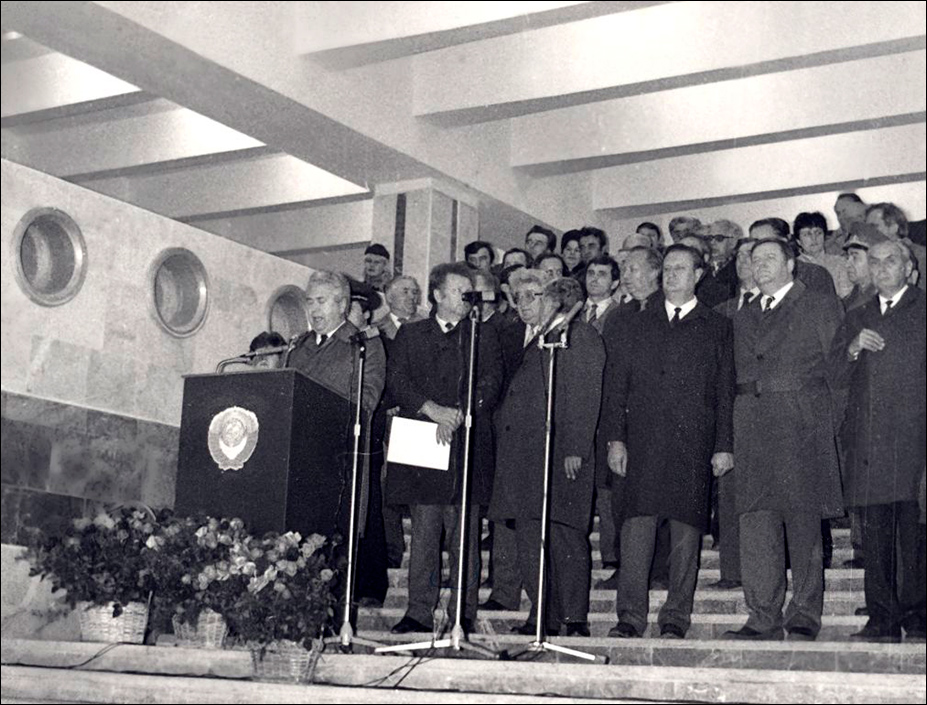
At the end of the meeting, the tunnelling team leader handed a symbolic key to the head of the metro and the station duty officer. At the solemn moment, a red ribbon was cut, and the honoured guests were invited into the trains. On the same day at 6:00 p.m., the new stations were opened to passengers.
After the extension of the line deeper into the Saltivsky residential area, the Kharkiv Metro reached record performance levels: the average daily passenger flow reached 800,000 people — more than in the present day. If, after the opening of the first stage of the metro, with a fare of 5 kopecks, the cost of carrying one passenger amounted to 7.6 kopecks, then as new sections were opened it decreased, and by that time stood at 5.6 kopecks. At the time, it was suggested that after the construction of the Oleksiivska line, the Kharkiv Metro might turn from a subsidised enterprise into a profitable one, but history took a different course.
In 1985, another innovation appeared in the Kharkiv Metro — a station management system using industrial television. Initially, it was introduced at the interchange hub between the first and second lines, and subsequently, over the course of five years, all the metro stations were equipped with it. This system serves to monitor the movement of passengers, allows observation of the situation at the station while providing a good overview, and enables better control over the operation of escalators. In the event of an emergency, it can be used to stop a train and cut off the power from the contact rail. This system also makes it possible to automatically count passengers entering the station.
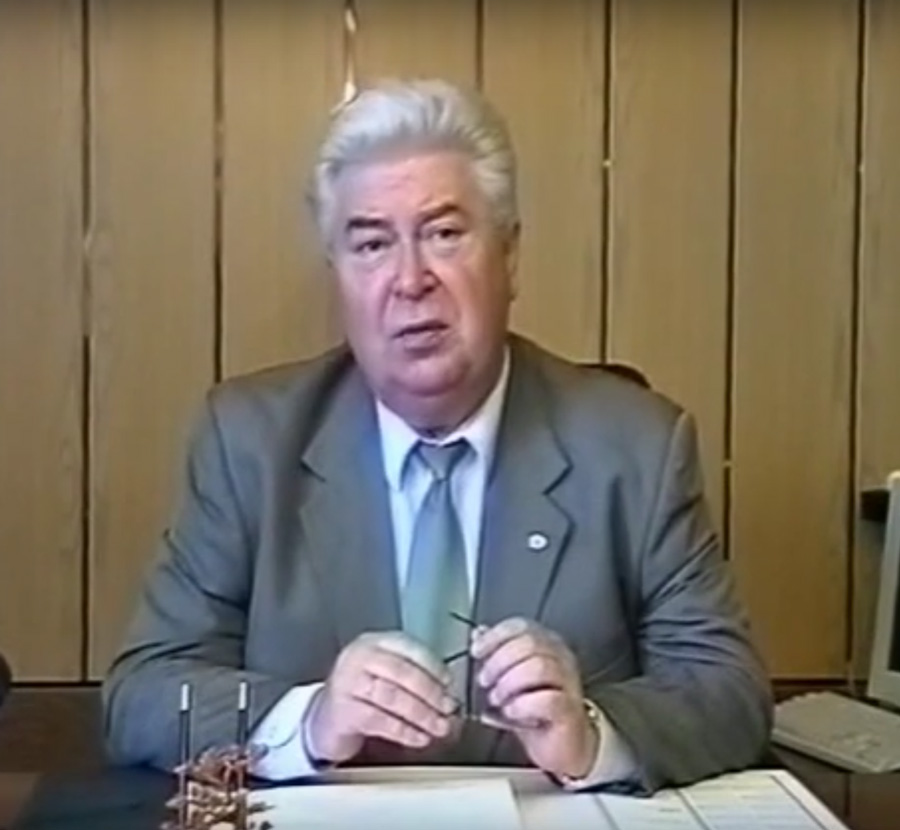
From 1984 to 2002, the Kharkiv metro team was headed by Leonid Isaev — incidentally, a world record holder for the longest tenure as head of a metro. The aforementioned achievements were largely to his credit.
Leonid Isaev
At last, the turn came for the Oleksiivka residential area, which was being intensively developed and expanded at the time. The Oleksiivska line project included 12 stations from Prospekt Peremoha to Odeska Street (extension to the Airport area and to the settlement of Dergachi was considered a distant prospect). Later, the project was reduced from 12 to 11 stations, as it was decided that building a station on the vacant land between the Pavlove Pole district and Oleksiivka was inexpedient. At the Kharkivmetroproekt institute, two variants for the construction phasing were considered. The first variant envisaged that a section from Pushkinska Street (Arkhitektora Beketova) to Prospekt Peremohy would be built first, and only then would the southern section of the line be opened. According to the second variant, the first launch section would run entirely through the central part of the city, from Prospekt Nauky (Naukova) to Derzhavinska, with the construction of six stations. In this case, train operations would be organised on the principle of three mutually intersecting lines forming a triangle in the city centre, so that passengers could reach any station with no more than one transfer. After some debate and meetings, the second variant was approved, although the Derzhavinska station was removed from the first section. Of course, the first variant was more rational from the point of view of covering new districts, as it would immediately have linked the metro network with the Oleksiivka residential area, but such a state of affairs could have led to a sharply uneven distribution of passenger flows across line sections and severely overloaded the interchange hubs. Furthermore, at the Arkhitektora Beketova station, the existing urban development did not permit the creation of an efficient transport hub.
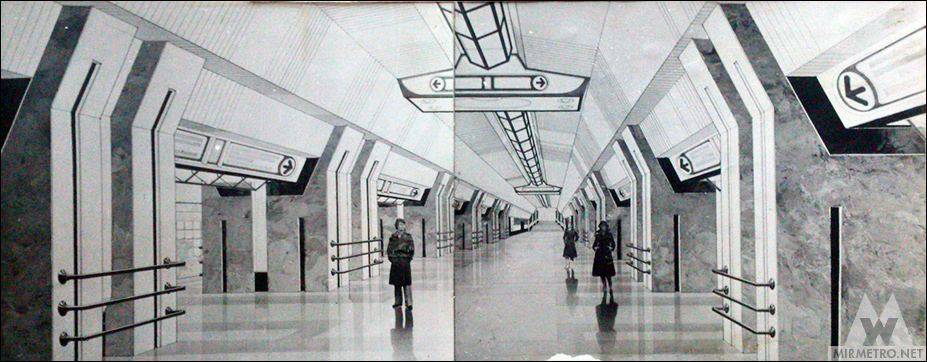
Incidentally, it was initially intended to build the stations of the Oleksiivska line with a platform length of 120 metres, i.e., for six-car trains. At that time, Kharkiv was continuously expanding, and it was assumed that by the beginning of the new century the population might exceed 2 million, but it was later decided that five cars per train would be sufficient, and the extra construction cost was unnecessary. As for the designs of the new stations, this time they were more restrained architecturally — evidently, it had been decided in the offices of high officials that Kharkiv had had enough luxurious underground palaces. Nevertheless, each station design was unique and individual, expressing the theme of its name well. For the designs of the Oleksiivska line stations, the team of architects was awarded the Prize of the Council of Ministers of the USSR.
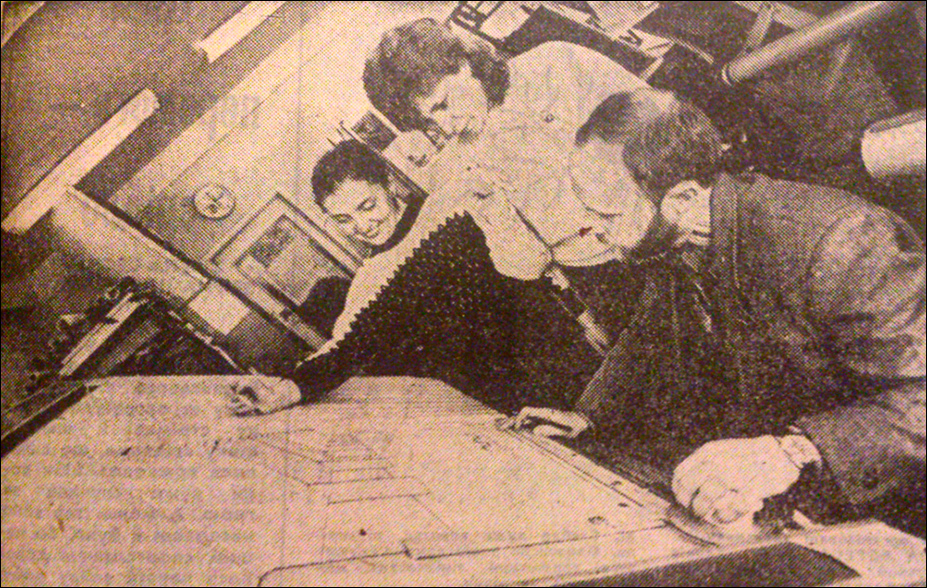
Architects working on the design of the third line of the Kharkiv metro and the first line of the Dnipro metro.
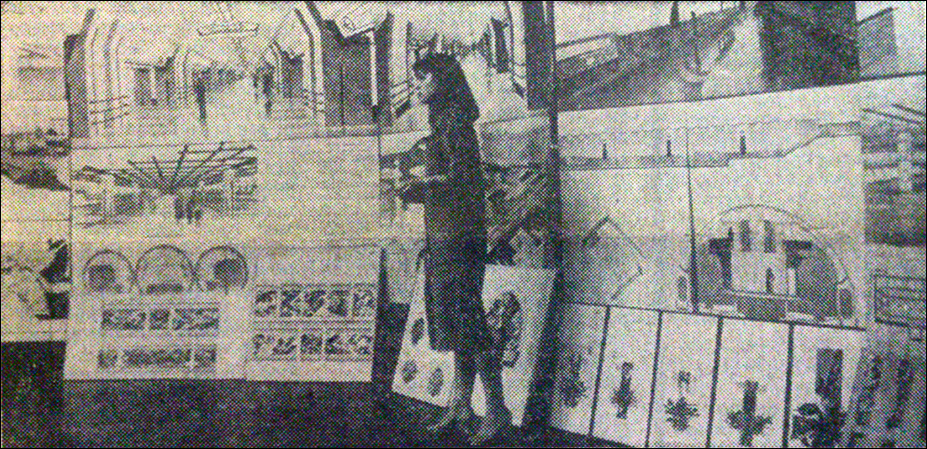
Presentation of the Oleksiivska Line station designs at the urban planning council.
In 1984, the Council of Ministers of the USSR approved the project for the third line. According to the plans of that time, the first section in the central part of the city, comprising five stations, was to be commissioned in 1992; the next section, with two stations in the Pavlove Pole area, in 1995; and the sections with two stations each in the Oleksiivka residential area and the Odeska district — by the end of the century. The metro builders, however, were determined to complete the construction of the first section ahead of schedule (in 1990), as had been the case on all previous occasions. For the first decade of the 21st century, it was planned to begin the construction of a fourth line, to extend the second line deeper into Northern Saltivka and towards the Kharkiv Circus area, and the first line towards the Zalyutine district and the Rogansky residential area.
On 6 February 1984, with the sinking of a shaft at the future Derzhprom station, the construction of the Oleksiivska line began, and within the next two years work had commenced on the construction sites of four more stations. The building of the new line on the section from the Metrobudivnykiv station to the Arkhitektora Beketova station took place under extremely difficult geological conditions. In this locality, heavily waterlogged fine-grained sands with quicksand properties are frequently encountered, and in some places up to 200 cubic metres of water per hour entered the face. The construction of the Plosha Povstannya station and the running tunnels adjacent to it, as well as the service connecting branch to the first metro line, was particularly challenging. To combat the groundwater, a wide range of dewatering measures was employed — ground freezing, chemical stabilisation and cement grouting, and driving under compressed air in a caisson. For tunnelling, in addition to the mechanical shields already in use, a new mechanised shield was deployed, with which between 40 and 150 metres were driven per month, depending on the tunnelling conditions.
By an already well-established tradition, thanks to the Kharkiv design institutes, a whole series of technological novelties was introduced during construction on the new line in order to reduce costs, enhance reliability and provide additional conveniences for passengers.
A true revolution was the Metrobudivnykiv station, which has no analogues in the world. On a site where limited space prevented the construction of a station according to a standard design, a three-tier station was built, with the platform hall located on the lower level, service rooms on the middle level, and on the upper level a concourse combined with escalators and a transfer corridor. The platform is directly adjoined by the main ventilation chamber and a combined traction-step-down substation.
The Plosha Povstannya station was built using the diaphragm wall method, entirely from precast reinforced concrete elements, which yielded a great gain in speed and cost. A reinforcement cage was assembled in a narrow trench and filled with a clay-cement grout. The walls on both sides of the station are also not monolithic, but assembled from precast reinforced concrete elements. Inside, between the wall and the vault, suspended ceilings — so-called decorative walls — were installed.
The deep-level stations Arkhitektora Beketova and Derzhprom were built using an entirely new technology. To construct the platform section, two pilot tunnels 5 metres wide were first built, then widened to 8.5 metres. After the driving of the side tunnels, a central tunnel was constructed between them, which was also widened to a diameter of 9.55 metres. After the construction of the three station tunnels, the passageways between the pylons were opened up. The new subtype of pylon station, with pylons 2 metres wide, was given the name “column-pylon station”. Such structural features increase the available space and allow for a better distribution of passenger flows in the interchange hub.
For the Naukova station, the already proven structural model of a two-tier balcony station was used, which is distinguished by its quality and reliability.
Concept design of Metrobudivnykiv station
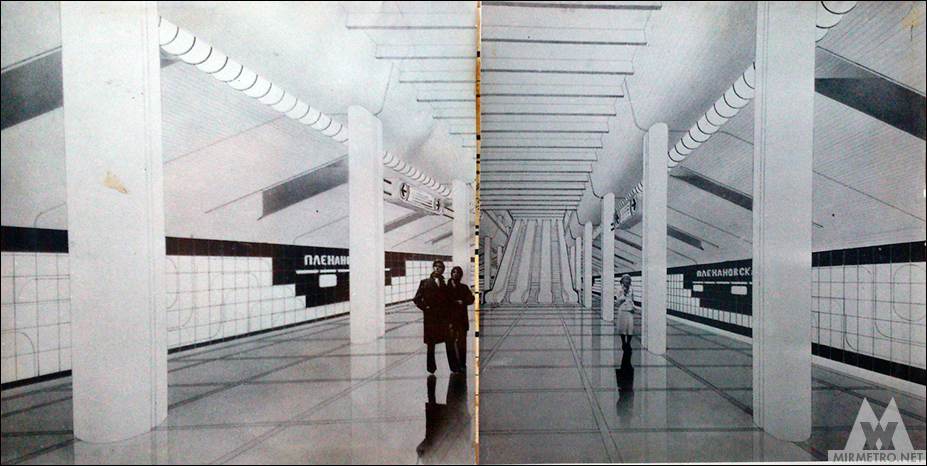
Concept design of Derzhprom station
Meanwhile, the socio-economic transformations of the late 1980s were making themselves felt more and more insistently. The situation in the economy and industry began to deteriorate, and the list of scarce materials was continually being replenished with new groups of goods. While in 1988 the metro builders were still somehow managing to maintain the set pace of construction, in 1989 everyone felt the full delights of Perestroika: the growing shortage of materials, primarily concrete, interruptions in supplies and lengthy downtime on the construction sites. This led to the fact that, in 1989, for the first time in the history of Kharkiv metro construction, the annual plan was not fulfilled. In March 1989, the chief engineer made an official statement that there would be no early launch of the Oleksiivska line in 1990, and that construction was proceeding according to the original plan.
During 1990–1991, the construction of the new line was slowed down owing to a chronic shortage of construction materials (but not yet of money). Factories and enterprises were going through hard times and often, through no fault of their own, let the metro construction down. During this period, work began on the construction sites of four stations on the Naukova – Peremoha section, but progress was slow: only a small part of the tunnels was built, and the excavation of the pits did not really get underway.
The economic crisis hit Kharkivmetrobud hard. In the autumn of 1991, the Cabinet of Ministers of Ukraine allocated 27 million roubles, which amounted to only a fifth of the required sum. Thereafter, the budget of the now independent state was in no hurry to allocate funds for regional metros, and the city could not sustain such a project on its own. It then became obvious that the planned launch in 1992 was completely out of the question. Construction continued mainly thanks to materials received earlier. The opening of the Oleksiivska line was postponed until 1993.
Things were no better with the operation of the metro. Since the Ministry of Railways of the USSR was no longer providing subsidies for the metro, funding for the underground fell onto the shoulders of the city and regional budgets. As a result of the sharp rise in the cost of electricity, spare parts for the cars, rails and other materials, against a background of low incomes of the population, the metro increasingly felt the financial problems, which only grew worse over time, while the metro’s profitability was falling. The metro’s profitability continued to fall catastrophically, and in the spring of 1993 it reached an “anti-record” of 18% (which was not so bad, considering that for surface transport this indicator stood at 3–5%).
Having no other choice, from April 1993 the Kharkiv Metro switched to an economy mode: escalators at shallow-level stations operated only during peak hours, the total number of trips was reduced — in particular, intervals in the evening were greatly increased. Previously, after 10 p.m., trains often ran half-empty, but now this had become an unaffordable luxury. For the same purpose of saving, the average speed of the electric trains was reduced from 42 to 35 km/h, since energy consumption has a quadratic dependence on the train’s speed (the figure is given taking into account dwell times at stations, so the actual speed of the train in the tunnel is considerably higher). A little later, the metro’s operating hours were shortened — since then, stations have closed to incoming passengers not at 1 a.m., but at midnight. This was due to the fact that during that time interval the underground carried only 0.12% of the total number of passengers, while operational costs were very high. Fortunately, despite all the hardships, the metro did not lose its reliability of operation and convenience for passengers. On the whole, in the 1990s, the metro remained in Kharkiv the only mode of transport that continued to function stably and without interruptions.
To get out of the situation that had arisen, the metro was forced to take under its wing trading stalls and kiosks that lined up in the passageways, and to place advertisements, which since then have flooded the car interiors. In the summer of 1993, advertisements were even added to the automated announcements, but the passengers’ indignation was so great that the advertisements were quickly removed, and casual visitors to the city who found themselves in the metro were bewildered — it seemed that all of Kharkiv consisted of nothing but banks and trading firms.
Thus, the 90-per-cent complete section of the Oleksiivska line was left hanging in the air, and it had to be finished somehow. In the spring of 1993, to continue the work, 250 billion karbovanets were needed, which were promised to be allocated from the state budget (of this sum, about 100 billion were required to complete the section, the rest — for the construction of the next one). Without waiting for help from the state, Mayor Yevgeny Kushnaryov and future governor Olexander Maselsky independently sought ways of resolving the pressing issues facing the city, among which was the construction of the metro. They themselves regularly visited the stations under construction and took an interest in the progress of the work. To the best of their ability, they pushed for funds to be directed towards the construction of the underground from various sources, although, of course, in the conditions of the economic crisis, when the city treasury was almost empty, doing this was by no means easy, and the maintenance of the unfinished stations also required considerable resources. They also regularly knocked on the doors of the President and the Cabinet of Ministers, but, as a rule, without success. After some time, the requested sum was allocated from Kyiv, but during this very period the national currency of Ukraine underwent catastrophic hyperinflation, which by the end of 1993 alone amounted to 10,200%. Therefore, in fact, only a tenth of the required funds was utilised. Another problem was that, due to the downtime in construction, various pieces of equipment were becoming obsolete and falling into disrepair, and their subsequent replacement required additional expenditure. The opening was postponed to 1994.
In April 1994, with a minimum requirement of 600 billion, 100 billion karbovanets were allocated from the state budget, and later a further 115 billion were allocated from the regional budget. After that, it would seem already clear that a new line was not in the cards for Kharkiv in 1994 either, but a project was presented to launch the line in the summer of that year. According to this variant, it was proposed to open a section of three stations from Metrobudivnykiv to Arkhitektora Beketova, owing to the serious delays at the Derzhprom station. In this case, two shuttle trains would run on the line without a full turnaround, while two more stations would be put into operation later. After lengthy consideration at meetings of the City Executive Committee, this plan was rejected, and it was decided that the section would be commissioned in its entirety.
On 31 December 1994, a meeting of the Kharkiv Regional Executive Committee was held, at which a decision “On Measures to Ensure the Commissioning of the First Section of the Third Stage of the Metro” was taken, according to which the new line was to be brought into service by Victory Day in 1995. At the beginning of 1995, Olexander Maselsky, realising that there was still a shortage of funds to finish off the new line, and that dragging out the construction any further would be highly undesirable, resolved on a desperate step. Through the mass media, he published an appeal to the enterprises of Kharkiv:
Dear residents of Kharkiv!
All of us daily feel the problems of the worsening urban transport situation, which is in many ways a consequence of the deep economic crisis our state is experiencing today. The capabilities of surface road and electric transport are almost exhausted due to a shortage of fuel, spare parts, buses, trams and trolleybuses.
We see a fundamental solution to the transport problem in the shortest possible time in accelerating the pace of metro construction, which could in the very near future improve transport links between the central districts of Kharkiv by putting into operation five stations of the first launch section of the third stage of the metro: Metrobudivnykiv, Plosha Povstannya, Arkhitektora Beketova, Derzhprom and Naukova, which will link the two existing lines, as well as the city centre with the residential areas of Pavlove Pole and the enterprises of the Comintern district. The main construction works at all stations have already been completed, permanent tracks have been laid on all sections, and the improvement of the adjacent territories has begun.
The Executive Committee of the Regional Council of People’s Deputies, as has already been reported in the press, taking into account the high degree of construction readiness of this section, has taken a decision to put it into operation on 9 May 1995. But for this, almost 1 trillion 300 billion karbovanets is needed: for carrying out significant volumes of special installation and finishing works, the acquisition of cars, cable and semiconductor products, other equipment, and also materials. We are not in a position to allocate such funds from the budget today.
The Executive Committee of the Regional Soviet of People’s Deputies appeals to the collectives of industrial enterprises, organisations and institutions of all forms of ownership, to entrepreneurs and to the residents of the city with a great request to make their own contribution to solving this problem, so that already in May train operations on the third stage of the metro can begin.
Olexander Maselsky
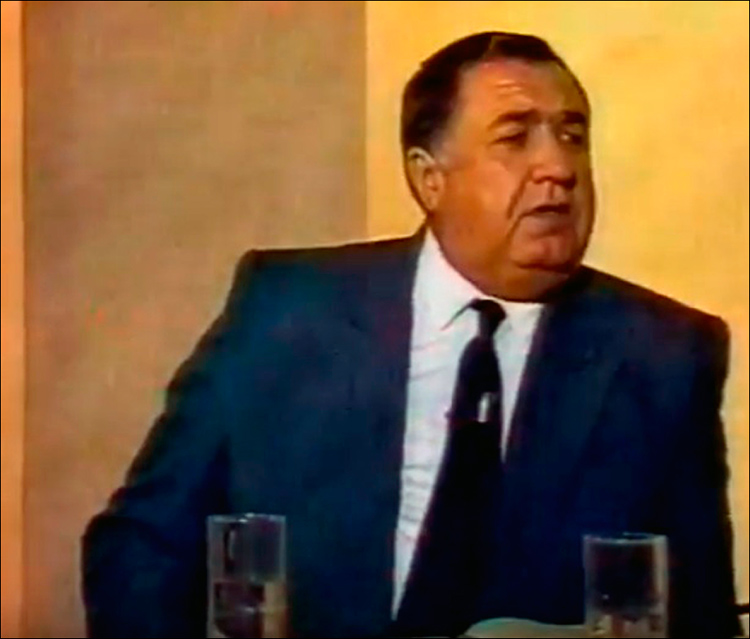
Indeed, new cars and cable and semiconductor products were the main things that the new line lacked for opening. The Kharkiv plants could manufacture only a small portion of the required quantity of cables. The governor’s appeal found a response among the city’s enterprises. Although Kharkiv enterprises themselves were far from living in clover, more than 100 billion karbovanets was received into a special bank account from more than 20 organisations. A further 234 billion came from the state budget, and the Regional Council undertook to allocate 200–250 billion a month. In January 1995, work on the stations was once again in full swing, and this time the promises were not empty — no one doubted any longer that the launch of the line was just around the corner. In less than four months, an enormous volume of work, estimated at almost a year’s worth, was carried out: the missing cladding of structures was completed, escalators, heating, lighting and water drainage systems were installed, and cables and permanent tracks were laid.
Finally, on 27 April 1995, the first trial train ran along the line, and on 6 May the state commission signed the acceptance certificate for the operation of the first section of the third line of the Kharkiv Metro. Five stations were put into operation: Metrobudivnykiv, Plosha Povstannya (now Zakhisnikyv Ukrainy), Arkhitektora Beketova, Derzhprom, Naukova. The Kharkiv Metro grew to 26 stations and became 5.3 km longer.
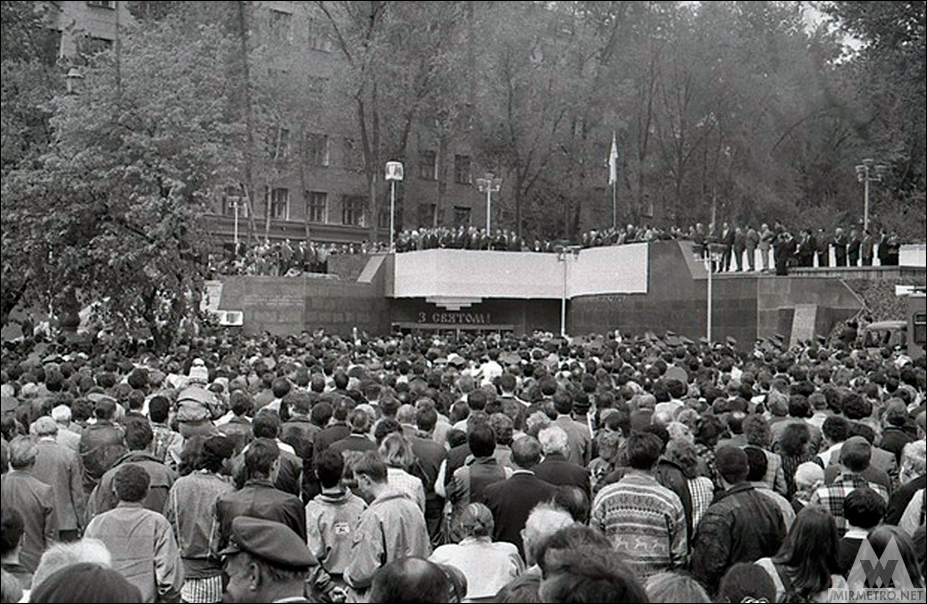
On 6 May 1995, a large crowd gathered on Svobody Square for a meeting dedicated to the opening of the Oleksiivska line. It was attended by representatives of the city and state authorities, metro builders, honoured citizens of Kharkiv, and Kharkiv war veterans.
Meeting on Svobody Square.
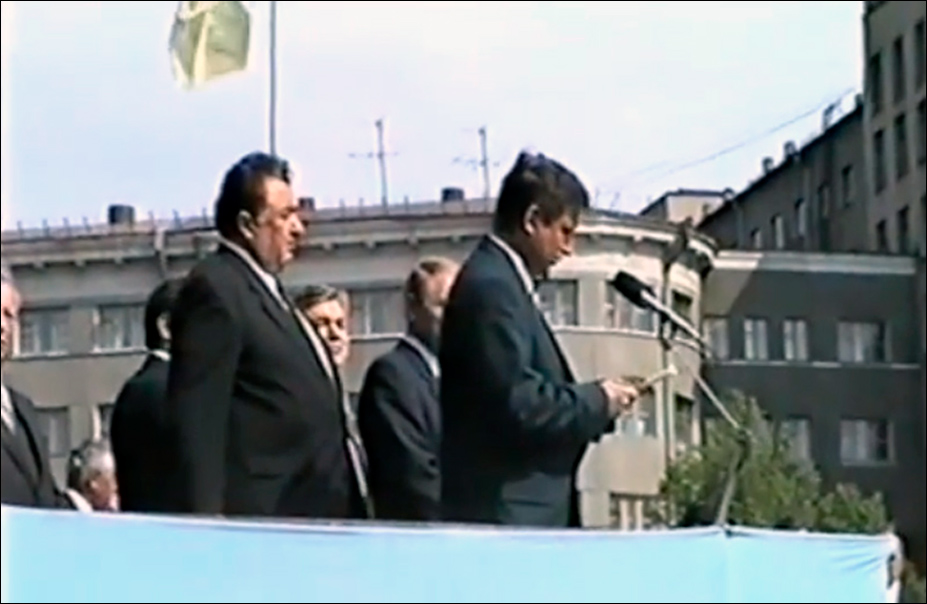
The solemn moment when the blue ribbon is cut.

At this meeting, Svobody Square (the largest square in Europe) was filled. The photograph shows the moment when the guests are already descending to the newly built station.
To the applause of those gathered, the head of metro construction handed the head of the metro a symbolic key to the station. The blue ribbon was cut, the guests descended to the Derzhprom station, where the president and the governor boarded the train surrounded by journalists. Besides them, Kharkiv veterans were also granted the honorary right to become the line’s first passengers. The train made lengthy stops at each station so that the honoured guests could alight, assess the newly built underground palaces, and share their impressions. At 6 p.m., the Oleksiivska line was opened to all passengers.
Thus ended yet another period in the history of the Kharkiv Metro.