Naukova
Opening date: 6 May 1995
Architects: V. Spivachuk, O. Denisenko
Engineers: R. Denisyuk, L. Koba
Station type: Shallow three-span column station
English equivalent: Science station
Average daily ridership: 20,800 passengers (2015)
The station opened on 6 May 1995 as part of the first section of the Kharkiv Metro’s third line, running from Metrobudivnykiv to Naukova and comprising five stations. These stations were heavily affected by budget constraints, yet the architects and artists still managed to give each one a distinct character, primarily through the use of a broader palette of colors. The station was inaugurated on the eve of Victory Day.
When Naukova served as the line’s terminal station, it was extremely busy, handling passengers from across the Oleksiivskyi residential district. Passenger traffic remains high today. There are no turnaround sidings beyond the station—only a short tail track, which can still be used for reversing trains.
Description
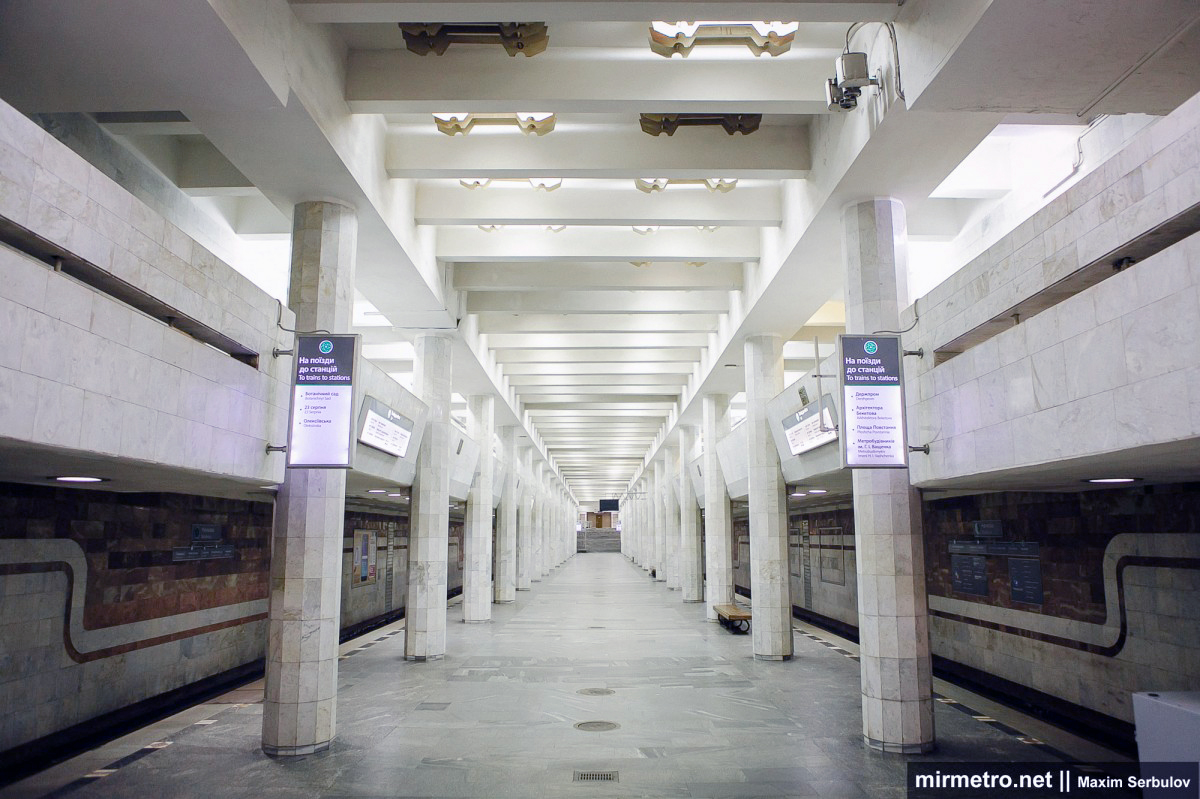
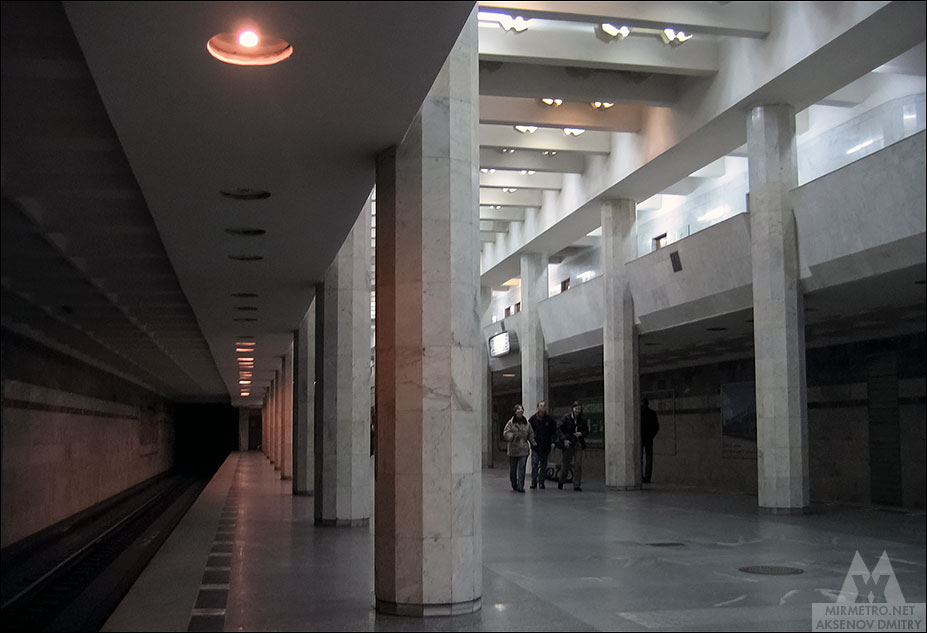
Naukova station was built to a custom three-span column station design. It is the second two-tier station in the Kharkiv Metro and the simplest in architectural terms on the Oleksiivska Line. The interior combines white, gray, and brown tones.
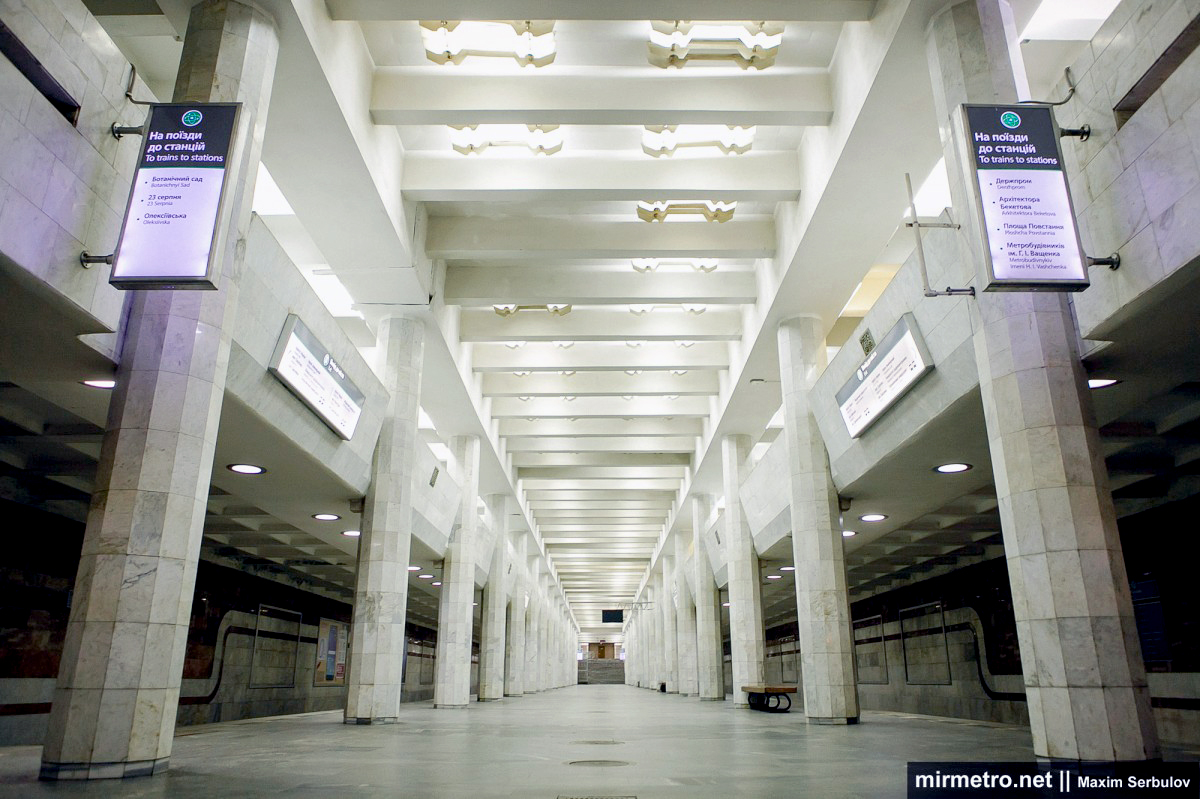
The design first introduced at Universitet station proved successful and was therefore adapted for Naukova. Unfortunately, apart from its two-tier structure, the station’s architecture is rather modest and does little to reflect its scientific theme.
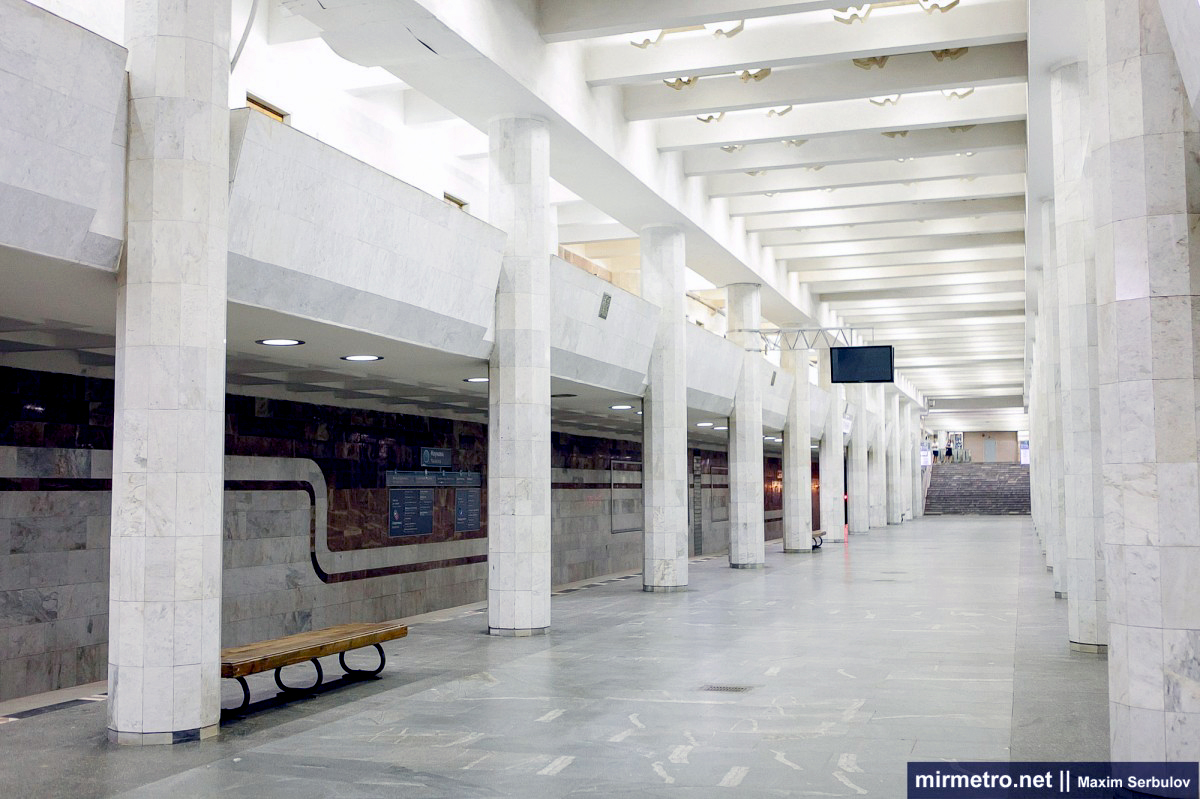
The station has a height of 5.85 metres, compared with 4.1 metres for a standard column station.

Originally, the station was intended to feature a textured ceiling made of aluminium profiles painted in various colours. However, due to funding shortages and the lack of available aluminium, these plans were abandoned, and a simple sectioned concrete ceiling was installed instead.
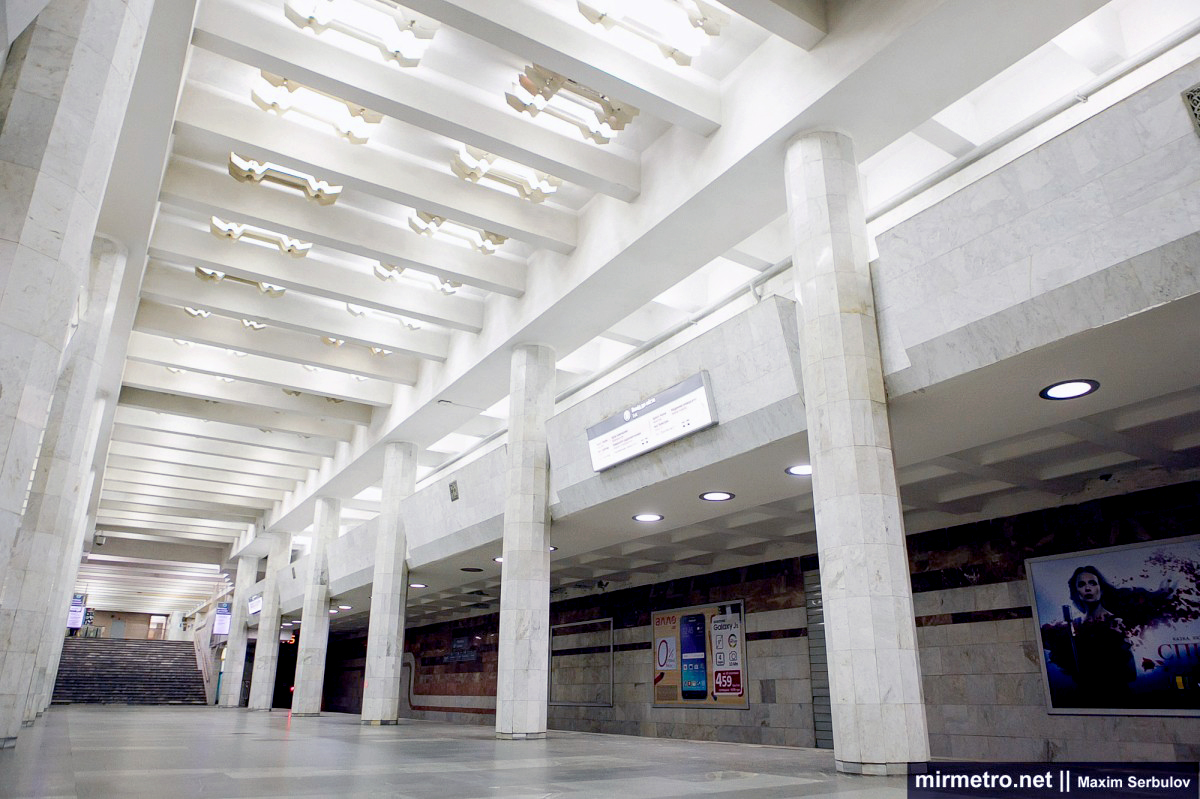
The station’s lighting is provided by elongated luminaires with aluminium louver diffusers, arranged in two continuous rows within recessed ceiling panels above the platform. This layout provides efficient, evenly distributed illumination, allowing the station to remain sufficiently bright even when many of the luminaires are switched off.

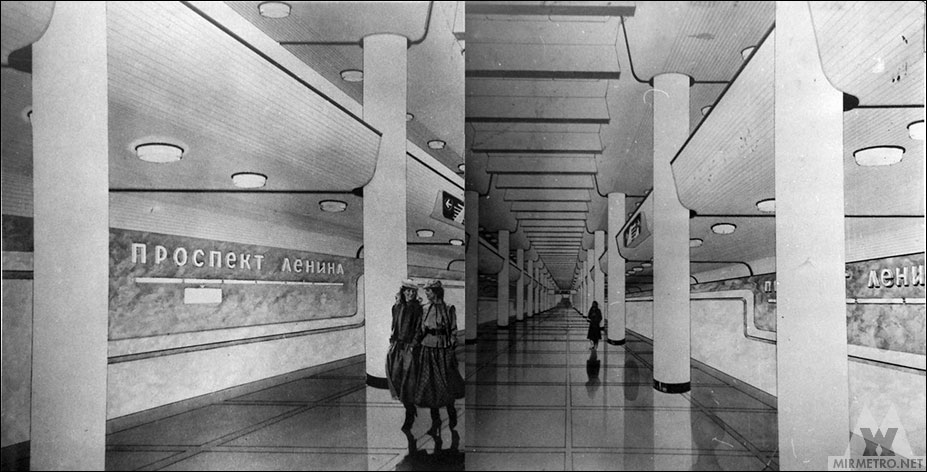
Both balconies at Naukova station are occupied by service rooms and are not accessible to passengers. During the design stage, it was proposed to decorate the balcony walls with cast relief compositions on Soviet themes and quotations from Lenin, in keeping with the station’s original planned name, “Lenin Avenue.” None of these ideas were ever realized, and today the white marble balcony walls are interrupted only by ventilation grilles.
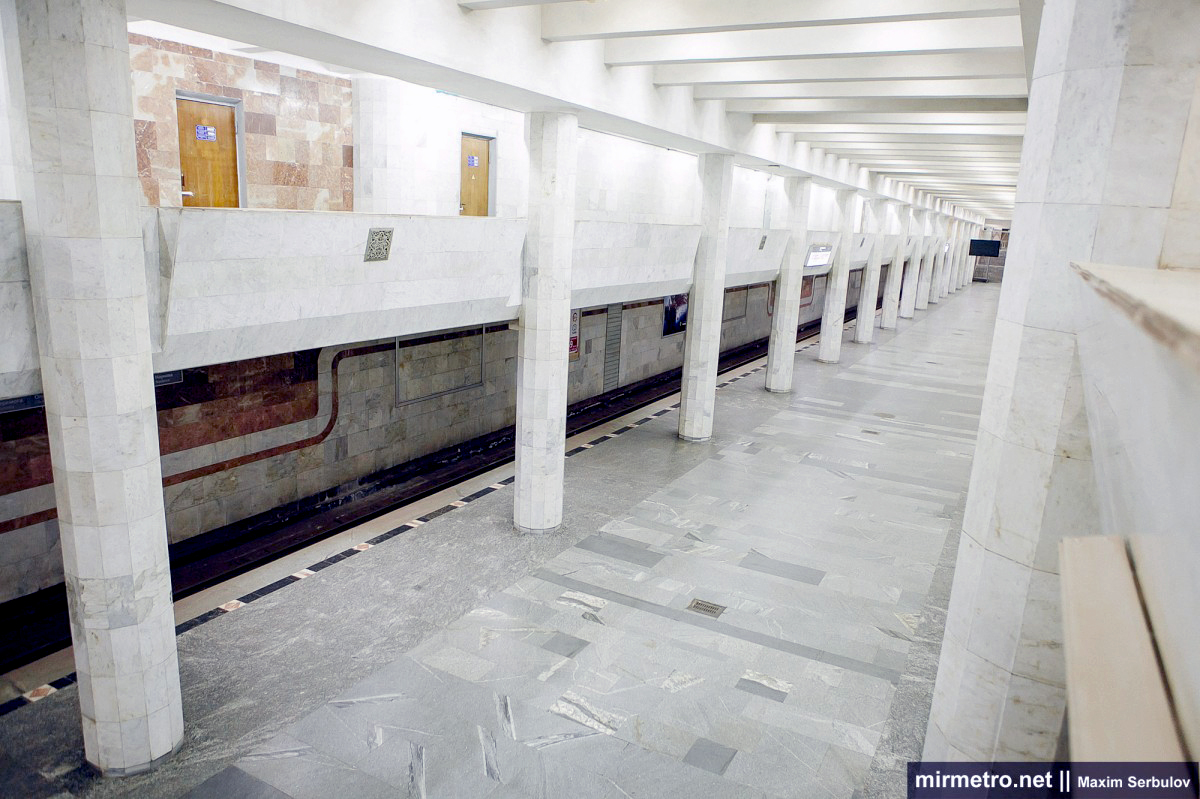
The floor is paved with gray granite. A strip of lighter-colored granite runs along the station’s central axis, visually guiding passengers through the platform.
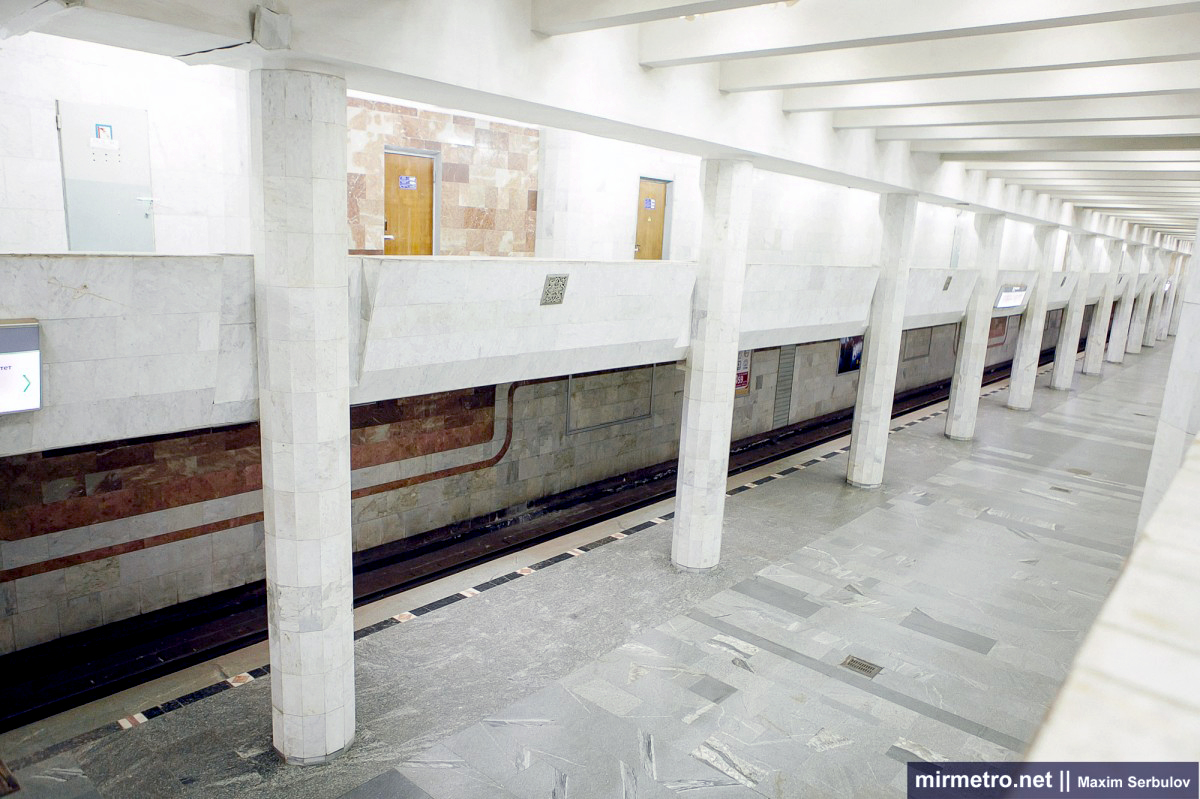
The tall precast concrete columns have twelve sides and are clad in white marble, which is also used throughout most of the station’s interior.
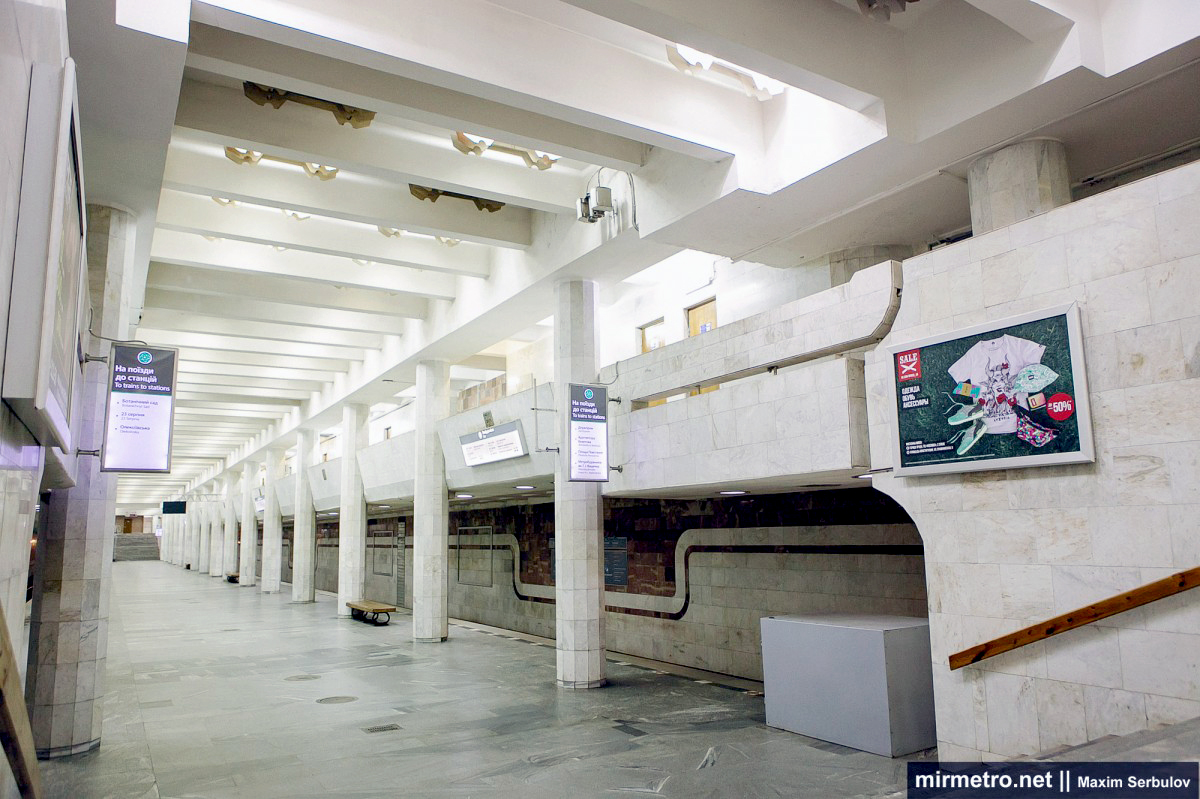
The mezzanines above the tracks feature the square lattice design typical of Kharkiv’s two-level stations. Additional lighting is provided by rows of LED fixtures installed in circular ceiling recesses.
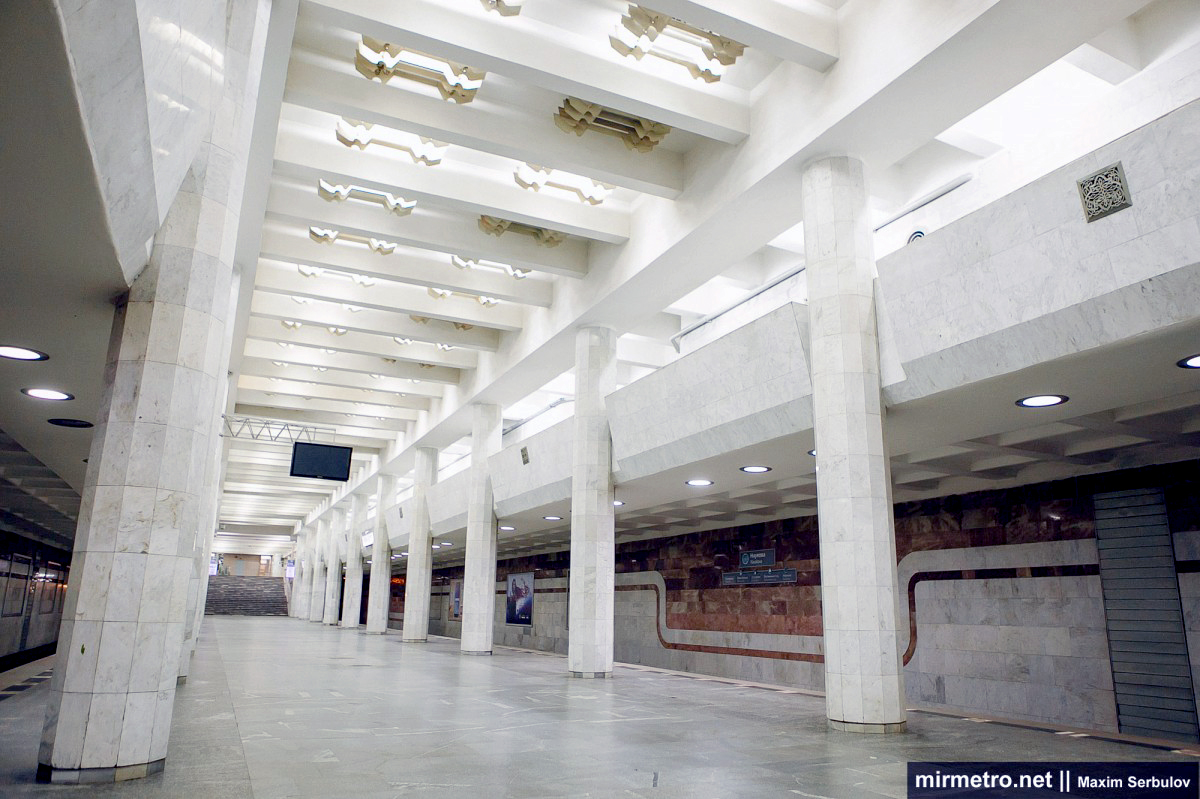
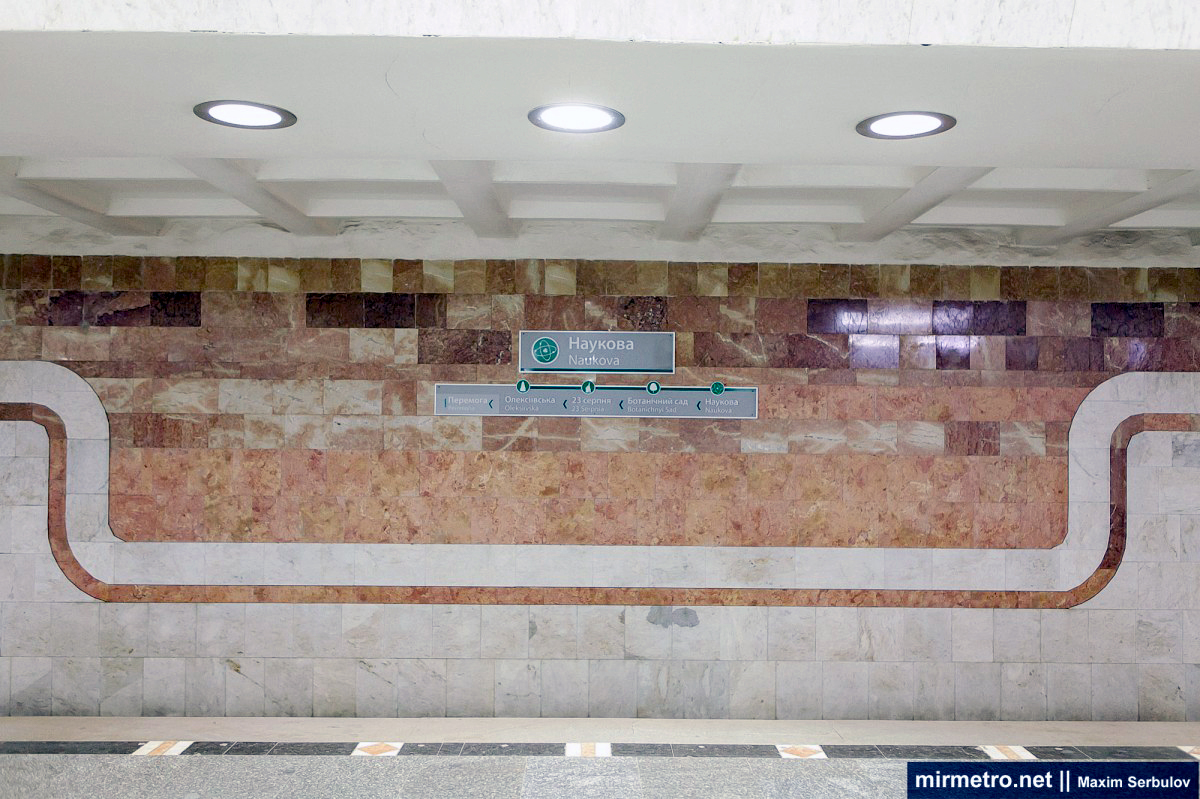
The track walls are faced with white and brown marble.

The original design called for decorative metal reliefs along the track walls, including a sculpture of Lenin and the hammer and sickle emblem. Following the collapse of the Soviet Union, these elements were deemed inappropriate and were abandoned. Unfortunately, they were never replaced with artwork reflecting the station’s scientific theme, despite the wealth of possibilities such a concept could have offered.
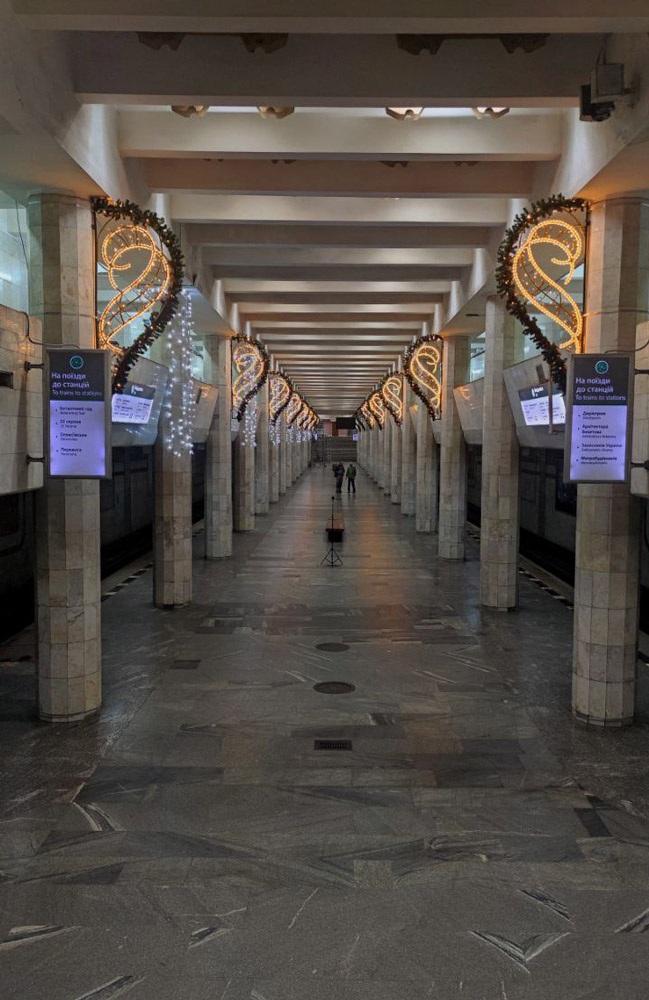
The station in New Year’s decoration.
The appearance of the toponymic name Naukova on the map is highly unusual. The station wasn’t named after a nearby landmark; rather, the metro station became the key factor influencing the avenue’s name.
When the City Council rejected the proposed name “Lenin Avenue” in 1993, the city’s toponymic commission suggested the name “Naukova” (“Science”). The choice reflected the concentration of universities and research institutes in the surrounding area. More than twenty years later, when Lenin Avenue was renamed under Ukraine’s decommunization laws in 2015, no more fitting name than Science Avenue could be found. As a result, the station finally became directly associated with the avenue above it—something that had not been the case when it first opened.
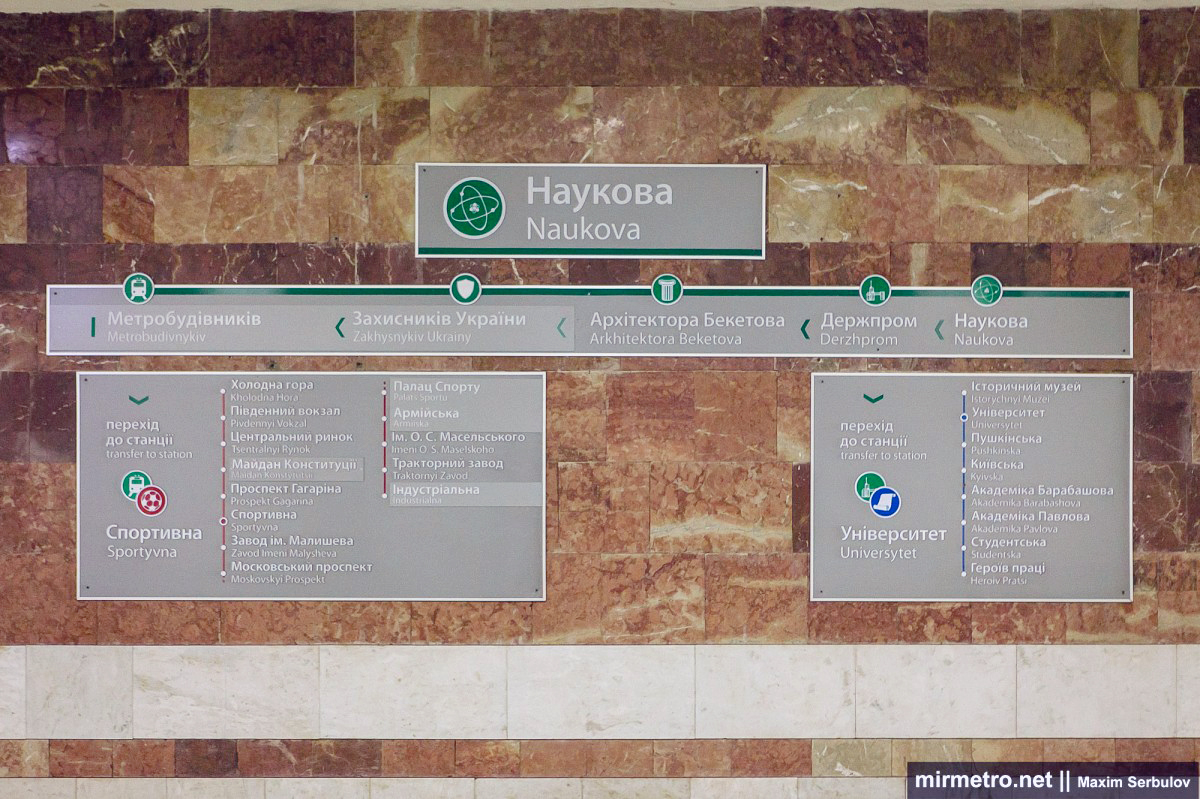
The six-metre-wide stairways are finished in gray granite.
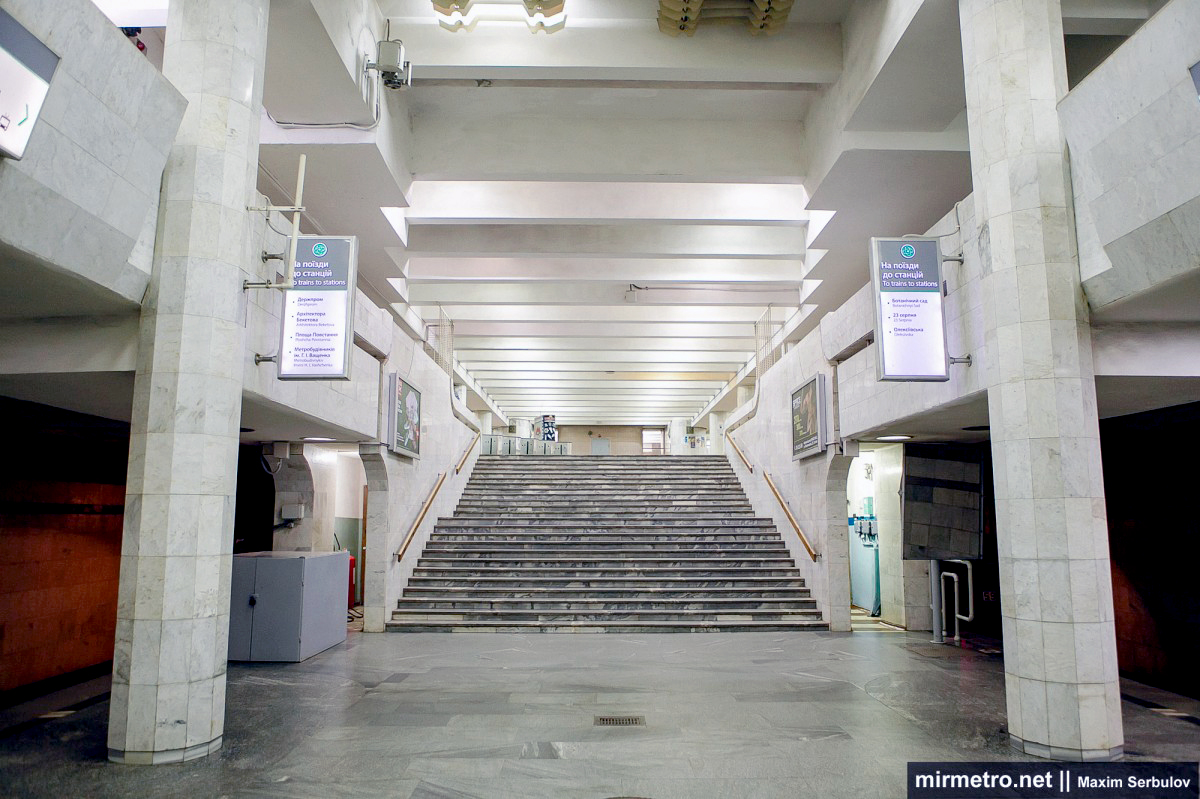
The ceiling curves seamlessly into the station vestibules.
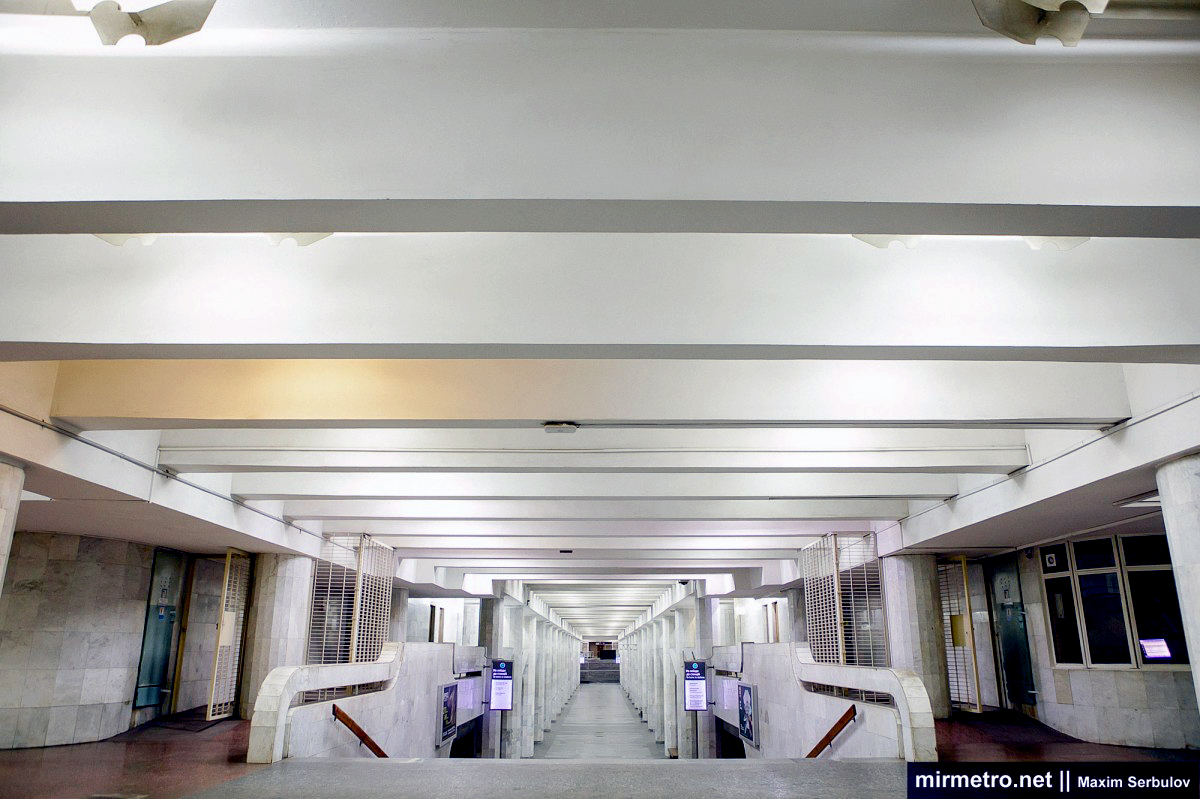
The vestibule follows the same restrained architectural style and is finished predominantly in white tones.
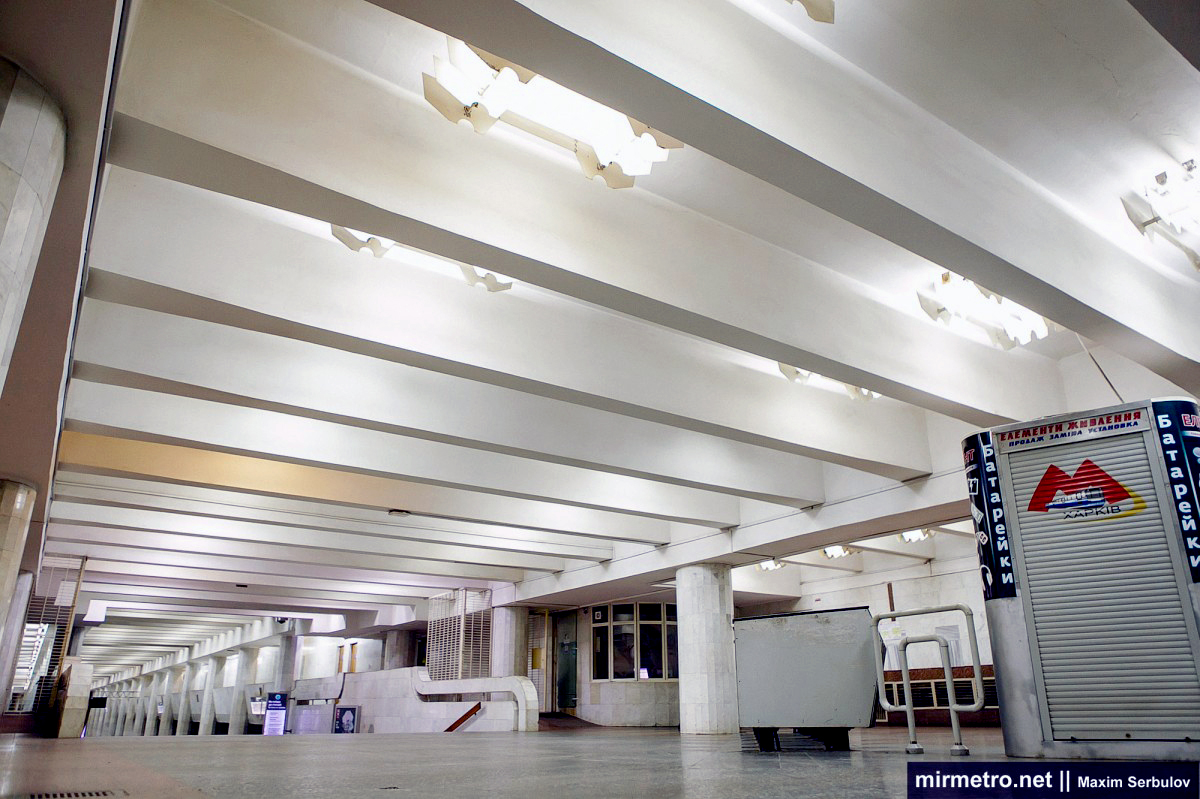
The station in 2002.

The photograph shows the barriers that were installed between 2001 and 2003, when four-car trains ran on the Oleksiivska Line.

The station in 2006.

The photograph shows that ordinary incandescent lamps were previously used for additional lighting above the tracks.
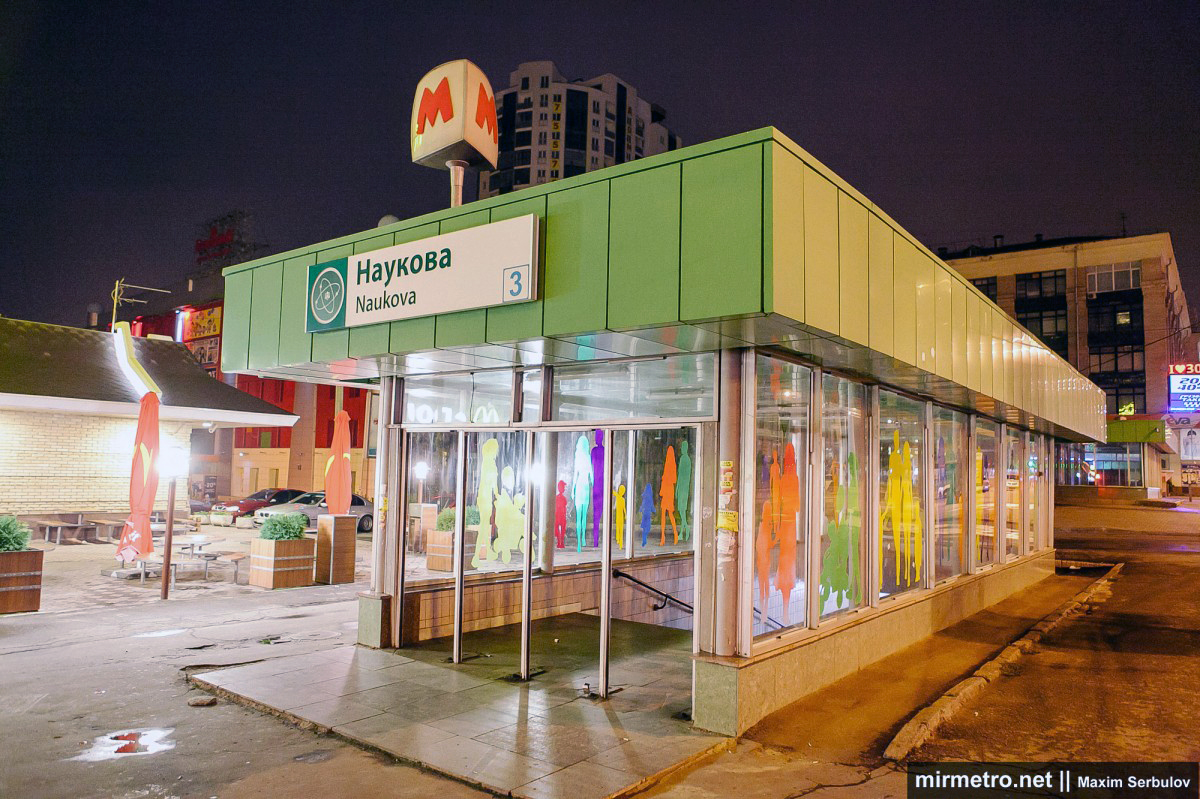
Oddly enough, Naukova station received its most distinctive decoration not inside, but outside. In 2009, decorative architectural elements were added to the station entrances. One of these entrances was damaged during a Russian airstrike in May 2026.
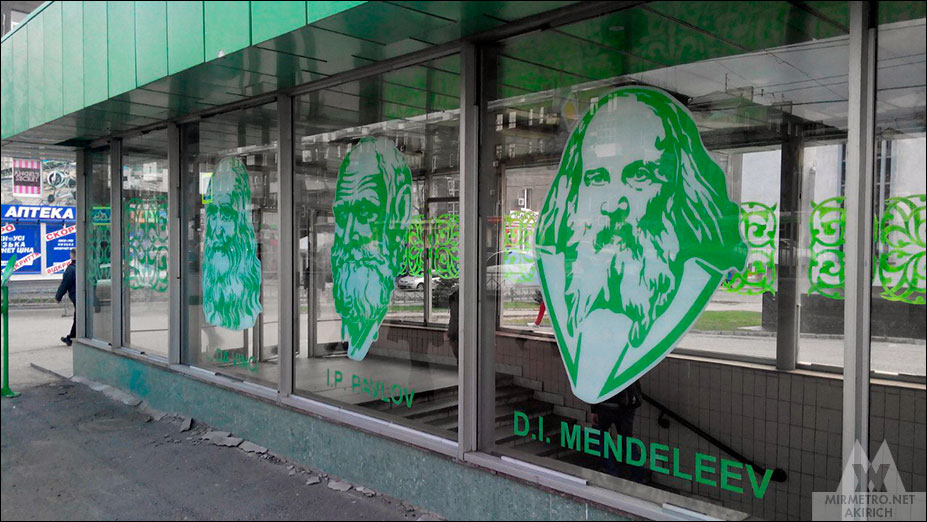
Several entrances were decorated with portraits of renowned scientists who made outstanding contributions to science.
The station welcomes its first passengers.

Construction and projects
Construction of a station on Nauky Avenue, intended to serve the many research institutes and higher education institutions in the area while also functioning as a major transport hub, had been planned from the earliest stages of designing Kharkiv’s third metro line. Once detailed planning began and it became clear that dense development left insufficient space for a standard shallow column station excavation, specialists at the Kharkivmetroproekt Institute quickly found a solution. The design of the first two-level station had proved highly successful, so the concept was adopted once again.
Naukova station was built using the open-cut method. Excavation of the station pit began in the spring of 1986 in the middle of Nauky Avenue. Temporary bypass roads were constructed to maintain traffic, although they were narrow and poorly suited for heavy vehicles. The station itself was assembled from standardized precast reinforced concrete elements manufactured at the Kharkiv Reinforced Concrete Plant. These large structural elements were delivered to the site and lowered into the excavation using a heavy-duty crane.
The geological conditions proved to be a pleasant surprise for the metro builders. Unlike the rest of the first section of the Oleksiivska Line, the ground here consisted mainly of dry sands and clays, eliminating the need for the extensive and expensive dewatering operations that had plagued construction elsewhere. As a result, construction of Naukova station was considerably easier and progressed much faster than at the neighboring stations. One unexpected problem did arise, however. During excavation, workers uncovered a large illegal dumping site, forcing them to spend additional time loading and removing thousands of cubic metres of waste by dump truck.
Construction of the station required driving 172 foundation piles, many of them close to the buildings of the Kharkiv National University of Radio Electronics and the Giprostal Design Institute. This lengthy operation generated significant noise and ground vibration, creating a risk of cracked plaster and damage to sensitive equipment inside the neighboring buildings. To minimize these effects, special boreholes were drilled first, allowing the piles to be installed in a way that greatly reduced vibration from the pile-driving equipment.
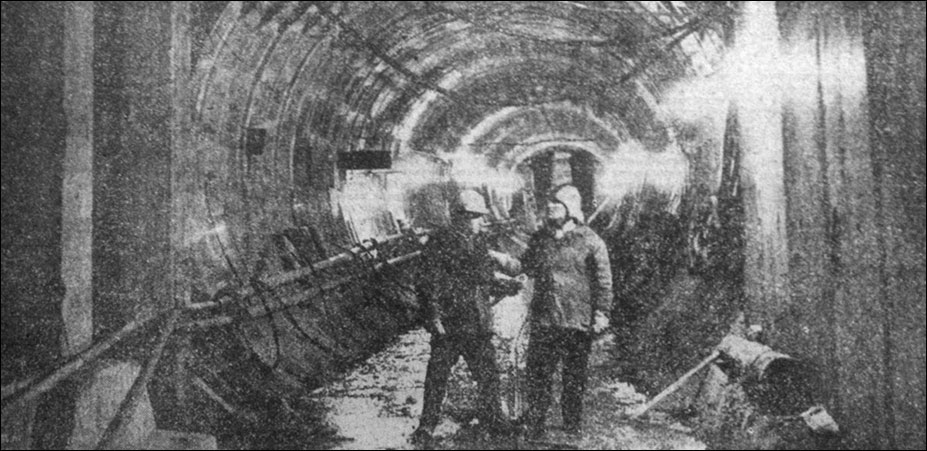
The running tunnels toward Derzhprom station were excavated using a mechanized tunnel boring machine (TBM) with the lining pressed directly into the surrounding ground. This was a new experimental machine, and site engineers independently modified several of its components to improve performance. As a result, excavation progressed remarkably quickly, reaching rates of up to 140 metres per month.
Naukova station was always intended to serve only as a temporary terminus—the official plans promised that the line would be extended within a year of its opening. For this reason, full turnaround sidings were never constructed, as they would have required considerable additional time and resources. Instead, a scissors crossover was built immediately beyond the platforms. By the time the station opened, part of the tunnels toward Botanichnyi Sad had already been completed, providing enough space for two trains to remain overnight.
The favourable geological conditions contributed to rapid progress. By 1989, the station structures, main ventilation chamber, and combined traction and step-down substation were almost complete. When Ukraine declared independence in August 1991, Naukova station was already the most complete station on the first section, with an estimated readiness of around 95 percent. Surface entrances were under construction, while the columns, balconies, and track walls had already been clad. During the final stage before opening, work consisted mainly of finishing operations: whitewashing the ceilings, laying the permanent track and power cables, and landscaping the surrounding area.
Running tunnel toward Derzhprom station before the breakthrough.
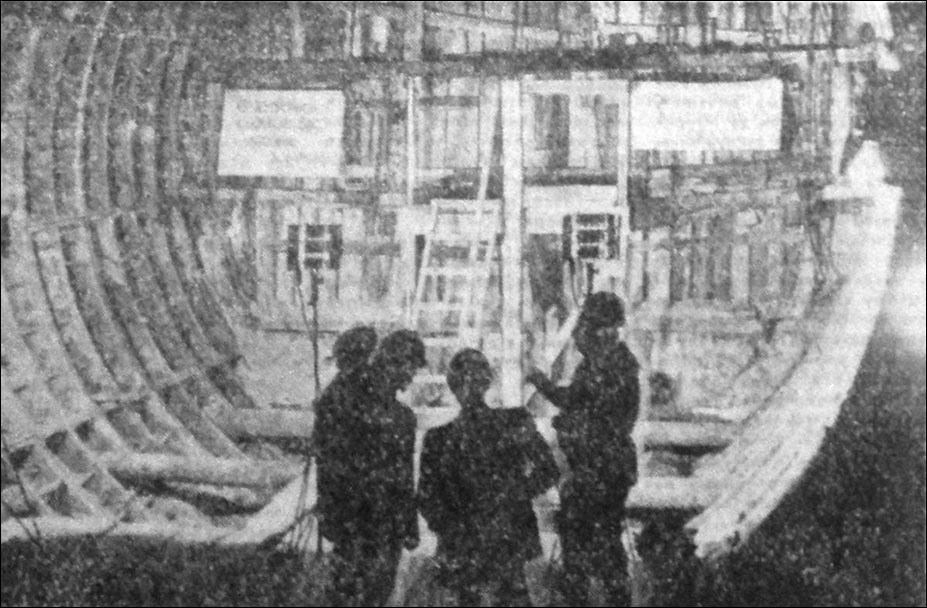
Completed section of the running tunnel toward Derzhprom station.
Excavation pit of Naukova station. May 1987.
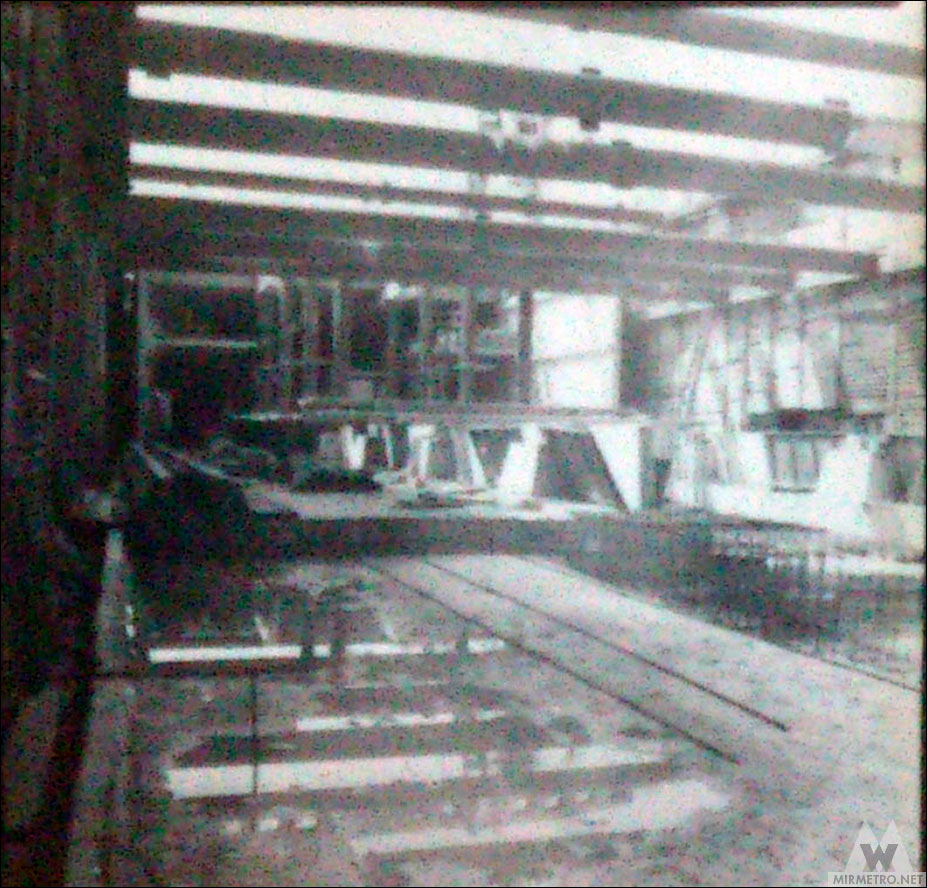
Site of the future station vestibule and combined traction substation.

Construction site of Naukova station. Summer 1993.

The station is almost complete and ready to welcome its first passengers. July 1994.

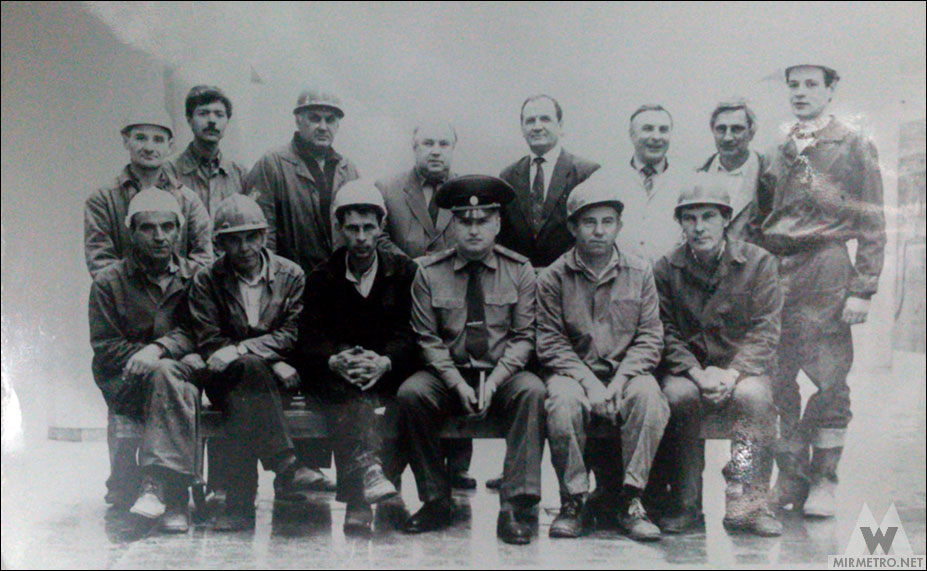
A team of metro builders who constructed Naukova station.
Naukova station a few months before opening.

Metro workers, city officials, and journalists during the launch of the first test train. April 27, 1995.

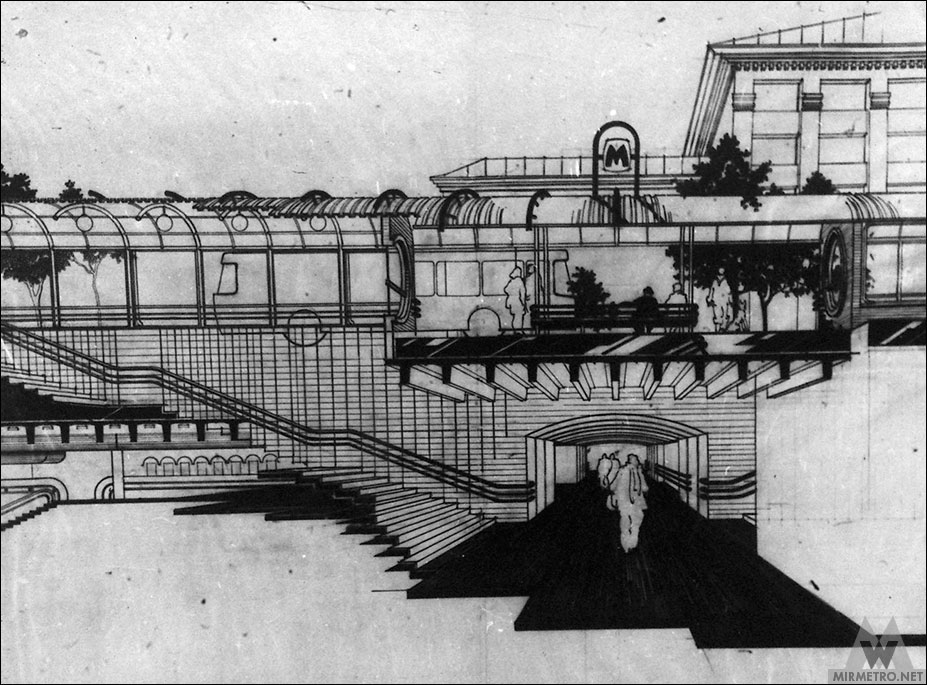
Concept design (Option 1).
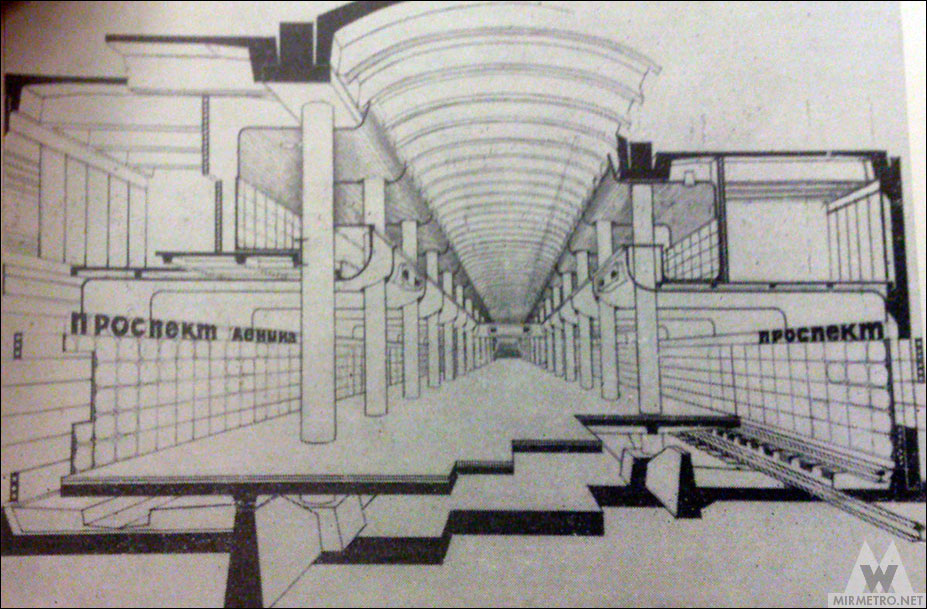
Concept design (Option 2).

Concept design (Option 3).
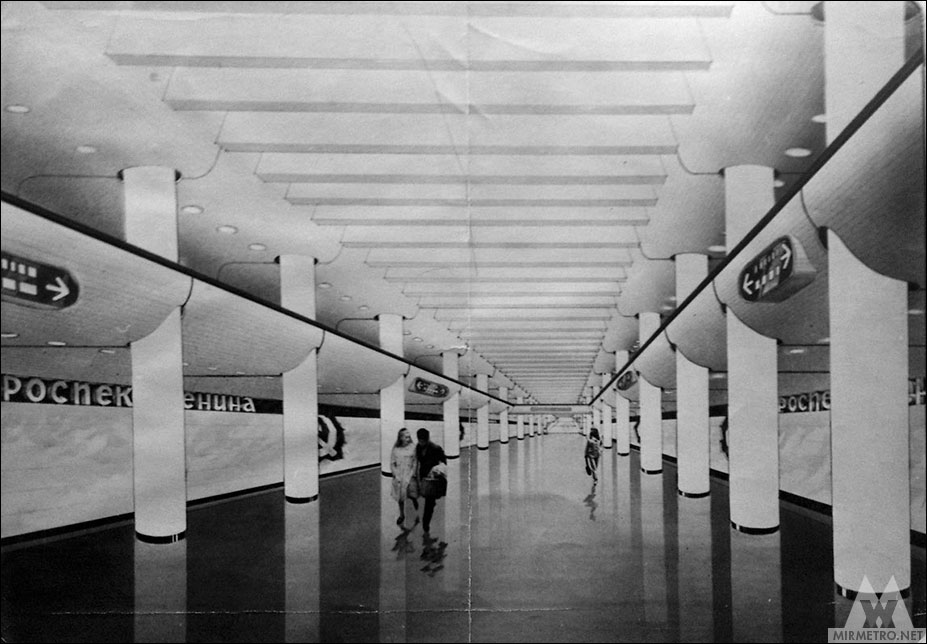
The implemented concept design.
Naukova station project (underground layout and pedestrian underpasses), including the unrealized exit toward the Kharkiv National University of Radio Electronics.

Naukova station project (longitudinal section).

Layout of station exits and connections to surface public transport.