
Peremoha
Opening date: 25 August 2016
Architects: P. Chechelnytskyi, S. Chechelnytskyi, H. Karpenko
Engineers: R. Denisyuk, L. Koba, D. Kokoshko
Artists: I. Morgunov, O. Erofeeva, A. Morgunova
Station type: Shallow three-span column station
English equivalent: Victory station
Average daily ridership: 28,000 passengers (2017)
The station opened on 25 August 2016 as the sole station of the fourth launch section of the Kharkiv Metro’s Oleksiivska Line, extending the route from Oleksiivska to Peremoha. With its opening, the Oleksiivska Line finally reached the northern edge of the Oleksiivka residential district and the Kharkiv Ring Road.
Peremoha station is the northern terminal stop on the Oleksiivska Line. Beyond the station, there are reversing sidings used for turning trains back. A maintenance facility is located on one of the stub tracks. After the station opened, construction of tunnels to the north began in the direction of the future Oleksiivske electric depot, but this has currently been suspended.
Description
Peremoha station was built to a custom design as a shallow two-level column station. It became the third and final two-level station in the Kharkiv Metro. Sadly, it is also likely to remain the last metro station opened in both Kharkiv and Ukraine for many years to come.

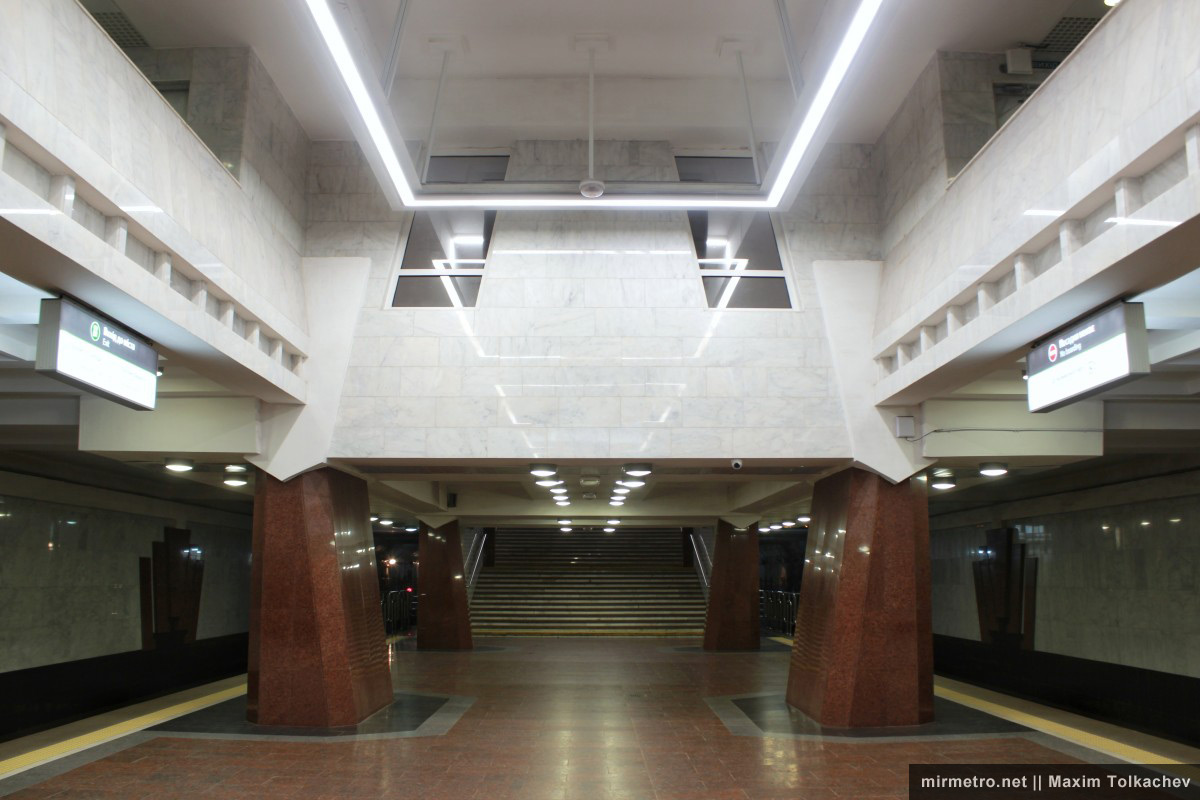
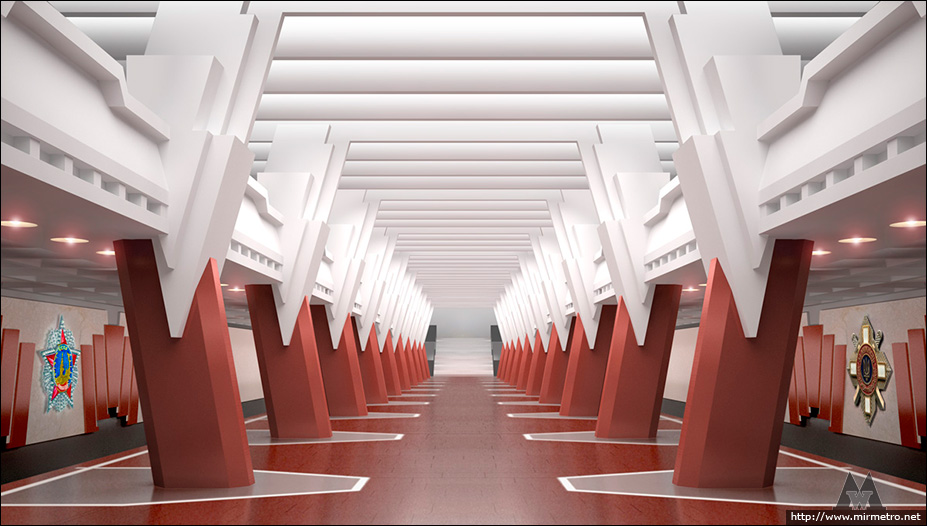
The station’s architectural concept is dedicated to the theme of victory. Its design was intended to convey the solemn atmosphere associated with Victory Day. The interior is dominated by white and reddish-brown tones.
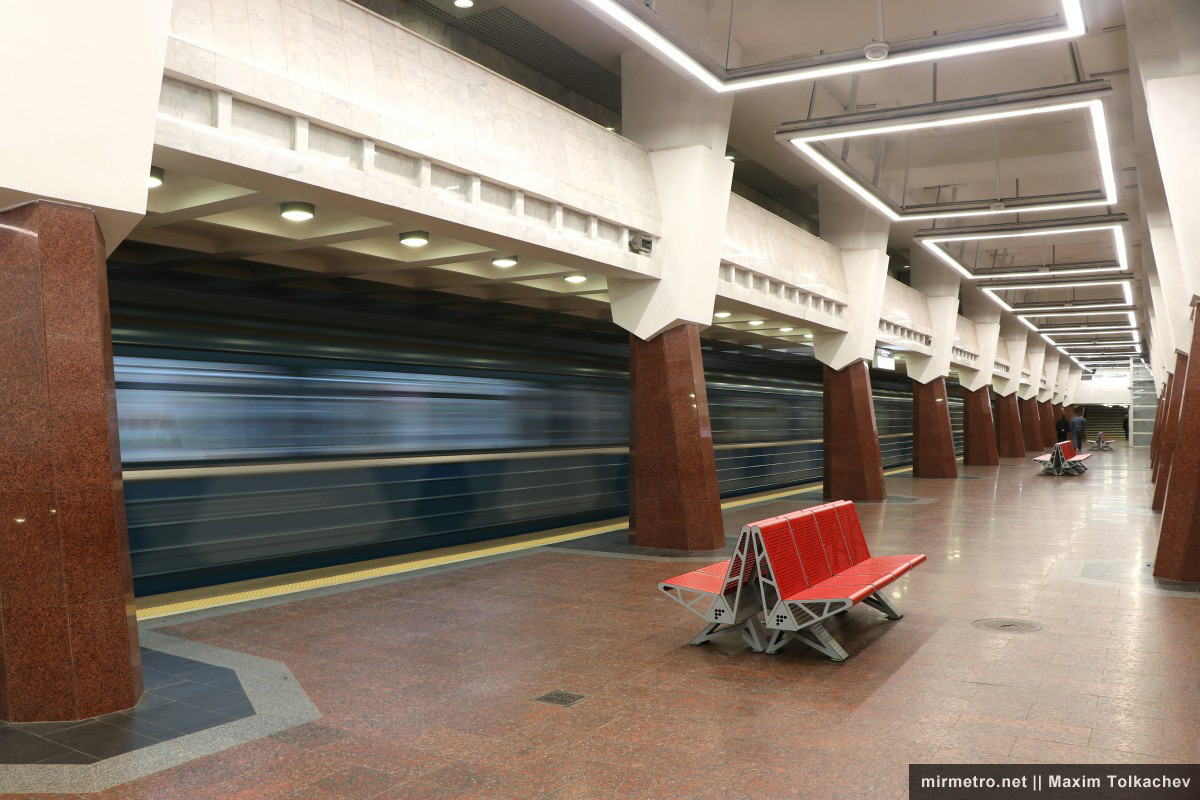
Unfortunately, financial constraints and other difficulties encountered during construction led to a number of design revisions that significantly simplified the station’s appearance and made it far more austere than originally intended.
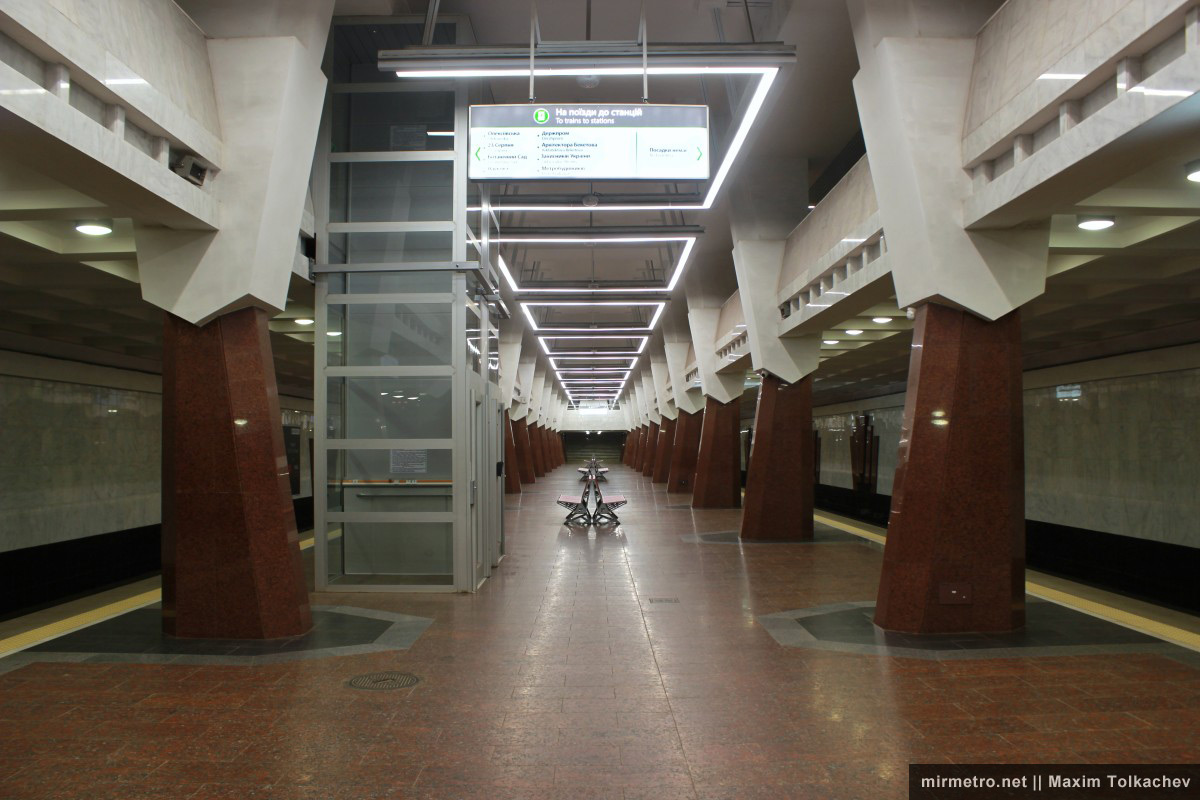
During construction, for example, the original lighting fixtures made of metal light-diffusing panels were abandoned. Instead, the station was fitted with rectangular LED panels simply suspended from the ceiling on metal hangers. Although functional, this solution looks rather crude and was evidently adopted as a cost-saving measure.
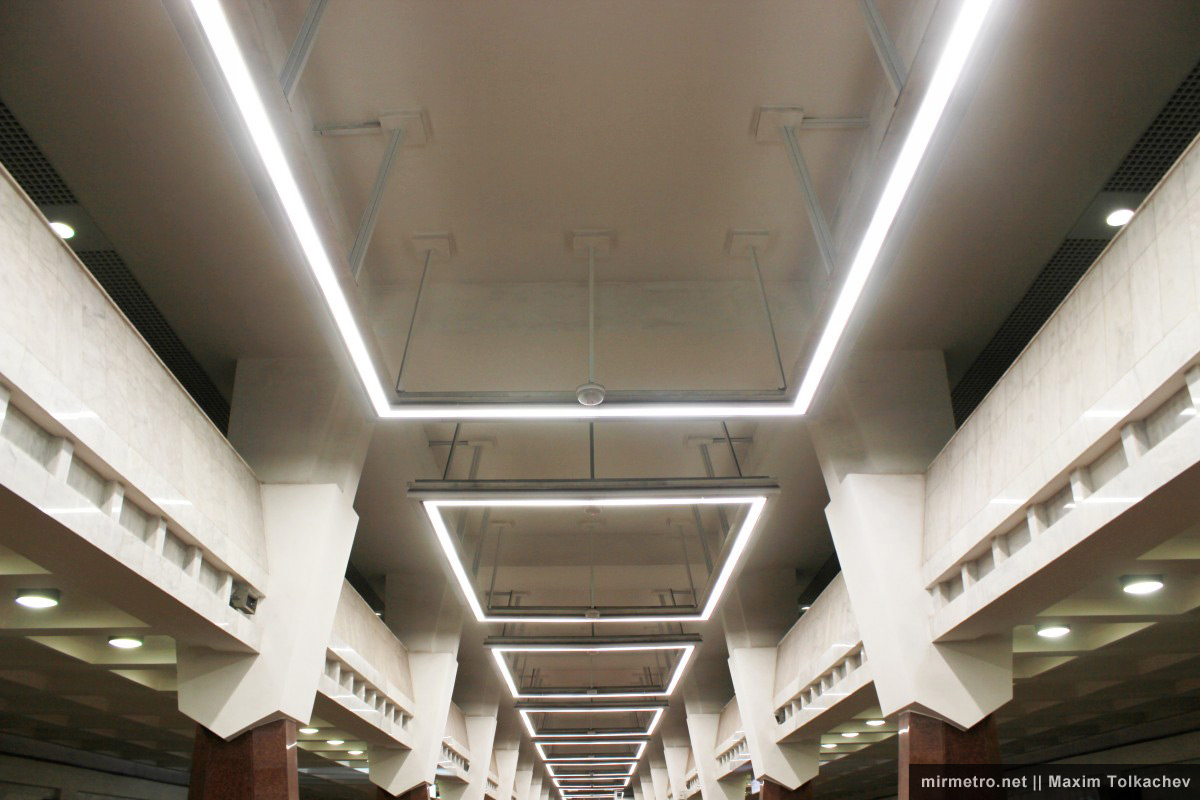
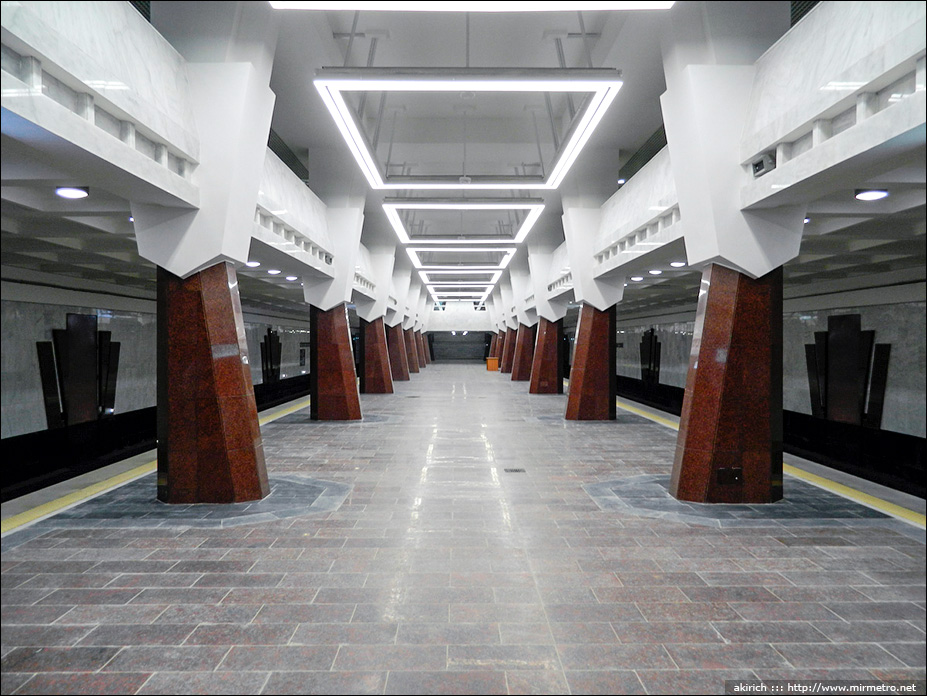
One of the station’s most distinctive features is the sculptural form of the balcony structures and the unusual shape of the columns, which appear to lean outward toward the track walls while supporting the balconies. Together, these elements create a dynamic composition that complements the station’s overall architectural design.
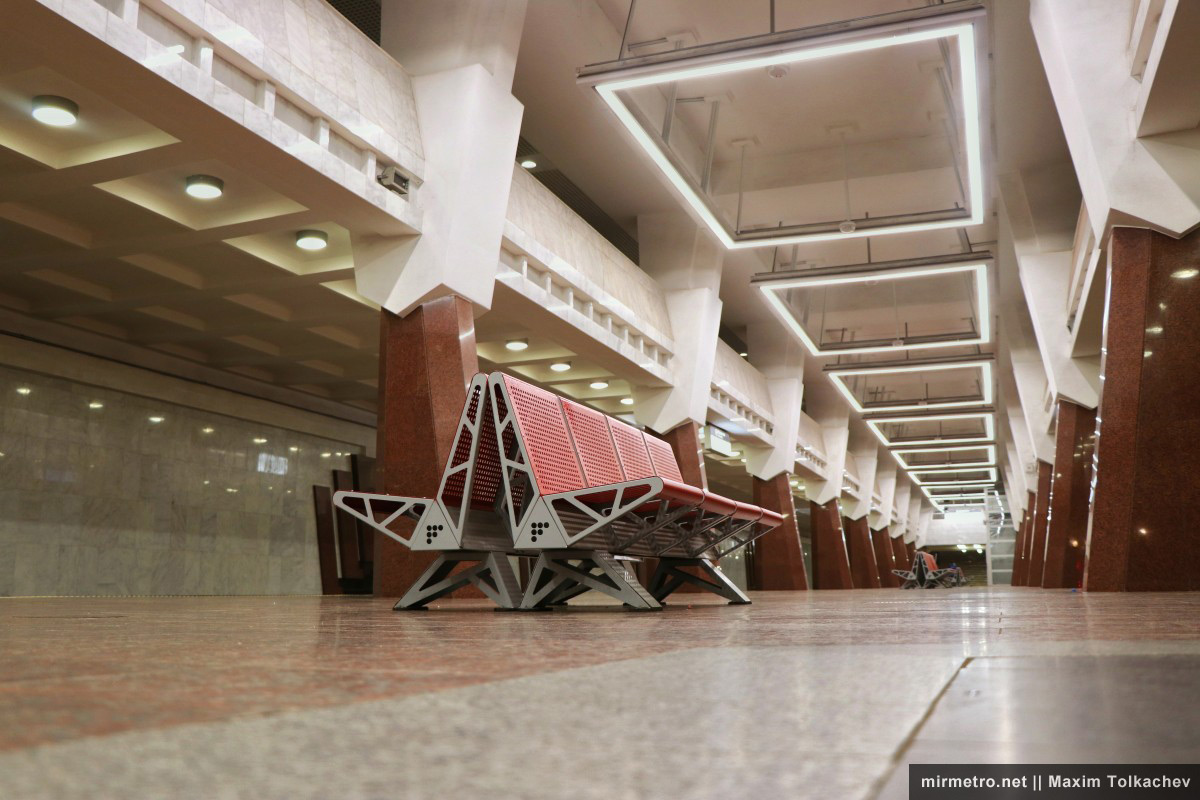
One balcony contains service rooms, while the other serves as a pedestrian underpass beneath Peremohy Avenue. This passage is completely separated from the station and cannot be accessed from the platform.
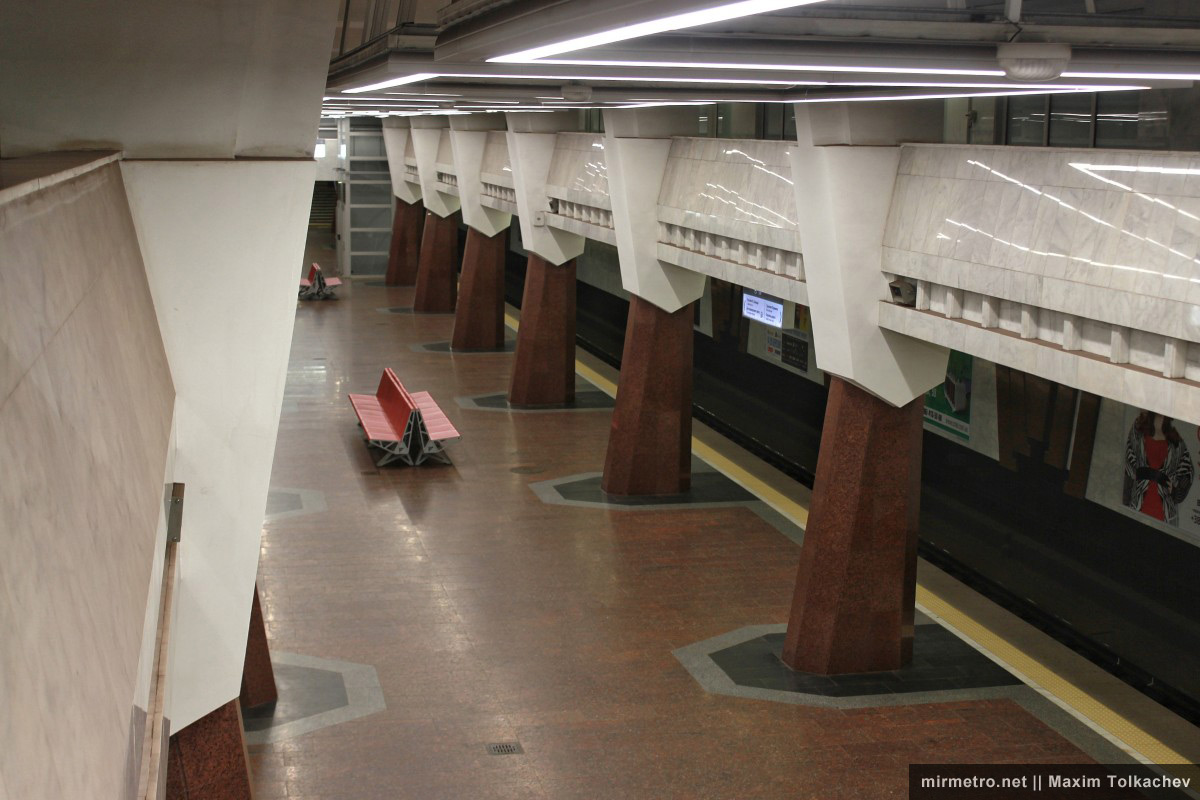
The columns are stylized as ceremonial torches and have a tapered, inclined appearance. Structurally, however, they consist of vertical cast-iron pipes 40 cm in diameter, enclosed within a reinforced-concrete frame, as inclined load-bearing columns are not permitted under building regulations. The spacing between the columns was increased from 6 to 7.6 metres, reducing the total number required. At both ends of the platform, the outer columns are paired, as this is where the station’s expansion joints are located.

Another distinctive feature is the arrangement of the pedestrian underpasses. Unlike at previous stations, they are aligned with the ends of the platform and positioned directly above the stairways leading between the vestibules and the platform.
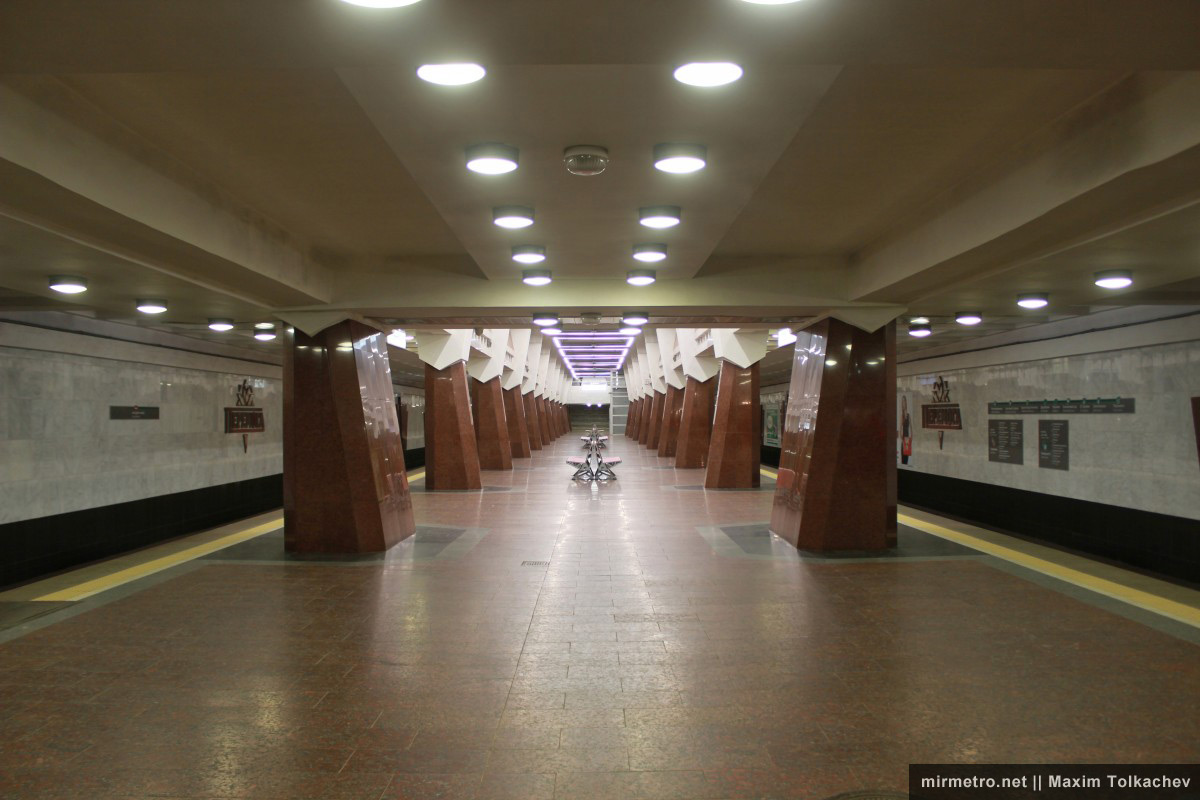
According to the original design, the columns and the relief elements of the track walls were to be clad in crimson marble imported from China. However, when the time came to purchase the material, funding was no longer available, and it was replaced with brown granite from Ukrainian quarries. This significantly altered the station’s appearance, as the red color was intended to be one of the key elements expressing the theme of victory.
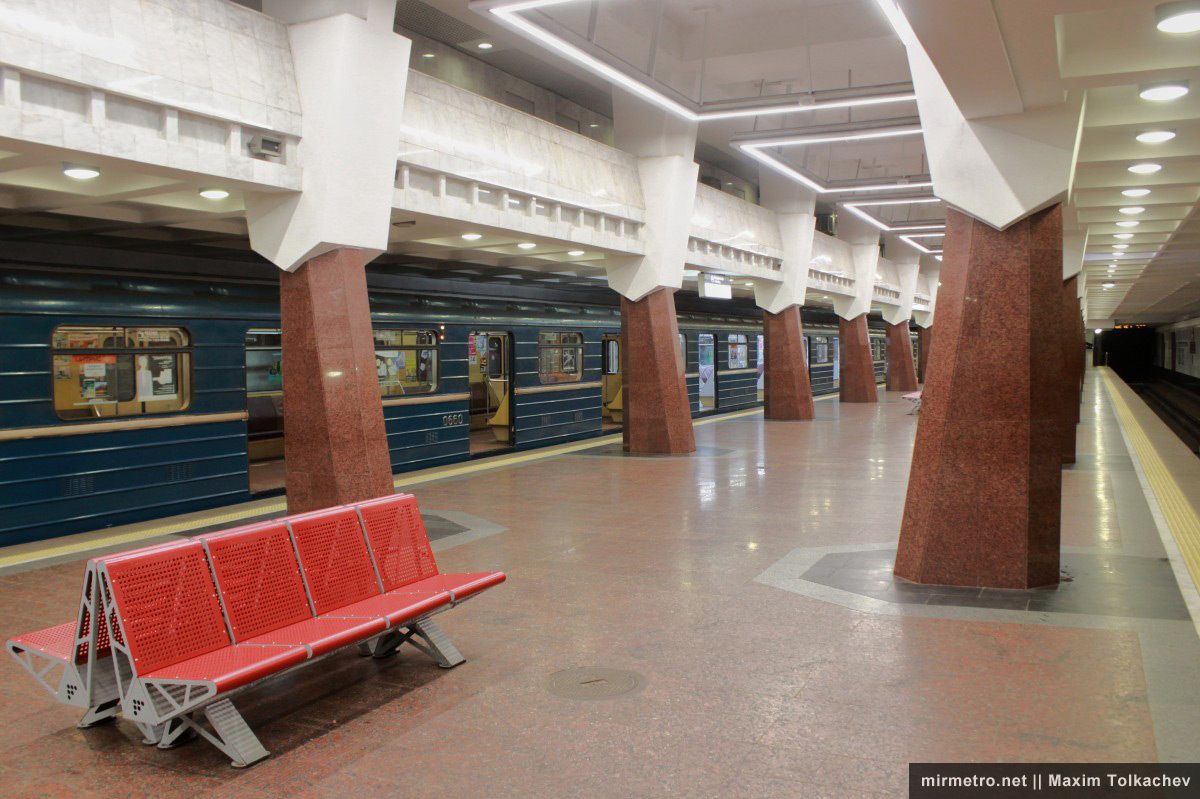
The track walls are faced with smoothly polished white marble, while the plinth is clad in black granite.

The projecting relief elements of the track walls symbolically represent an explosion or a burst of light, reinforcing the station’s overall compositional concept.
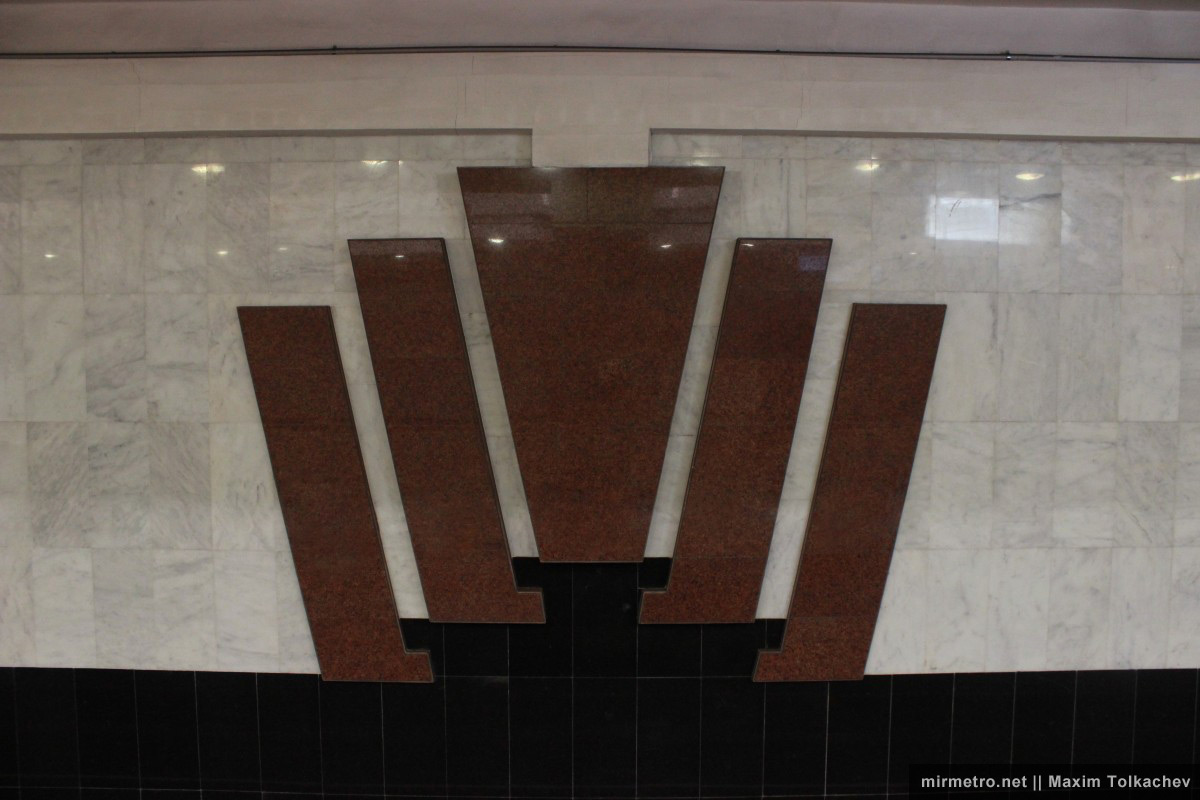
The original design called for the track walls to be decorated with reliefs depicting World War II decorations framed by ornamental motifs. However, after Ukraine adopted the decommunization legislation in 2015, these elements were abandoned. When it became clear that this concept could no longer be implemented, another proposal suggested decorating the walls with works by prominent Kharkiv artists, but that idea also remained unrealized.
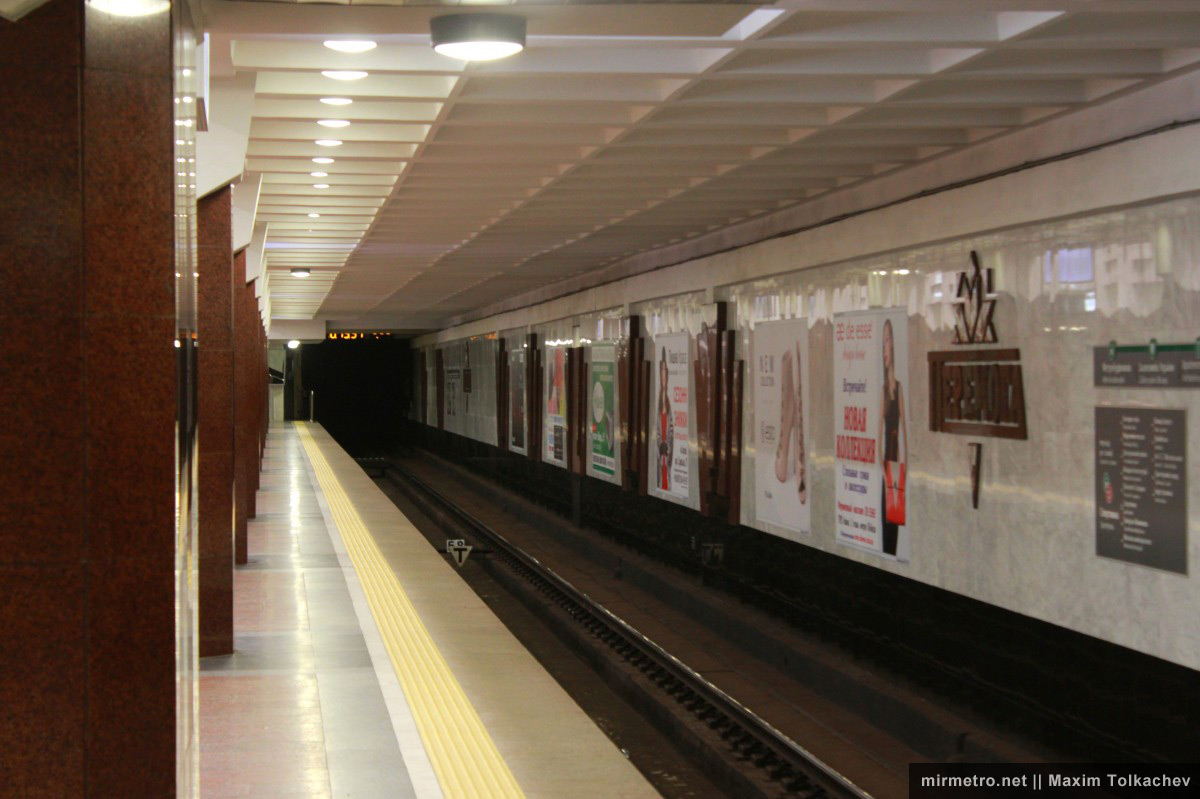
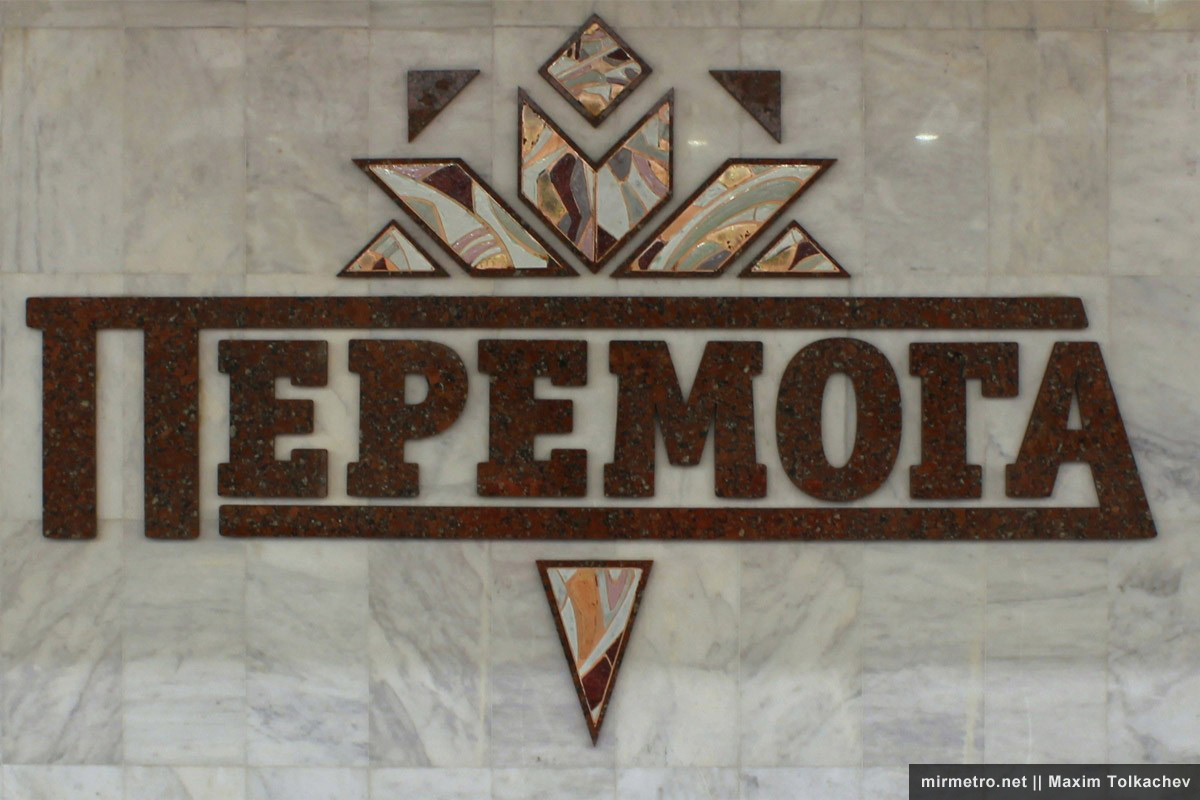
The station’s name is formed from large three-dimensional granite letters, complemented by relief elements with enamel inserts. Together, these details are intended to evoke both the Victory Torch and a bouquet of flowers.
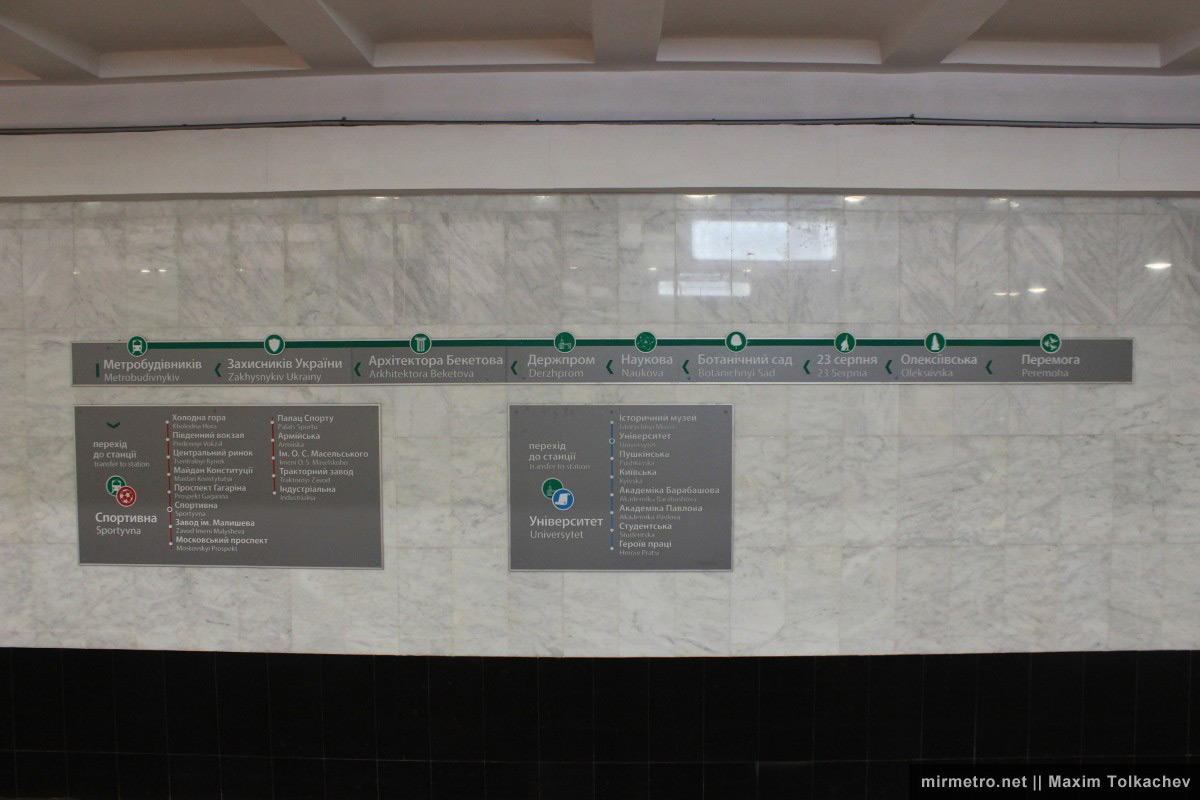
Because of the unusually large station name, the directional signs had to be moved to the side. As a result, this became the first station in the Kharkiv Metro where the traditional arrangement of placing the arrows directly beneath the station name was abandoned.
The mezzanines above the tracks feature the square lattice structure characteristic of all Kharkiv Metro stations with balcony galleries. Additional lighting is provided by LED fixtures recessed into circular ceiling niches.
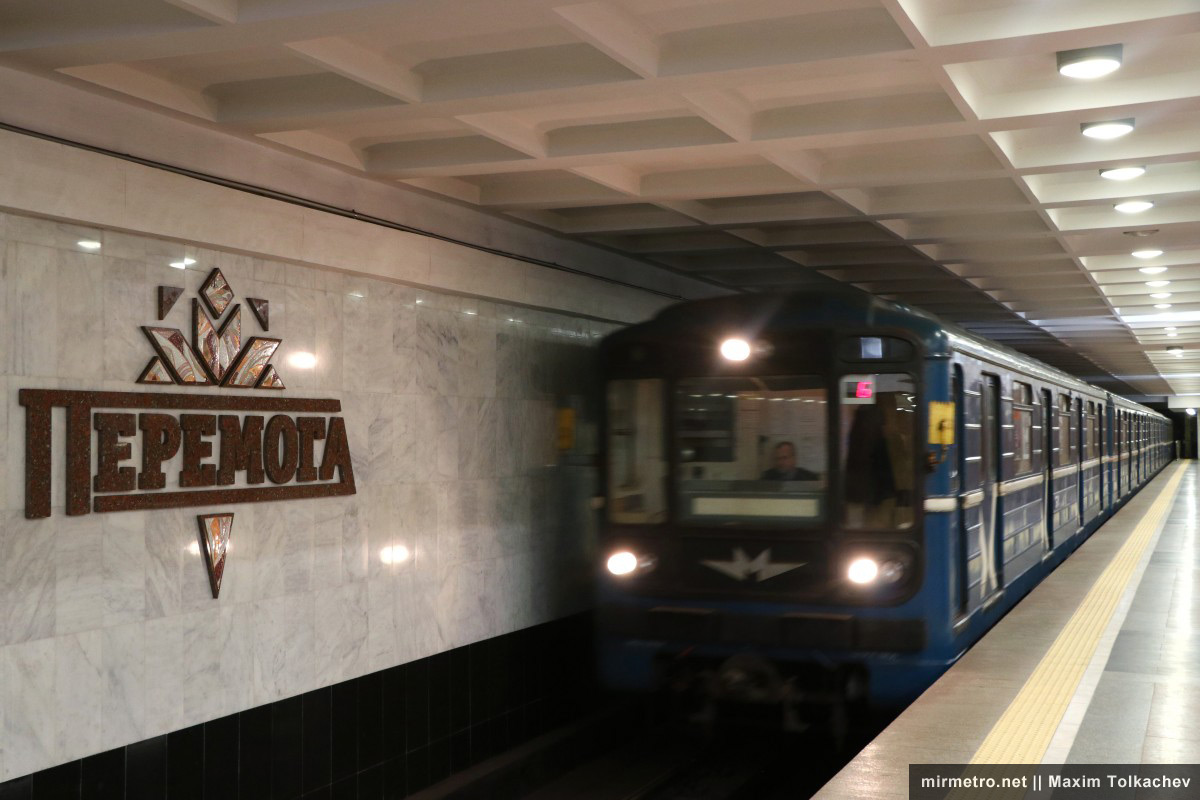
Tunnel portal and interval clock.

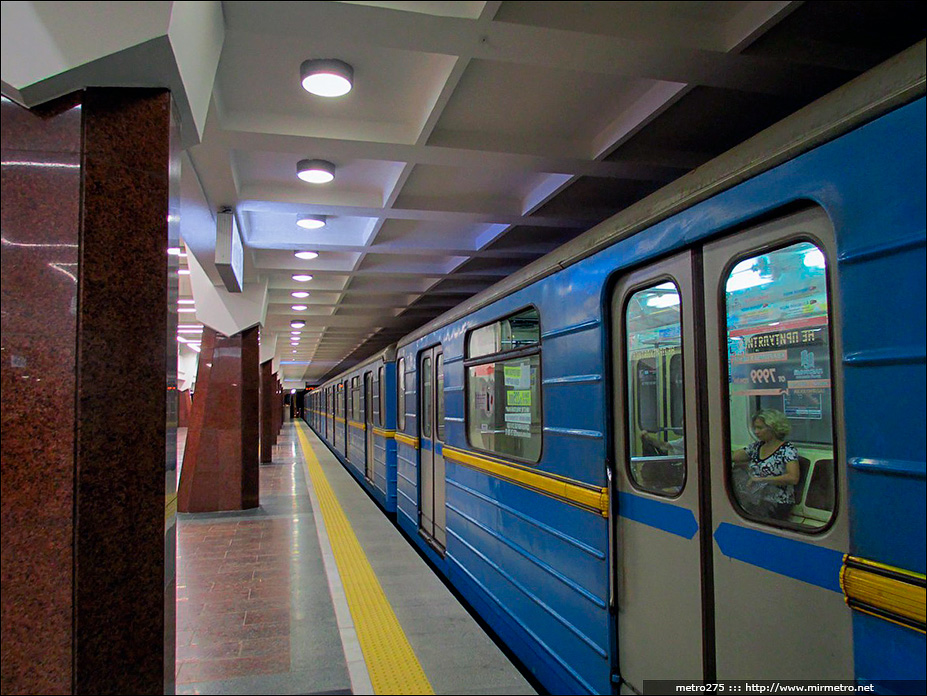
The floor is paved with brown granite, while the areas surrounding the columns are finished with grey and black granite.

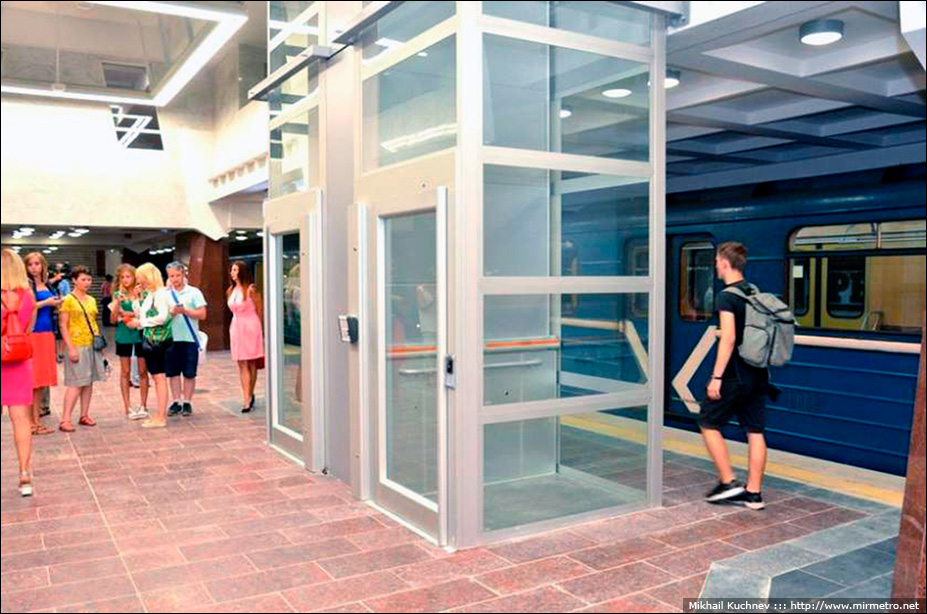
Peremoha became the first station in the Kharkiv Metro to be equipped with elevators providing step-free access between the platform and the surface. Two parallel elevator cabins operate within a single shaft. An intercom beside each elevator allows passengers to contact the station attendant, who then dispatches a metro employee to assist wheelchair users. In practice, however, the elevators are of limited usefulness, as none of the older stations on the network are equipped with similar facilities. Their installation was therefore more a reflection of modern construction standards than a fully accessible metro system.

A tactile warning strip is installed along the platform edge.
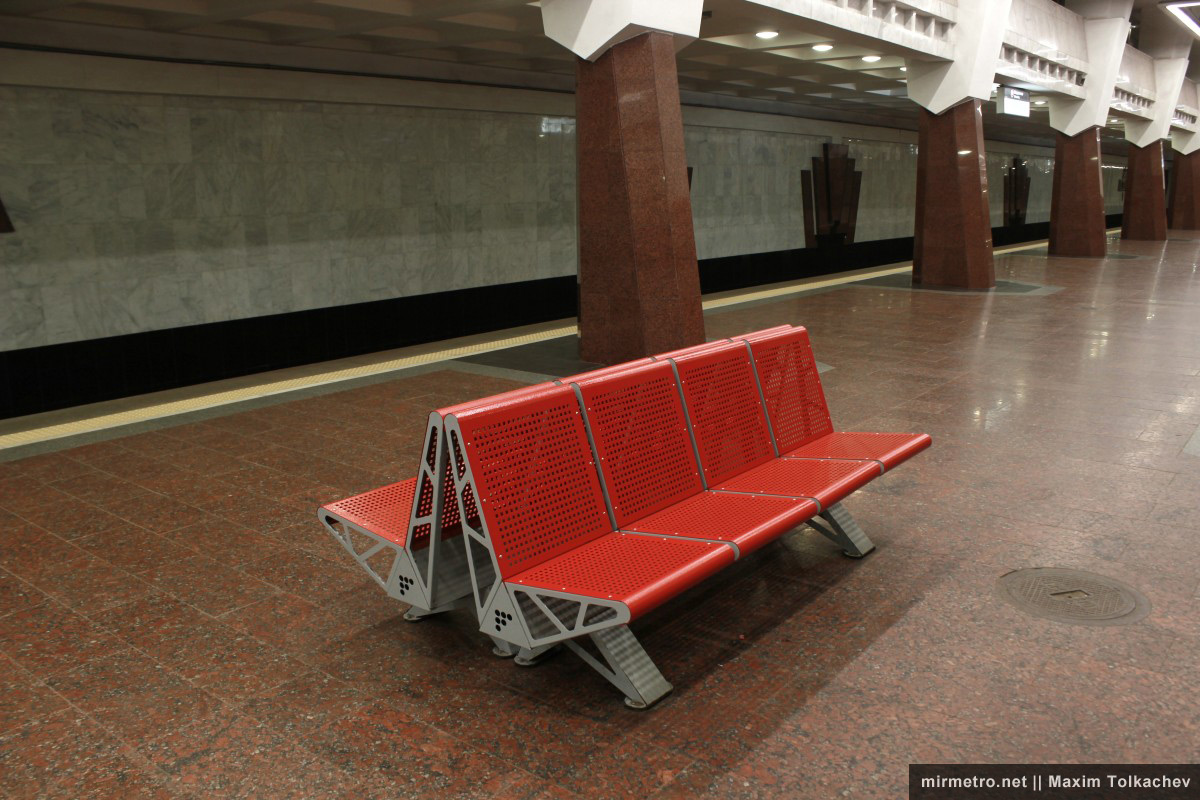
Red-painted aluminium benches are installed along the central axis of the platform.
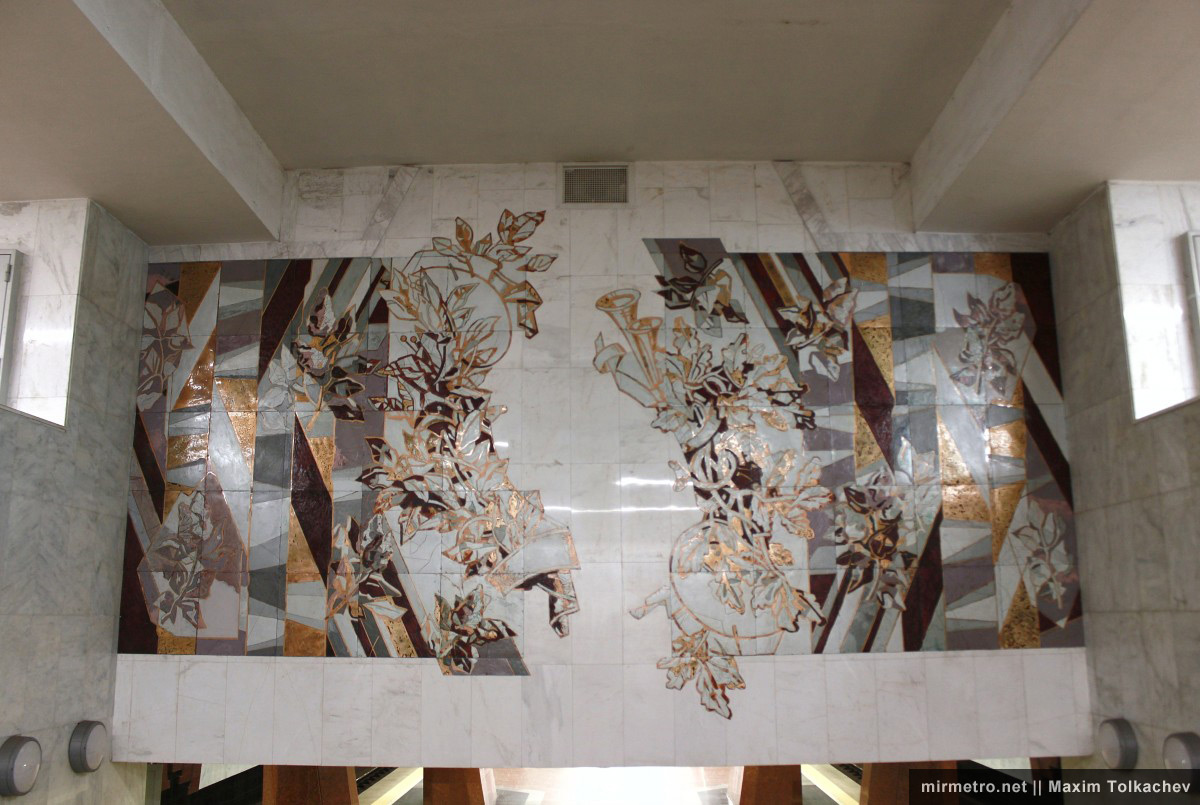
Large artistic compositions created using the enamel-on-copper technique are suspended above the stairways. Besides serving as the station’s main decorative feature, they visually enlarge the space and enhance the atmosphere of celebration and solemnity. Their creation took five years. In the hot-enamel technique, enamel paints are applied to copper plates, which are then fired in a kiln at approximately 860 °C. Transparent enamels are painted directly onto the prepared copper surface, allowing its golden glow to remain visible beneath the colours. Depending on the firing cycle, the same pigment may produce different shades, levels of saturation, and degrees of transparency. Because fire always introduces an element of unpredictability, every composition is unique—even its creators could never reproduce it exactly.

The compositions are intended to evoke the joy of victory and the end of the war. They depict wreaths of oak and laurel leaves together with bouquets of flowers seemingly floating through the air, recalling those thrown to the victorious soldiers returning home. When the proposal was presented to the city planning council, it received widespread approval because it deliberately avoided direct military imagery such as soldiers, tanks, or aircraft. Large medals were originally intended to occupy the centre of each composition, but, for the reasons mentioned above, this idea was abandoned.
Thanks to the station’s design, it can be viewed from the pedestrian underpass through large windows. Unfortunately, the suspended ceiling lights interfere somewhat with the overall visual impression.
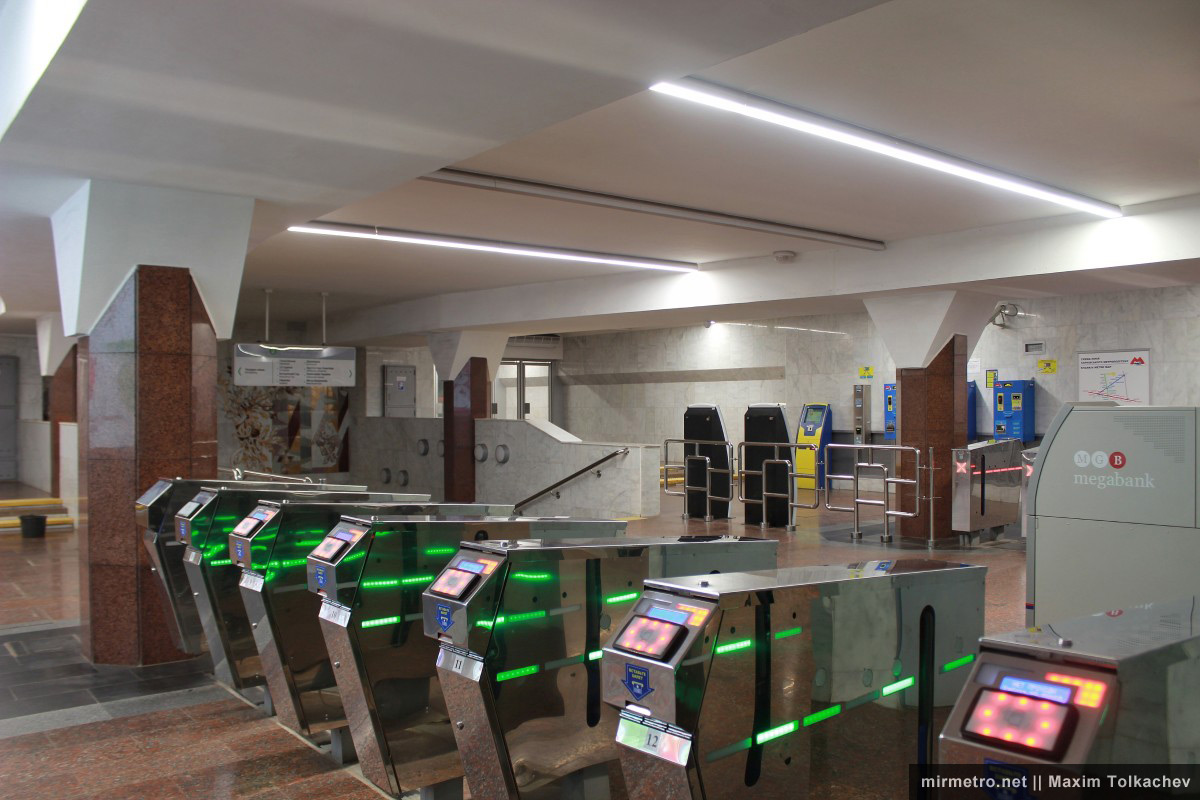
New-generation turnstile in the station vestibule.
The pedestrian underpass beneath Peremohy Avenue is completely separated from the station. Passengers can glimpse it through the windows, although they are now covered with photographs of Kharkiv landmarks. Unlike the station itself, the underpass remains open around the clock and can be used even when the metro is closed.

A ceremonial event marking the opening of Peremoha station took place on 19 August 2016. It was attended by city and state officials, metro builders, journalists, and representatives of public organisations.

Speeches congratulated the people of Kharkiv on the completion of the long-awaited extension and expressed gratitude to everyone who had contributed to its construction. President of Ukraine Petro Poroshenko also addressed the audience.
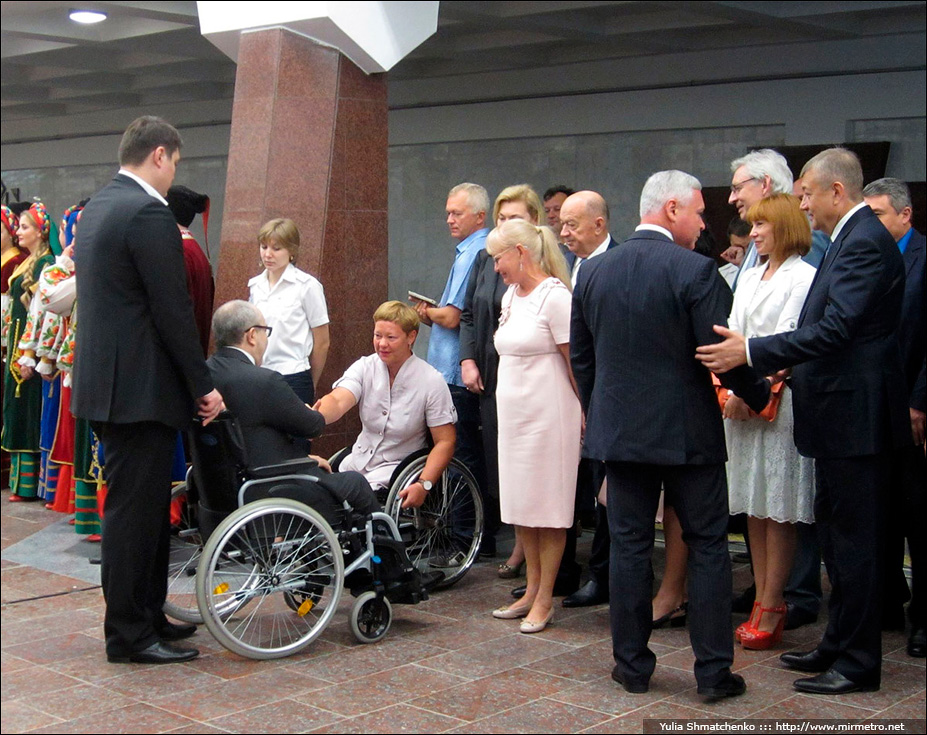
Despite the ceremony, the station did not open immediately. Before passenger service could begin, the Cabinet of Ministers of Ukraine had to issue a formal decree transferring the station to the Kharkiv Metro municipal operator. As a result, Peremoha station officially opened to passengers on 25 August.

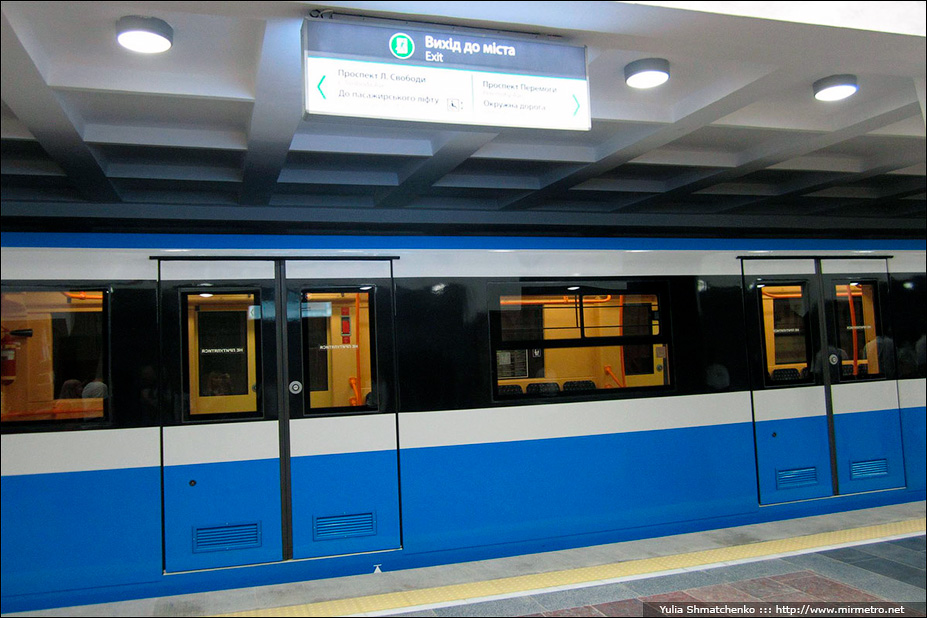
The train used during the ceremony consisted of 81-7036/7037 series cars. These trains were not normally assigned to the Oleksiivska Line and were brought there specifically for the opening event.
The President presented the station’s director with a symbolic key and awarded state decorations to a group of workers and engineers who had distinguished themselves during the station’s construction.

Construction and projects
Preparation of the site for the future Peremoha station, including the relocation of underground utilities, began as early as 1988. In November 1991, the construction site was officially established, and excavation work commenced. Because of the worsening economic situation, progress was slow and intermittent until 1994, after which construction came almost to a complete standstill as all available resources were redirected to other sections of the line.
Work on the abandoned section resumed only in 2005, when mechanised tunnel boring machines began driving the tunnels between Oleksiivska and Peremoha. No major engineering difficulties were encountered, as the route passed through relatively dry ground and followed an almost perfectly straight alignment beneath Liudvyha Svobody Avenue. Tunnel excavation was virtually completed by 2007. Since then, no new metro running tunnels have been built in Kharkiv, apart from the short section leading toward the future Oleksiivske electric depot.
Building on the experience gained during the construction of Kharkiv’s earlier two-level stations, the same concept was adopted once again in order to reduce the overall length of the excavation pit beneath Peremohy Avenue. In addition to the station itself, the project also included a ramp chamber with turnback sidings. In this design, the service rooms are located on the upper level, while a combined traction and step-down substation adjoins one side of the vestibule.
The station was constructed primarily from monolithic reinforced concrete. At each stage of construction, reinforcement and concrete were placed into specially prepared formwork. After the concrete had gained sufficient strength, the formwork was dismantled, moved forward, and reused for the next section of the structure.
Unlike several earlier stations on the line, Peremoha encountered only a modest amount of groundwater during construction. Conventional pumping equipment proved sufficient to keep the excavation dry, eliminating the need for more complex dewatering measures.
Because residential apartment buildings stand very close to the station, a new type of rail fastening was introduced at Peremoha. Concrete track blocks fitted with resilient vibration-absorbing pads significantly reduce the transmission of vibration from passing trains to the tunnel structures and the surrounding buildings.
The station itself entered active construction only after the opening of Oleksiivska in 2011. Workers first cleared the site of debris that had accumulated during nearly two decades of inactivity, after which excavation resumed. Soon afterwards, a ceremonial event marked the pouring of the first cubic metre of concrete. At that time, the authorities officially announced that Peremoha station would open on 9 May 2012.
However, as had so often happened before, reality fell far short of the ambitious promises. Initially, all construction was financed solely by the city. Significant funding from the state budget was not allocated until September, causing work to progress much more slowly than planned and even come to a halt during the summer. Nevertheless, by that time, most of the platform and vestibule structures had been erected, installation of the traction substation had begun, and by the end of 2011 the station was approximately 45% complete. Unfortunately, by February 2012 all available funds had been exhausted, construction stopped once again, and the state budget contained no allocations for Peremoha station. The planned opening was repeatedly postponed—from May 2012 to December 2012, then to May 2013, August 2013, and finally December 2013.
The construction pause lasted for more than a year. During this period, only a handful of security guards and maintenance workers remained on site, pumping out groundwater and monitoring the condition of the unfinished structures and equipment. Constant exposure to the weather weakened the temporary supports, corroded metal structures, and caused soil settlement. In February 2013, a landslide occurred, buckling the rusted steel supports and crushing the timber bracing.
At last, there seemed to be genuine hope that the long-suffering station would finally be completed. The city authorities agreed to sell Metalist Stadium, with most of the proceeds intended to finance the completion of the Kharkiv Metro. The amount involved appeared more than sufficient to finish the project. Even before the funds had actually been received, construction resumed in May 2013 using the contractors’ own resources. After the City Council approved the distribution of the stadium sale proceeds, the first tranche of funding was allocated to the metro in October. Work resumed on the platform, vestibules, and turnback sidings; the waterproofing and drainage systems were restored; damaged structures were replaced; and by the end of the year workers had already begun installing the ceiling structures. The station was now expected to open in August 2014.
But events took another unexpected turn. The businessman who had agreed to purchase Metalist Stadium left Ukraine during the events of February 2014, making it impossible to fulfil the agreement. As a result, most of the anticipated funds never reached the city budget, and construction of Peremoha station was suspended yet again. Determined to avoid another prolonged delay, the City Council reallocated municipal funds in November, diverting part of the road repair budget to metro construction. Additional funding followed in early 2015, although it remained far from sufficient.
Without relying on state support, the City Council adopted a programme to finance the completion of Peremoha station through regular allocations from the municipal budget. Construction resumed in April 2015 and, this time, continued without interruption to completion. Within a year, the main station structures were finished, the surface entrances were completed, the excavation pit was backfilled, track laying began in the autumn, and by winter the station was approximately 80% complete.
In 2016, financing from the city budget allowed construction to enter its final stage. Finishing works, cable installation, lighting and engineering systems, and landscaping of the surrounding area were all completed.
On 2 August 2016, a test train ran over the newly completed section for the first time. The official opening ceremony took place on 19 August, while regular passenger service began on 25 August. Twenty-five years after construction had begun, Peremoha station finally opened, completing the extension of the Kharkiv Metro into the Oleksiivka residential district. It thus became one of the longest-running metro construction projects in Ukraine.
Peremoha station under construction. Early 2011.
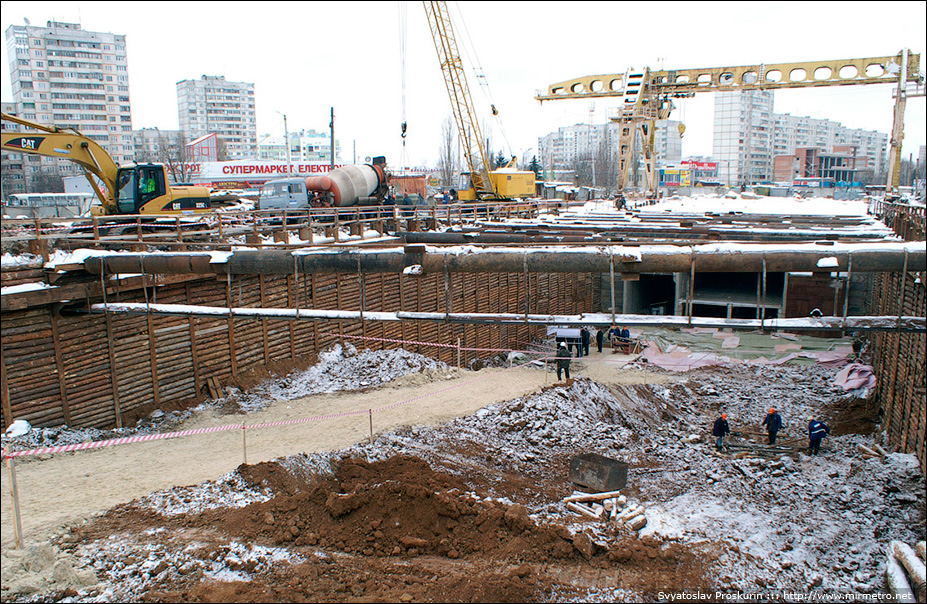
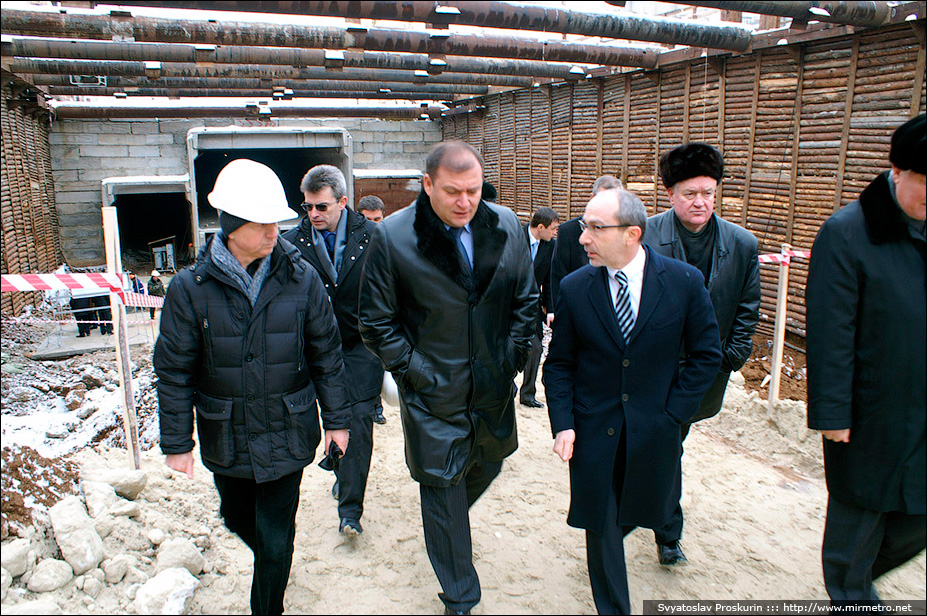
Officials from Kharkiv Metro Construction and the city administration visit the construction site.
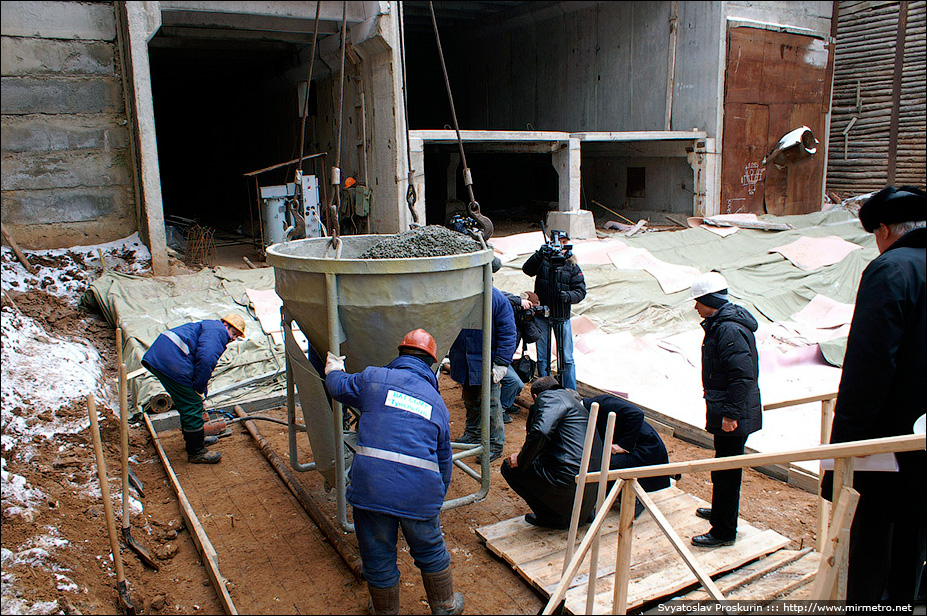
Ceremonial pouring of the first cubic metre of concrete, with a commemorative capsule placed inside. “This capsule was laid on 31 January 2011 to mark the pouring of the first cubic metre of concrete for Peremoha, the 30th station of the Kharkiv Metro, being built as part of Kharkiv’s preparations for hosting the UEFA Euro 2012 Football Championship.”
Concreting the station foundation. 5 October 2011.
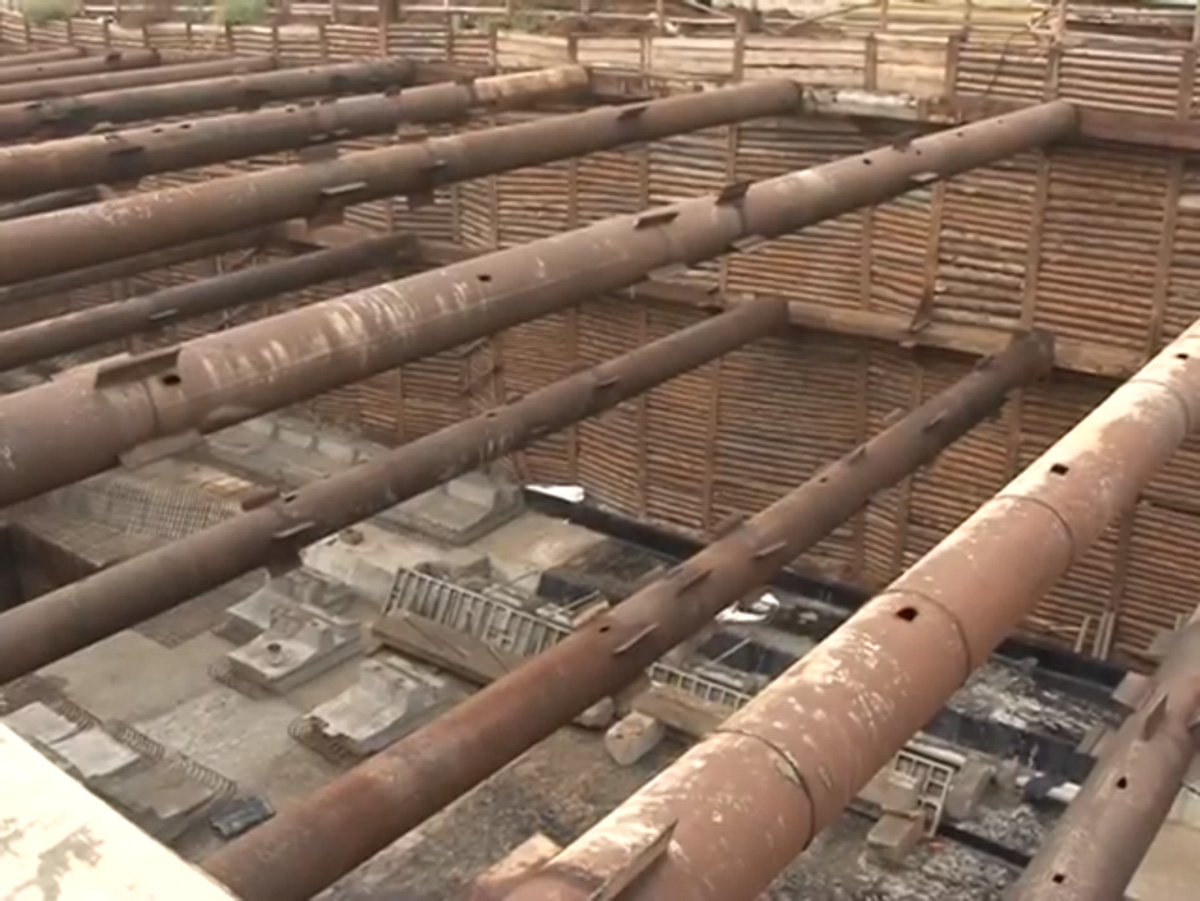
During construction, the excavation pit was divided into two sections by a temporary roadway. 9 December 2012.
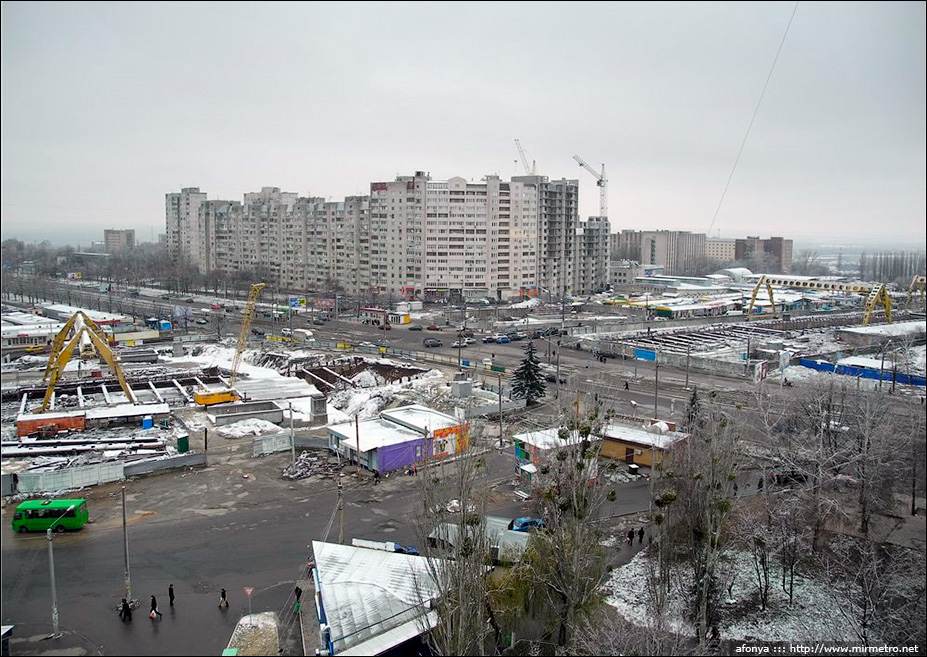
Construction of the turnback sidings beyond the northern end of the station. 8 June 2013.

Construction of Peremoha station. 17 August 2013.
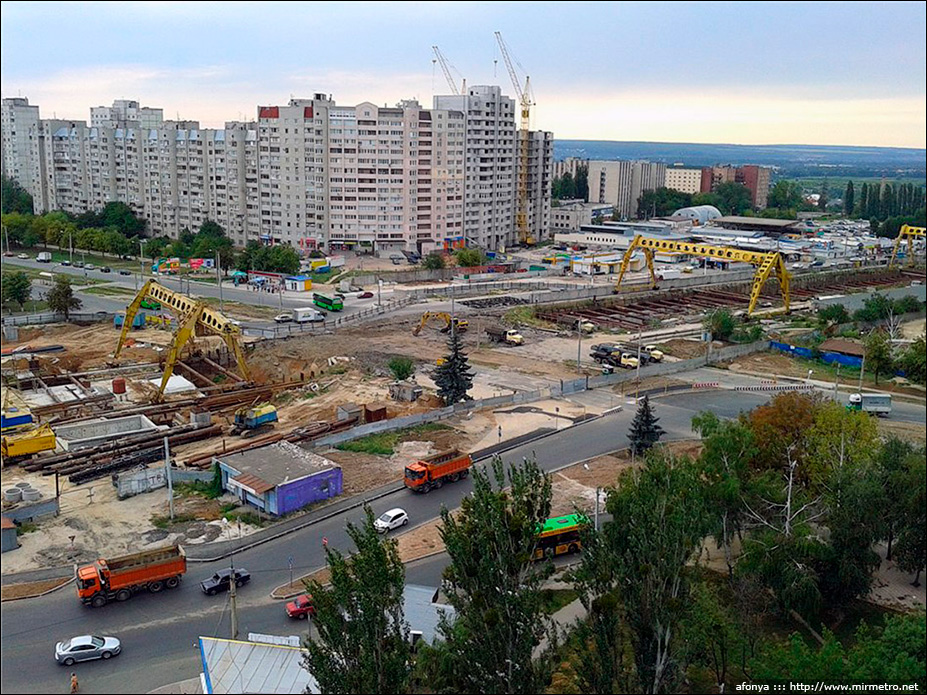
Excavation work at the station platform site. 10 October 2013.

Installation of reinforcement in the excavation pit.
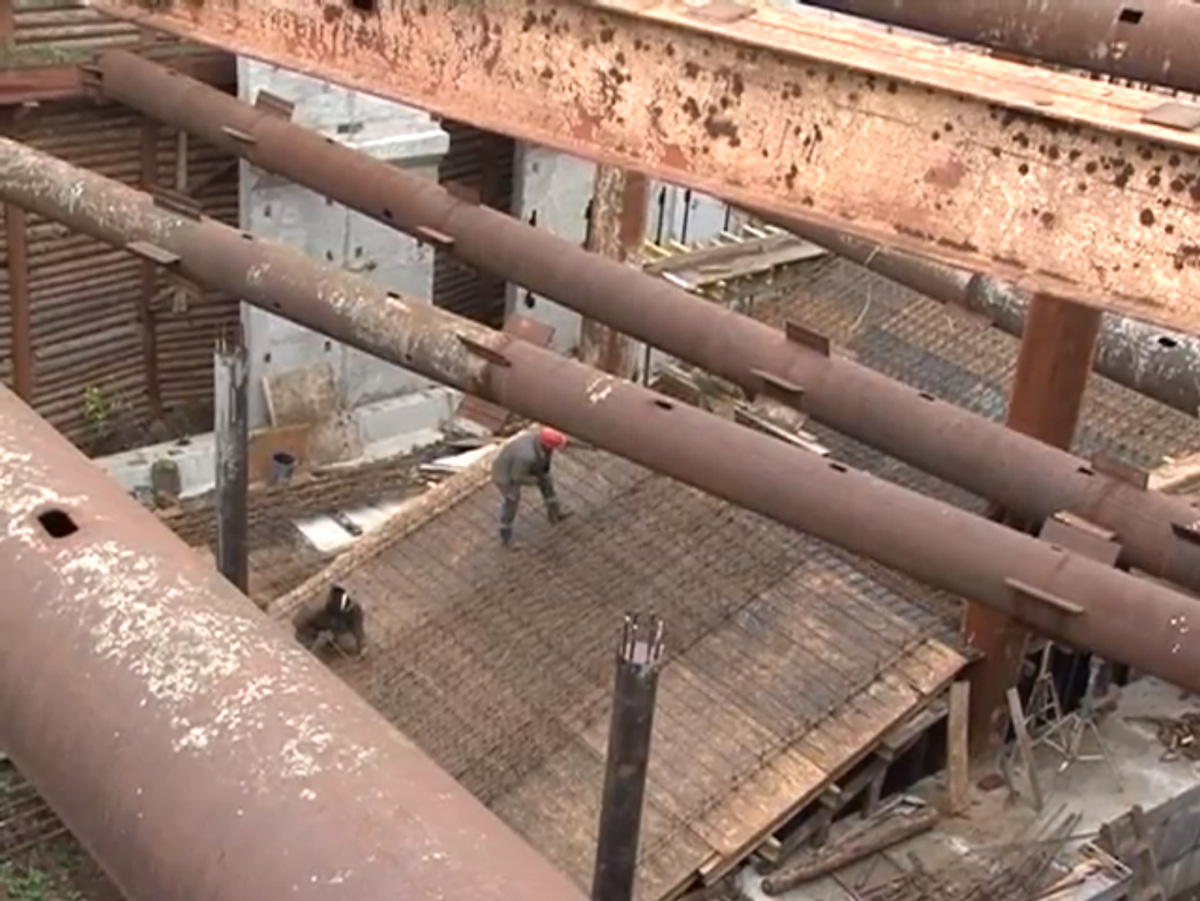
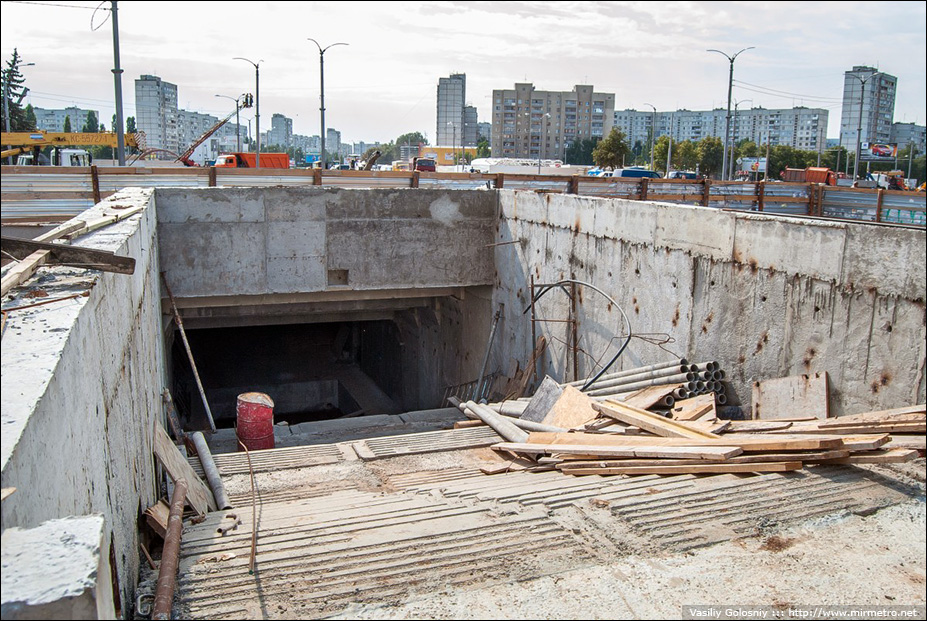
The excavation pit of Peremoha station. 10 November 2014.

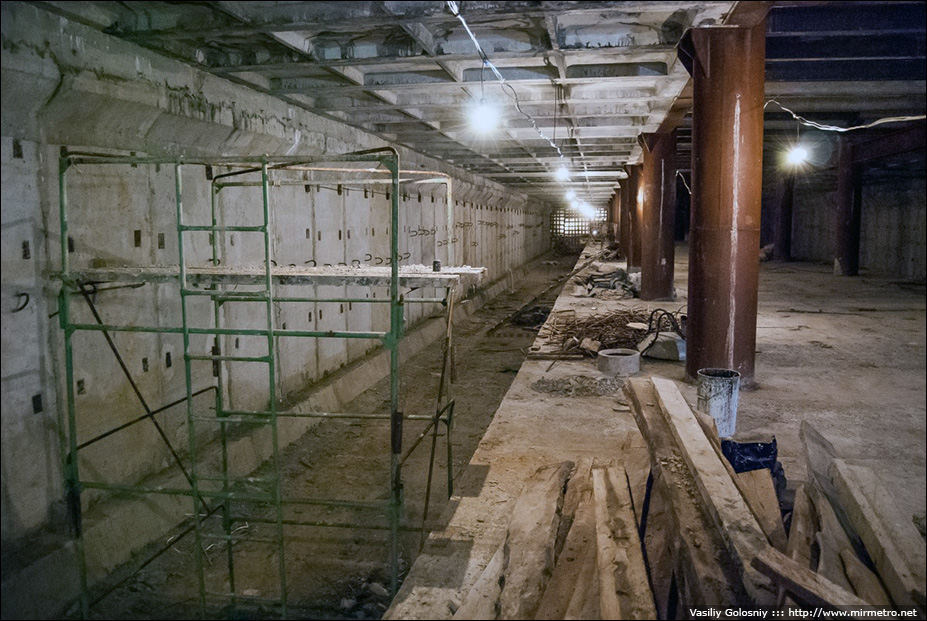
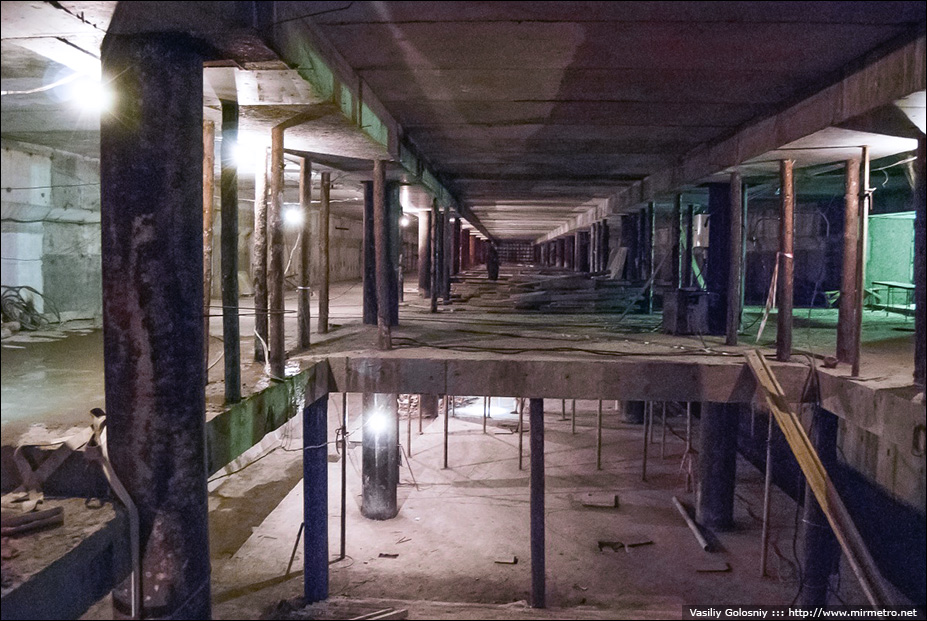
The station platform under construction. 28 January 2015.

The station with its main structures completed. 13 August 2015.
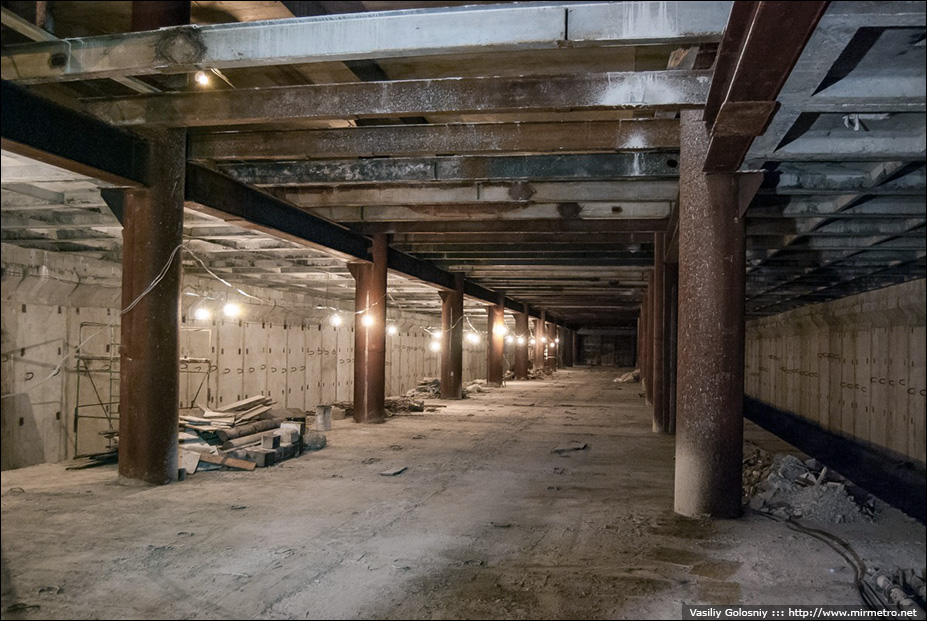
A section of the track wall.
A staircase leading from the platform to the vestibule.
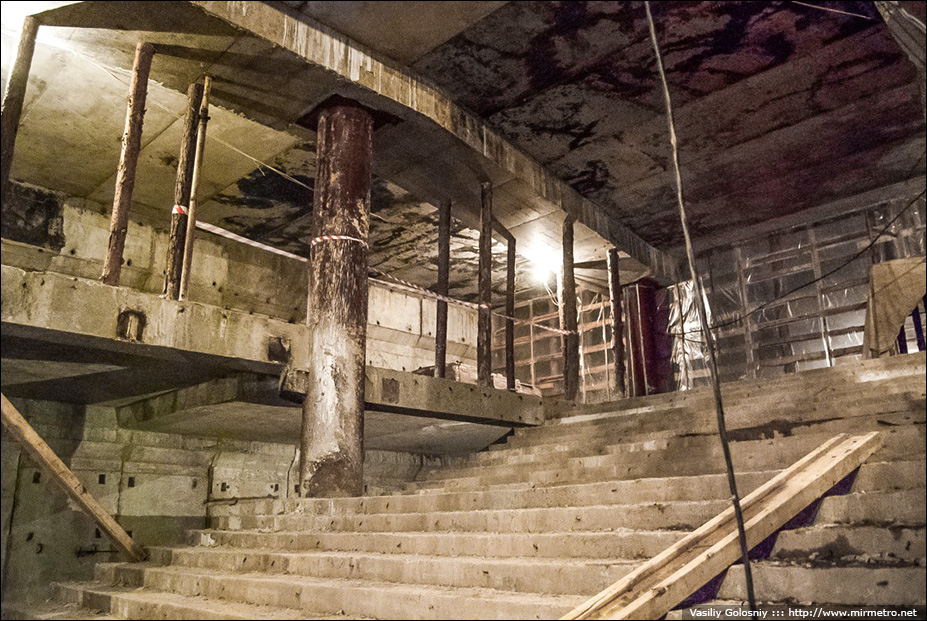
The platform ceiling and the service rooms above the platform. Precast reinforced-concrete elements were partially used in the ceiling structure.
The excavation pit after backfilling has been completed.
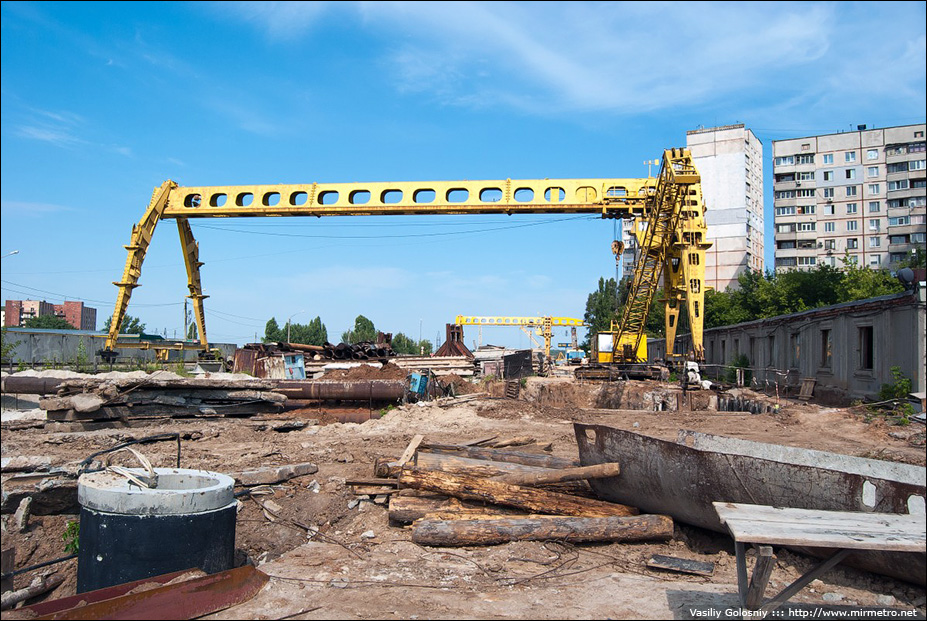
Construction of one of the station entrances.
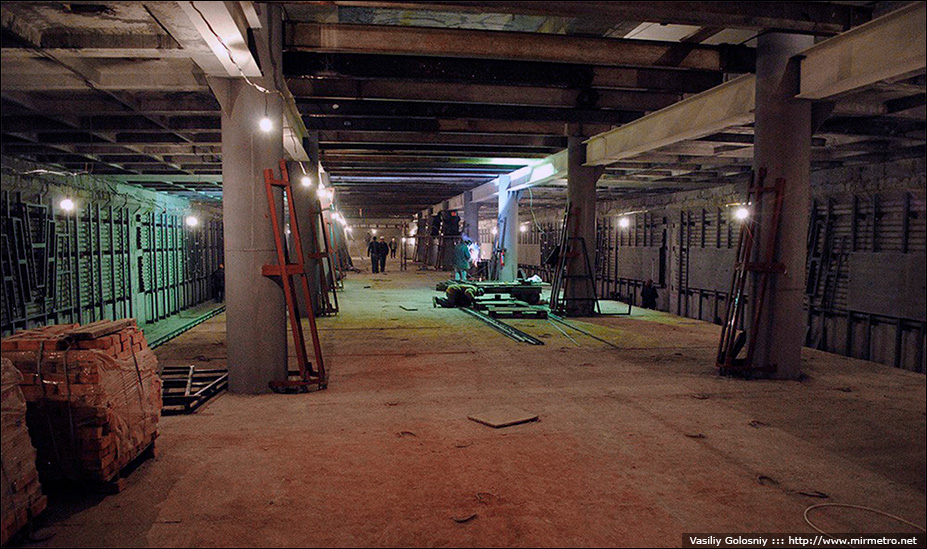
Installation of water supply pipes and cable routes in the tunnel.

The columns have been coated with a fire-resistant compound, and installation of the reinforced-concrete framework has begun. 10 November 2015.
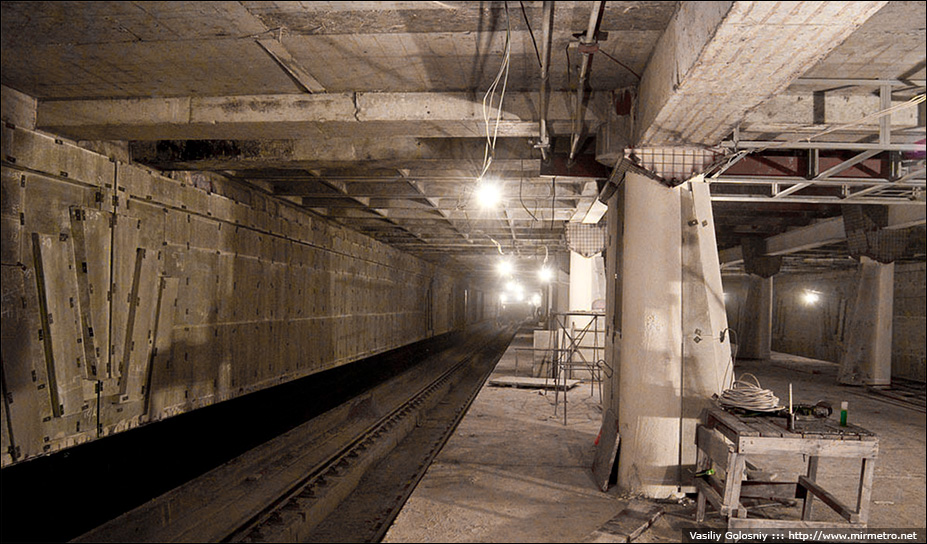
The track wall is covered with fire-resistant asbestos-cement panels. 9 February 2016.
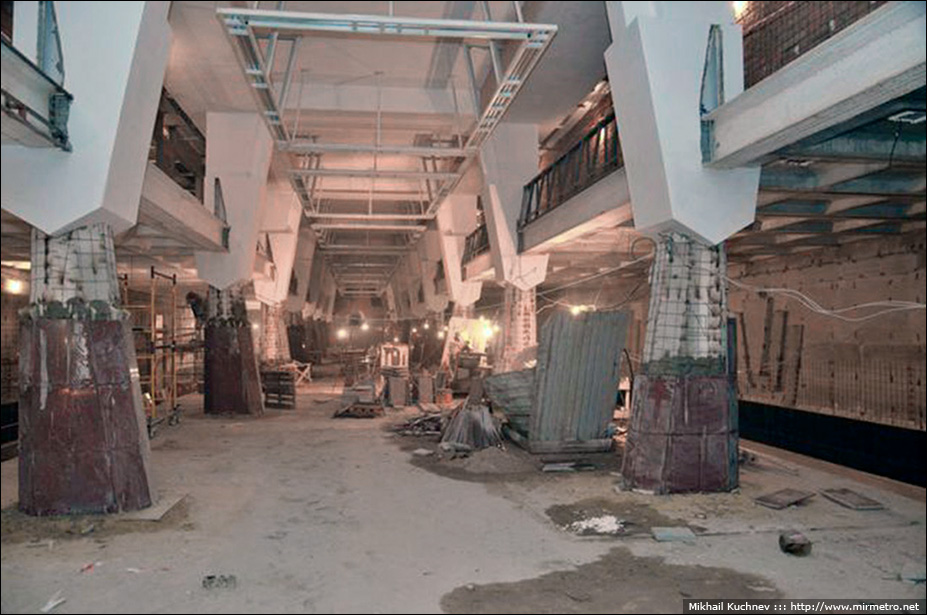
Peremoha station during the cladding of the columns and track walls. 4 April 2016.
The ceiling is being whitewashed. 30 June 2016.
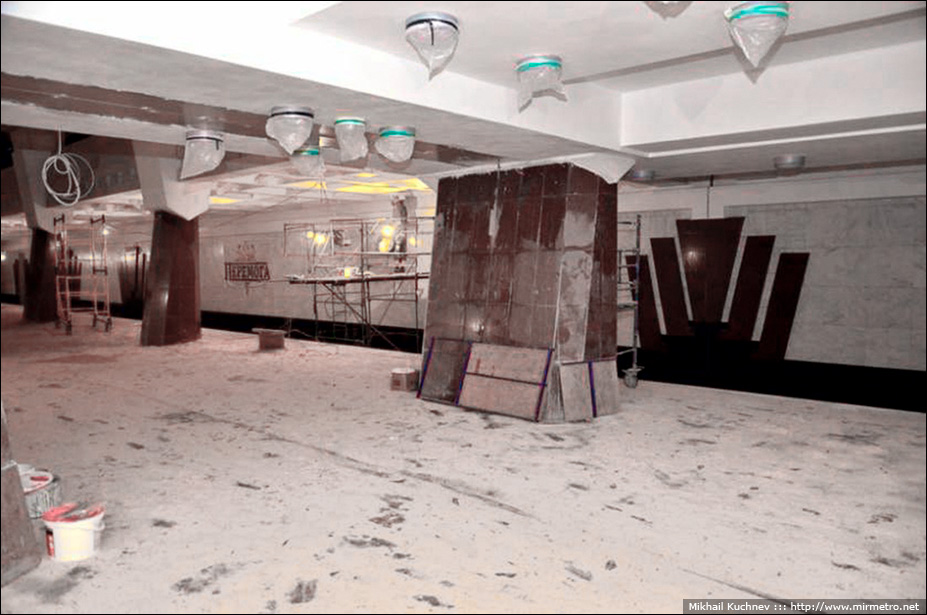
Cladding of the underground pedestrian passage.
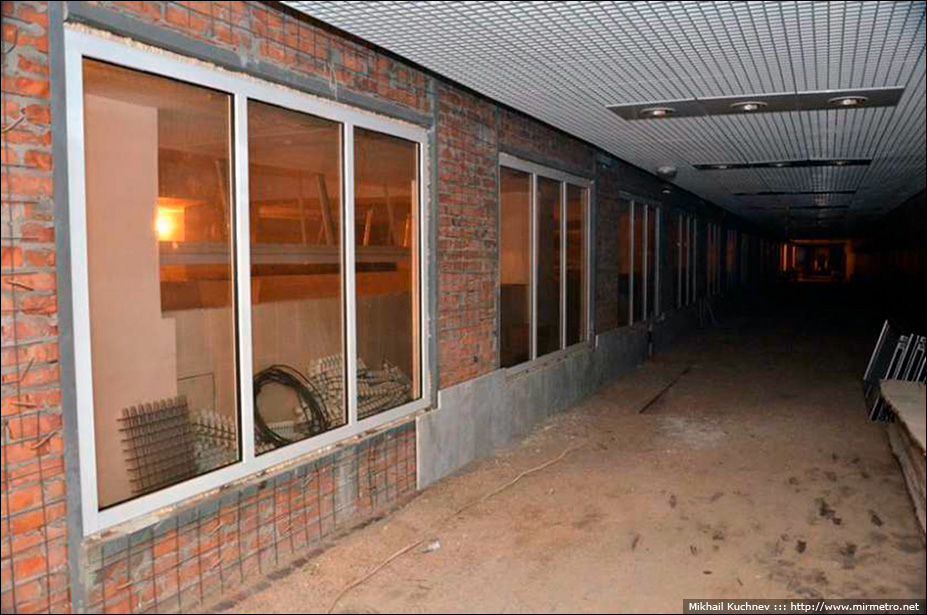
Turnback sidings beyond the station.
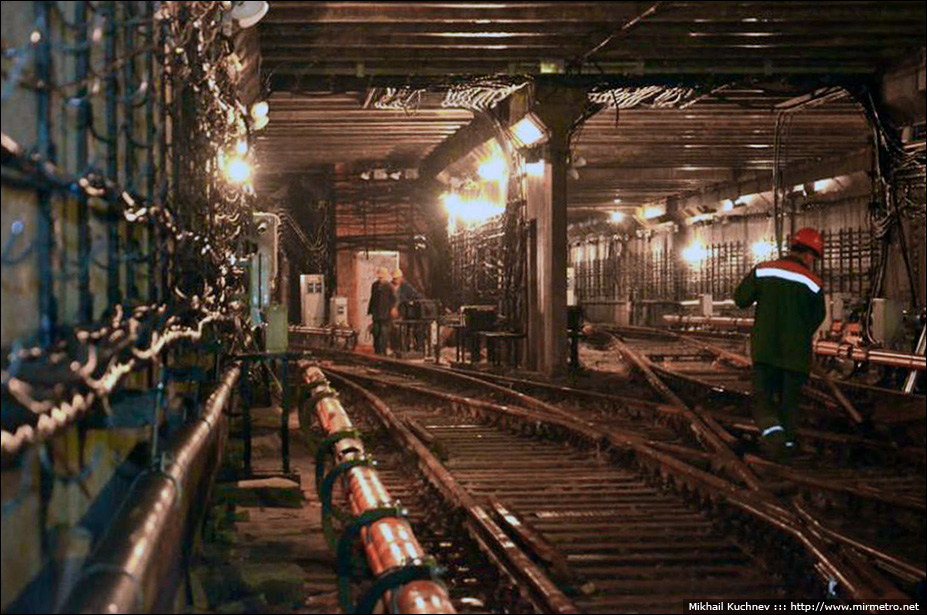
Installation of the ceiling lighting. The station is almost complete—only the finishing touches remain.

Artists Ihor Morgunov and Olha Erofeeva completing work on one of the hot-enamel panels.

Installation of cable lines on the Oleksiivska–Peremoha section.
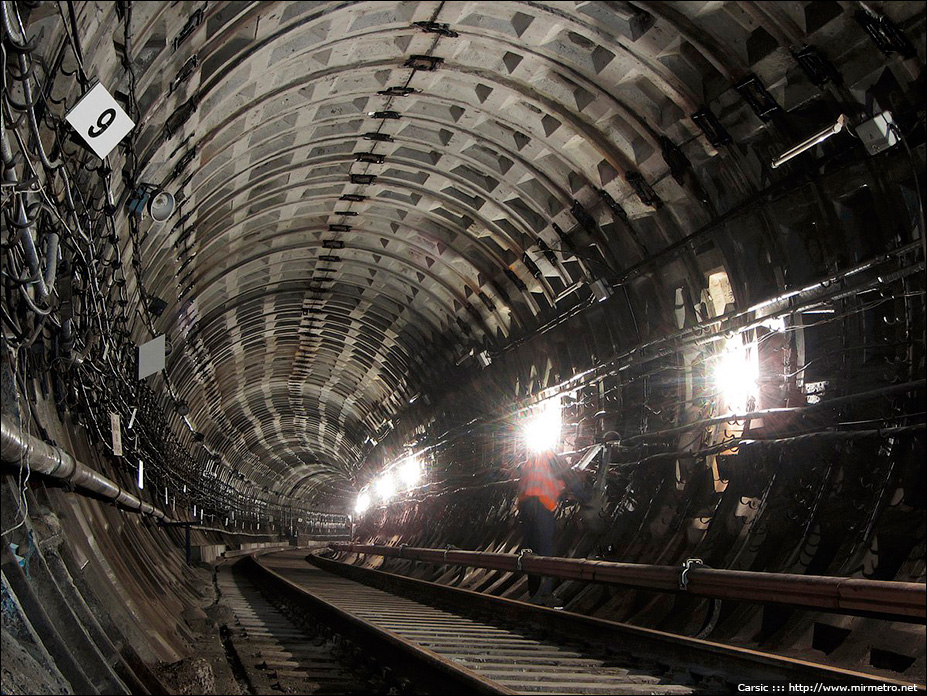
A test train at Peremoha station. 2 August 2016.
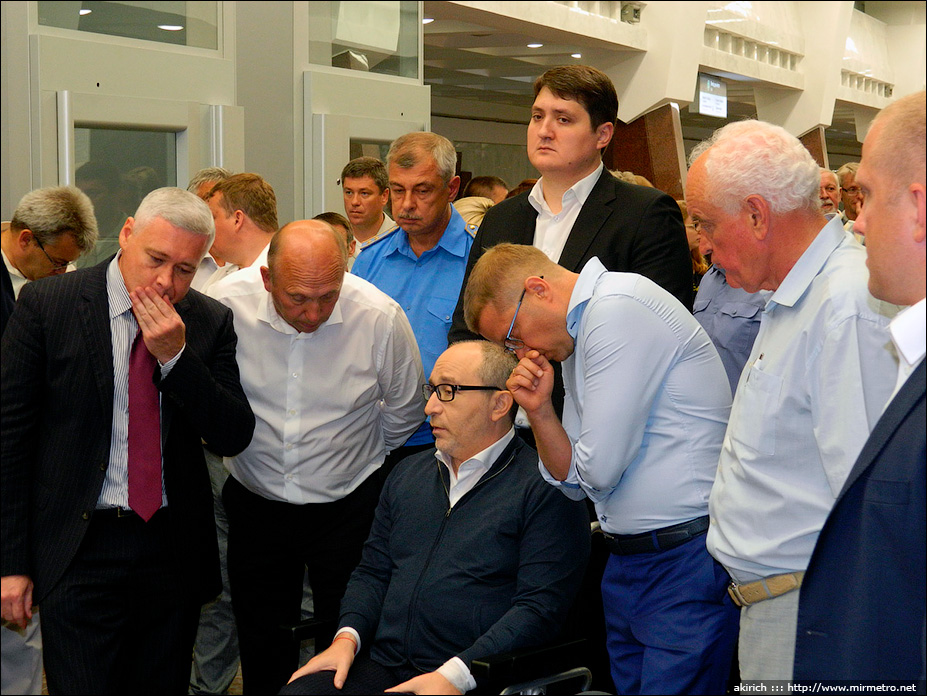
Distinguished guests inspect the station as Mayor Hennadii Kernes speaks about the completion of its construction.
Peremoha station in the final days before opening.
One of the early station designs from the late 1980s.

A high-tech design concept for Peremoha station.
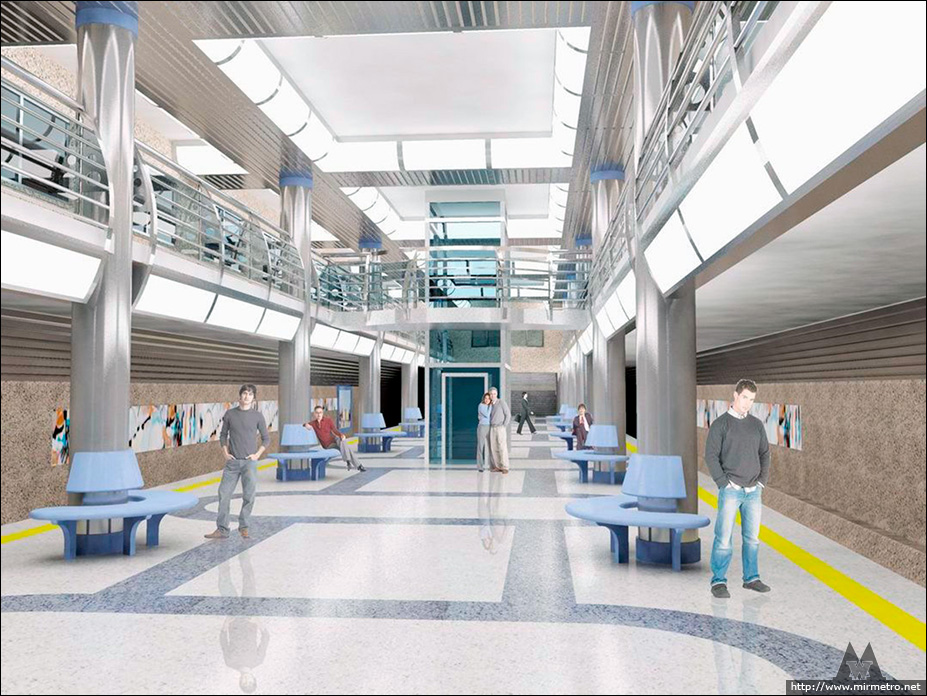
An intermediate design proposal.
The orders and medals originally intended to decorate the station.

The approved design, implemented with several modifications.
